Disclaimer: Information found on CryptoreNews is those of writers quoted. It does not represent the opinions of CryptoreNews on whether to sell, buy or hold any investments. You are advised to conduct your own research before making any investment decisions. Use provided information at your own risk.
CryptoreNews covers fintech, blockchain and Bitcoin bringing you the latest crypto news and analyses on the future of money.

China Injects $44B via New Overnight Repo Tool, Offering Bitcoin Traders a Fresh Liquidity Signal Amid Market Fear

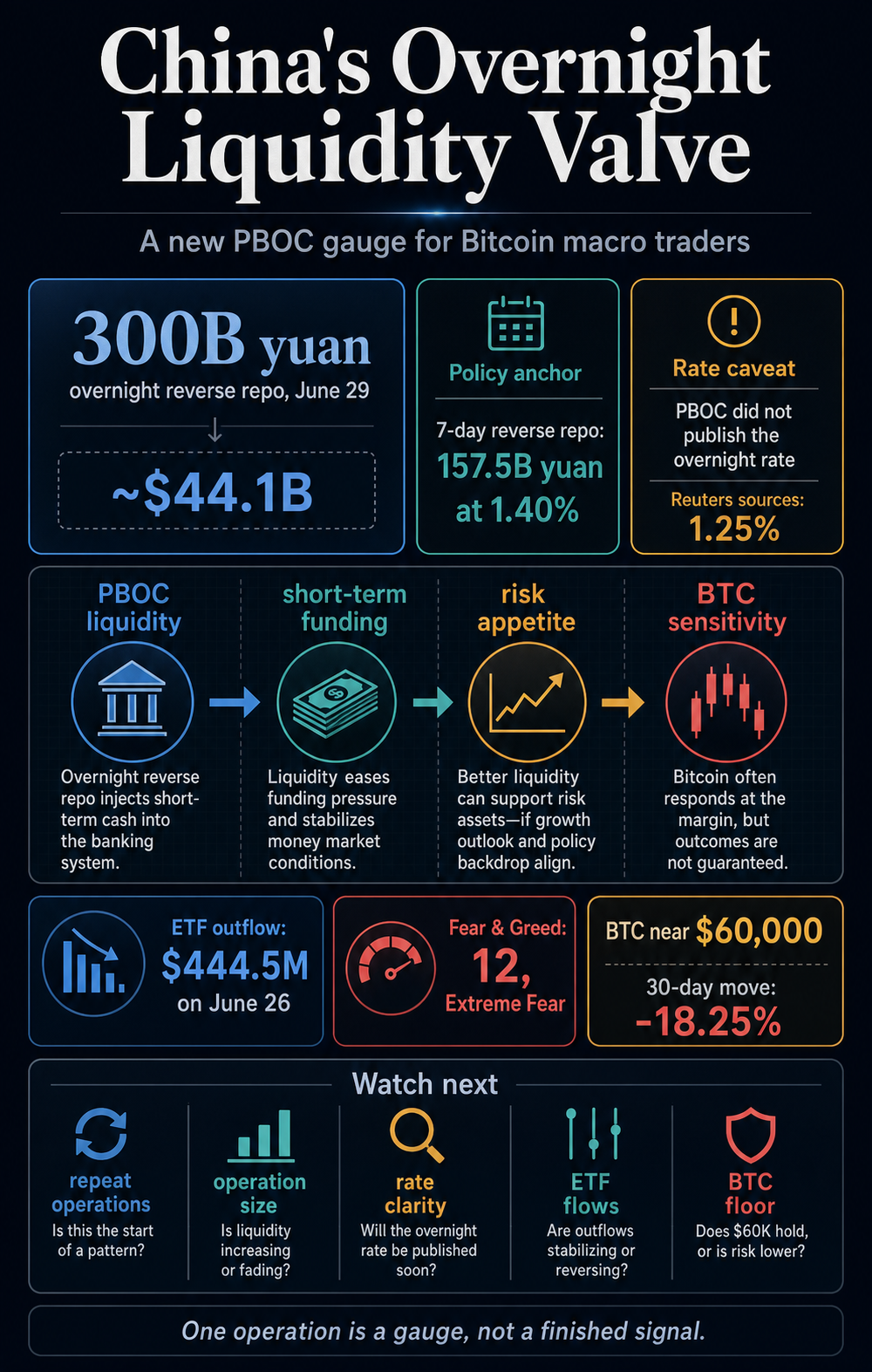
China’s central bank provided Bitcoin traders with a new liquidity gauge on June 29 by launching an overnight reverse repo channel valued at 300 billion yuan, approximately $44.1 billion.
This signal arrives as BTC attempts to stabilize near the $60,000 mark. A single operation confirms the tool is active; however, repeated usage would indicate whether the People’s Bank of China (PBOC) is establishing a recurring liquidity valve capable of altering the risk-asset landscape.
The PBOC announced it conducted 300 billion yuan in overnight reverse repos on June 29, alongside 157.5 billion yuan in seven-day reverse repos at a rate of 1.40%. At current exchange rates, the overnight operation amounted to roughly $44.1 billion.
This development is significant for Bitcoin because it transforms a policy framework change into a daily money-market indicator. If the PBOC continues to utilize overnight reverse repos, traders will gain a more immediate perspective on how aggressively China is smoothing short-term funding stress.
Conversely, if the operation proves to be a one-off month-end adjustment, the market will have less justification for treating it as a durable tailwind.
While China’s new overnight tool is valuable for macro traders, a single liquidity operation has not fundamentally shifted Bitcoin’s risk backdrop. On June 29, BTC was trading at $60,042 on CryptoSlate, having fallen 18.25% over the preceding 30 days. ETF demand and sentiment remained weak, keeping traders in a defensive posture.
The new valve in China’s money markets
The PBOC pre-announced the addition of overnight reverse repo operations on June 29 and June 30 to better address short-term liquidity needs within the banking system, utilizing fixed-rate, quantity-bidding operations.
The macroeconomic value lies in the PBOC’s use of a daily liquidity valve and the size of the injection. In central banking terms, an overnight operation can inject cash rapidly, reveal where funding pressure is accumulating, and demonstrate the extent of liquidity the central bank is willing to supply at the front end of the money market.
The PBOC’s official June 29 notice confirmed the transaction amounts but did not disclose an overnight rate. Reuters-syndicated reports indicated that sources placed the inaugural overnight reverse repo rate at 1.25%. Business Times coverage noted that analysts believed the withholding of the official rate was a strategic move to avoid diluting the seven-day reverse repo’s role as the primary policy signal.
This aligns with the broader framework outlined by PBOC Governor Pan Gongsheng. In remarks reported by the Bank for International Settlements, Pan described the seven-day reverse repo rate as the key policy rate, supported by an interest-rate corridor, with overnight repo or reverse repo operations deployed as needed.
For traders, the variables are now concrete: whether China adds liquidity, the frequency of these operations, the scale involved, and whether market funding conditions respond accordingly.
| PBOC variable | What changed | Why BTC traders may follow it | Caveat |
|---|---|---|---|
| Overnight reverse repo size | 300 billion yuan on June 29 | Indicates the scale of immediate cash added to short-term funding markets | A single operation does not confirm a lasting easing cycle |
| Operation frequency | June 29 and June 30 were pre-announced dates | Repeated use would establish the tool as a cleaner daily liquidity gauge | Month-end funding needs may partially explain the move |
| Rate signal | PBOC did not publish the overnight rate; Reuters sources reported 1.25% | The rate could illustrate how the new tool compares to the seven-day policy rate | Without official disclosure, traders rely on inference and source reporting |
| Seven-day reverse repo | 157.5 billion yuan at 1.40% | Remains the main policy-rate anchor for China’s money market | The overnight tool should be interpreted alongside the policy-rate framework |
Why Bitcoin traders care now
Bitcoin has a long history of reacting to global liquidity conditions, though the connection is rarely mechanical. Liquidity can support risk assets by easing funding stress, improving leverage conditions, or shifting investor appetite back toward higher-beta trades.
However, liquidity may fail to move BTC if local credit demand is weak, the dollar tightens, ETF flows continue to decline, or traders determine the move is too small to alter positioning.
This is why the China gauge should be viewed alongside other market inputs rather than above them. The first operation provides traders with a concrete data point.

Related Reading
Bitcoin’s next risk is hiding in the gap between debt and liquidity
US debt is growing faster than M2, leaving Bitcoin trapped between a bullish liquidity thesis and tighter market plumbing that continues to cap risk.
Apr 30, 2026 · Gino Matos
The next few operations will reveal whether the PBOC is merely smoothing short-term funding or building a repeatable liquidity valve around the front end of the yield curve.
Related Posts
Bitcoin’s current setup makes this distinction particularly important. CryptoSlate’s market data showed BTC dominance at 58.1% on June 29, while the Bitcoin page highlighted a steep 30-day decline with price clustering near the psychological $60,000 level.

Related Reading
Bitcoin crash below $60,000 triggers $1 billion loss as markets now price Fed rate hike by October
Spot selling led the decline before forced liquidations spread losses across Bitcoin, Ether, and other major cryptocurrencies.
Jun 25, 2026 · Oluwapelumi Adejumo
A market in this condition is highly sensitive to marginal liquidity, as traders debate whether selling pressure has been exhausted or is still driven by weak demand.
ETF flows add to this fragility while remaining secondary to the China-liquidity question. Data from Farside Investors showed a $444.5 million net outflow from US spot Bitcoin ETFs on June 26.
Alternative.me’s Crypto Fear and Greed Index recorded a live reading of 12, indicating Extreme Fear, on June 29. CryptoSlate’s crypto sentiment analysis stood at a slightly negative 38/100.
These figures explain why traders are seeking a macroeconomic offset, though it remains unclear whether China can provide it.
The practical question is whether the PBOC’s new overnight activity coincides with improving ETF flows, calmer sentiment, or a firmer Bitcoin price floor.
A durable signal would require repetition. A single 300-billion-yuan operation signals to traders that the tool is live. Repeated injections of similar scale, or larger operations during periods of funding stress, would make it harder to dismiss the move as a calendar-driven liquidity adjustment.
If the PBOC continues to withhold the official overnight rate, markets will infer the level from Reuters-source reporting, money-market pricing, and the relationship with the seven-day reverse repo.
If the rate becomes clearer, traders can assess whether the overnight valve is simply operational plumbing or a more active effort to guide short-term funding costs.
Transmission remains the critical filter. China can add liquidity without Bitcoin immediately rallying if the cash remains within domestic funding markets or if broader risk appetite stays poor.
The operation is better understood as a liquidity gauge rather than a direct Bitcoin catalyst. China’s new overnight tool may affect BTC if repeated use coincides with easing funding stress and a recovery in risk demand.
CryptoSlate’s recent coverage provides additional context. Prior analysis has separately connected PBOC liquidity, debt-versus-liquidity gaps, ETF pressure, and Bitcoin’s sensitivity to macro conditions.
China’s central bank has now provided traders with a shorter-duration gauge to compare against Bitcoin’s price action.
The risk for Bitcoin bulls is mistaking a new gauge for a finished signal. The PBOC’s June 29 operation establishes a new reference point for global liquidity.
However, ETF outflows, weak sentiment, and Bitcoin’s sharp 30-day decline remain prominent factors.
The market now has a clearer sequence to follow. Future PBOC overnight reverse repos will indicate whether the operation extends beyond June 30.
Operation sizes near or above 300 billion yuan would carry more weight than a quick retreat. A clearer overnight rate relative to the seven-day policy rate would help traders distinguish routine plumbing from stronger funding support.
If these elements begin to move in tandem, China’s overnight reverse repo could become a useful macro indicator for Bitcoin traders. If they diverge, the first operation will appear less like a bullish catalyst and more like another reminder that liquidity affects BTC only when it actually reaches risk appetite.
The post China issues $44B cash injection giving Bitcoin bulls a new signal as fear grips market appeared first on CryptoSlate.
