Disclaimer: Information found on CryptoreNews is those of writers quoted. It does not represent the opinions of CryptoreNews on whether to sell, buy or hold any investments. You are advised to conduct your own research before making any investment decisions. Use provided information at your own risk.
CryptoreNews covers fintech, blockchain and Bitcoin bringing you the latest crypto news and analyses on the future of money.

Challenging conventions: The reasons gold prices diverge from trends in 10-year Treasury yields

Traditionally, the 10-year Treasury yield has served as a dependable indicator of overall economic sentiment. However, recent findings indicate a diminishing correlation between this yield and another significant asset: gold. This separation, which has not been observed in decades, carries substantial implications for investors and the wider market.
The 10-year Treasury yield signifies the return on investment for U.S. government bonds with a maturity of ten years. It is an essential metric for several reasons.
Firstly, it reflects investor confidence. An increase in yield suggests optimism regarding the U.S. economy’s future. In contrast, a declining yield may indicate economic pessimism. Secondly, since these bonds are backed by the U.S. government, they are regarded as nearly risk-free, making their yields a standard for other interest rates, including those for mortgages and corporate bonds.
Conversely, gold is viewed as a store of value. Its price frequently moves in opposition to the 10-year Treasury yield. Investors tend to turn to gold as a safe haven when yields are low, signaling economic uncertainty. Conversely, when yields increase, indicating economic optimism, gold often becomes less appealing compared to income-generating assets.
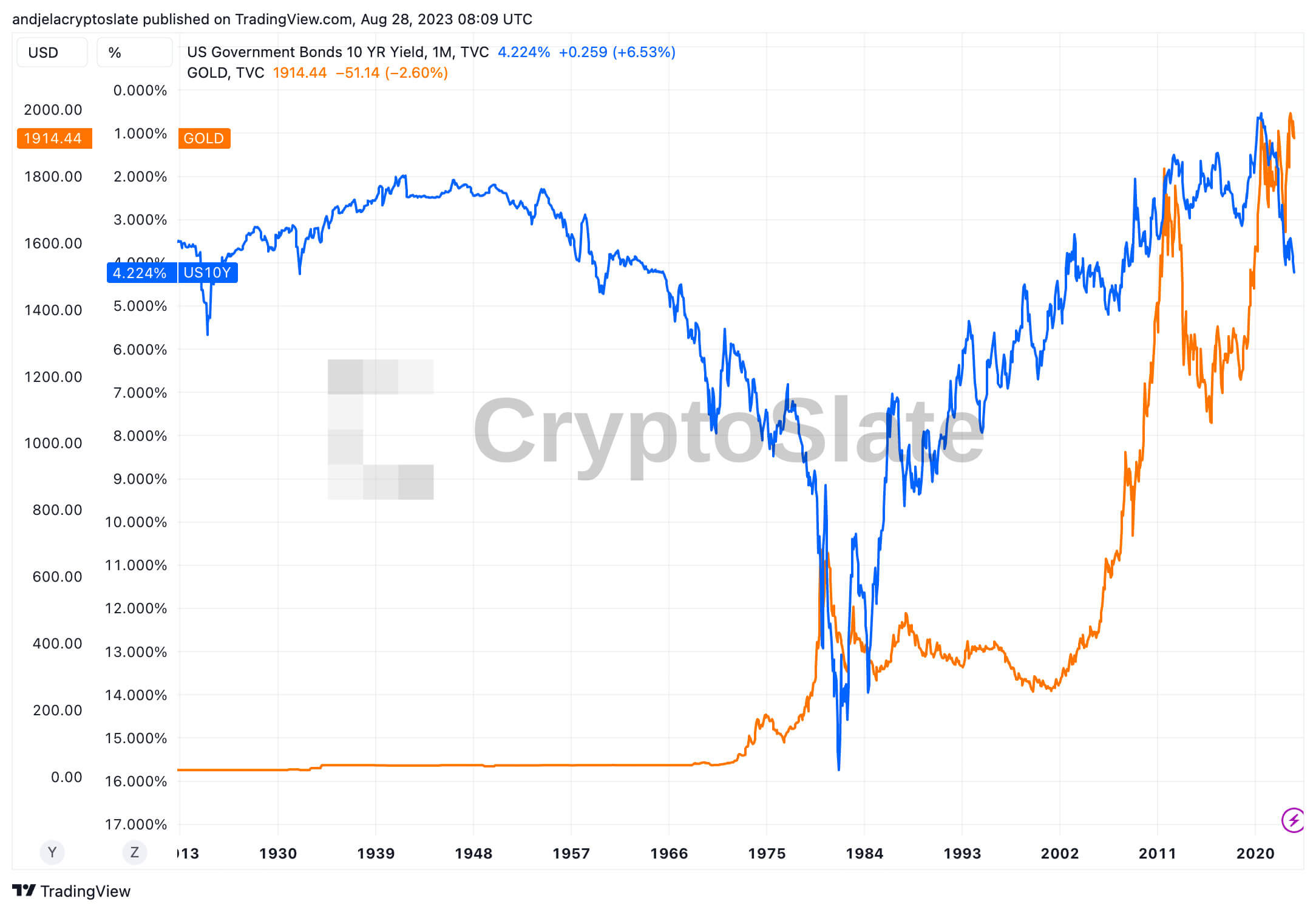 Graph illustrating the correlation between U.S. 10-year Treasury yield (inverse) and gold from 1915 to 2023 (Source: TradingView)
Related Posts
Recent market dynamics and global occurrences have altered this historically inverse relationship.
In July 2020, the 10-year Treasury yield dropped to 0.5%, marking its lowest point ever. Since that time, it has risen considerably, reaching 4.22% on Aug. 28. Such an increase typically indicates enhanced economic confidence, which would usually coincide with a decline in gold prices. However, gold has surpassed expectations. After reaching a peak of $1,974 in July 2020, it surged to an all-time high of $1,991 by Apr. 3, 2023, and remains robust at $1,914 as of Aug. 28, 2023.
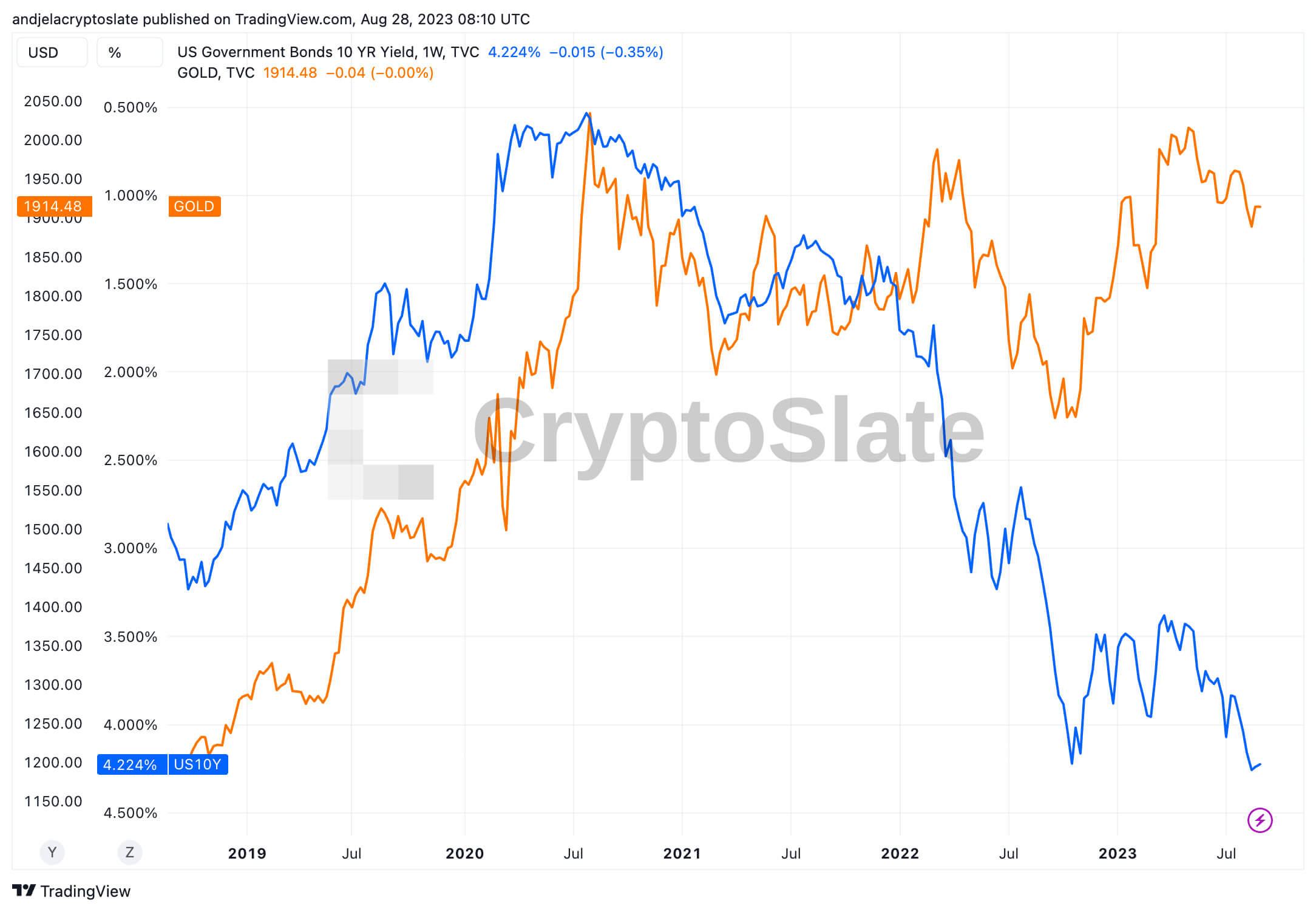 Graph depicting the correlation between the U.S. 10-year Treasury yield (inverse) and gold from Aug. 2018 to Aug. 2023 (Source: TradingView)
This divergence is noteworthy, and its origins may be complex, involving various global events and market trends that affect investor behavior. While the increasing yield suggests optimism about U.S. economic growth or potential inflation, the strong gold prices indicate other global factors maintaining its demand and suggest a possible instability of U.S. Treasurys. Elements such as geopolitical tensions, monetary policies, fluctuations in the U.S. dollar’s value, or ongoing inflation concerns could all play a role in this trend, making gold a more appealing hedge for investors.
This divergence introduces both challenges and opportunities for the market, establishing a new framework for investors. They must navigate a landscape where traditional correlations, crucial for shaping investment strategies, are less predictable. This transition may require new approaches, such as diversifying portfolios or placing greater emphasis on individual asset dynamics.
The post Breaking traditions: Why gold prices defy 10-year Treasury yield movements appeared first on CryptoSlate.
