Disclaimer: Information found on CryptoreNews is those of writers quoted. It does not represent the opinions of CryptoreNews on whether to sell, buy or hold any investments. You are advised to conduct your own research before making any investment decisions. Use provided information at your own risk.
CryptoreNews covers fintech, blockchain and Bitcoin bringing you the latest crypto news and analyses on the future of money.


Bitcoin’s limited trading range and reduced liquidity have significantly affected centralized exchanges. Given their critical role in the market, evaluating volumes across these exchanges is becoming essential for assessing crypto market sentiment.
In May 2021, centralized exchanges experienced a record high in monthly trading volumes, reaching $4.1 trillion. Leading this remarkable volume was Binance, which represented $1.64 trillion in monthly transactions. However, this peak was fleeting, as exchanges began to experience considerable declines in trading volume almost every month following May 2021.
Trading volumes surged briefly in November 2021, likely due to the collapse of FTX and the resulting substantial market selloff; nevertheless, the prevailing trend since May indicates a clear decline in volume.
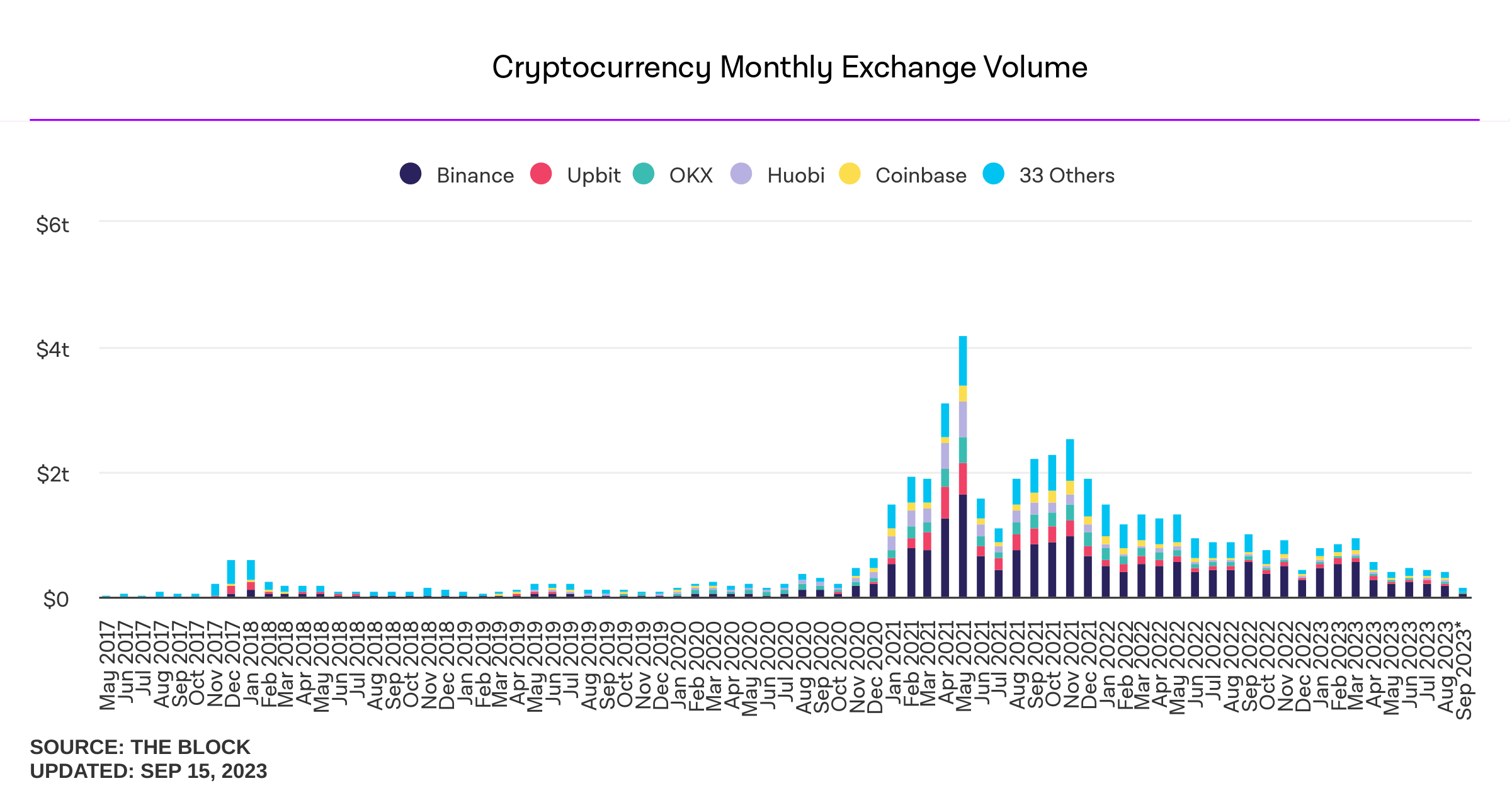 Chart illustrating the monthly trading volume across centralized crypto exchanges from May 2017 to September 2023 (Source: The Block)
Data from The Block reveals that December 2022 experienced the largest drop in the past year. The total monthly trading volume across exchanges fell sharply from $905.32 billion in November to merely $458.32 billion in December 2022.
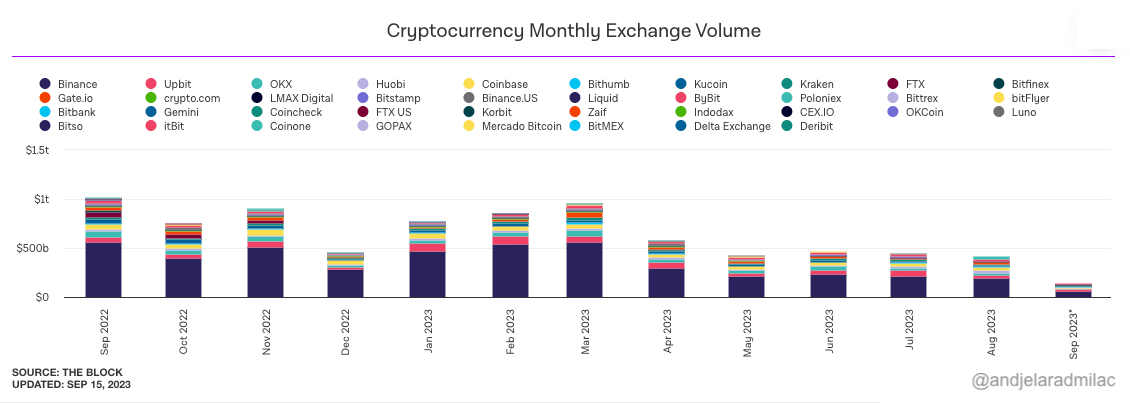 Chart depicting the monthly trading volume across centralized crypto exchanges from September 2022 to September 2023 (Source: The Block)
By January 2023, the volume was recorded at $778.47 billion. However, by August 2023, it had decreased to $422.95 billion, marking a $24 billion drop from the monthly trading volume noted in July 2023.
Related Posts
Binance experienced the most significant impact from this decline. While it reported a trading volume of $474.11 billion in January, this figure fell to $192.12 billion by August. The most drastic monthly decline for Binance occurred between March and April of this year, plummeting from $556.36 billion to $293.83 billion.
In contrast, Coinbase managed to navigate the situation more effectively. Although it concluded January with a volume of $55.32 billion and saw a decrease to $26.59 billion by August, Coinbase’s monthly trading volume has notably remained stable at approximately $26 billion since May.
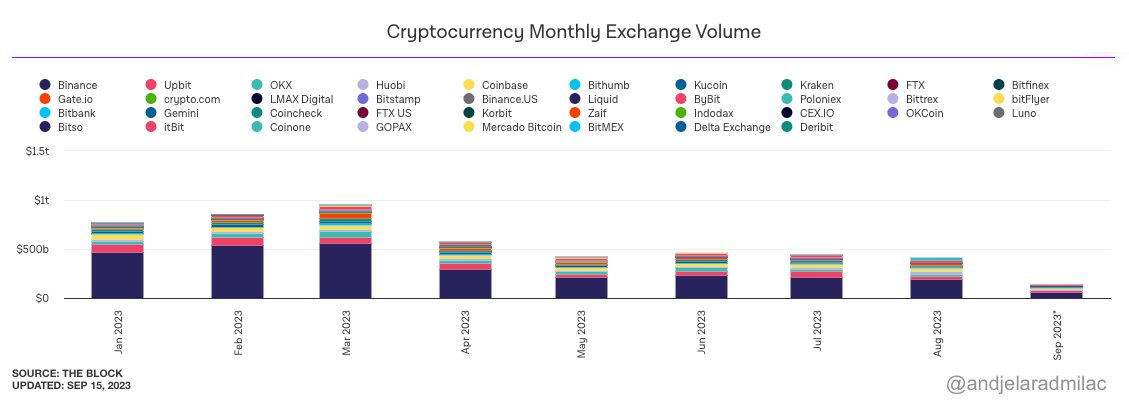 Chart showing the monthly trading volume across centralized crypto exchanges from January 2023 to September 2023 (Source: The Block)
The variations in Binance’s volumes can be linked to the considerable regulatory and internal challenges the exchange has encountered this year. Initially, the SEC’s lawsuit against Binance and its executives indicated turbulent times ahead for the platform. Following this, Belgium’s financial regulators required a suspension of its services. The exit of two senior executives from Binance US further compounded the platform’s vulnerabilities, with regulatory pressures resulting in a significant 70% decline in spot trading. The company’s European operations faced obstacles, and most recently, substantial staff reductions and significant asset withdrawals have characterized its ongoing challenges.
On the other hand, Coinbase’s ability to withstand these pressures can be attributed to its strategic positioning. The approval from the CFTC to provide regulated futures to U.S. customers, an expansion into the Canadian market following Binance’s withdrawal, and its efforts to counter SEC actions have positioned Coinbase favorably, increasing its market share amid difficulties.
The declining trading volumes, particularly on leading exchanges like Binance, reflect a sense of caution and a market in reflection. A combination of global regulatory pressures, company-specific issues, and the market’s inherent cyclical nature contribute to this trend. While Coinbase’s stability presents a positive outlook, Binance’s challenges necessitate a more cautious approach.
The post Centralized exchanges grapple with declining trading volume appeared first on CryptoSlate.
