Disclaimer: Information found on CryptoreNews is those of writers quoted. It does not represent the opinions of CryptoreNews on whether to sell, buy or hold any investments. You are advised to conduct your own research before making any investment decisions. Use provided information at your own risk.
CryptoreNews covers fintech, blockchain and Bitcoin bringing you the latest crypto news and analyses on the future of money.

Cardano Foundation reduces ADA holdings as Bitcoin and cash comprise a greater portion of reserves.

The Cardano Foundation is reducing its reliance on ADA. Its most recent report indicates that Bitcoin and cash now represent a significantly larger portion of its reserves following a year of considerable price divergence.
This transition alters the correlation between the Foundation’s balance sheet and the performance of Cardano’s native token.
In its 2025 Activity and Financial Insights Report shared with CryptoSlate, the Foundation reported total assets of 287.5 million Swiss francs, approximately $361 million. This marks a 45% decrease from the $659.1 million in assets it possessed at the close of 2024.
The decline in overall value reflects a challenging year for Cardano’s native token, ADA, but the more significant change lies in the makeup of the Foundation’s holdings.
Why this matters: Historically, the Foundation has been one of the largest long-term holders of ADA, so alterations to its treasury structure influence the level of internal alignment between Cardano’s ecosystem and its primary institution. A reduced concentration of ADA diminishes direct exposure to the token’s price while also weakening the feedback loop connecting the Foundation’s balance sheet to ADA’s performance.
 Related Reading
Bitcoin rally has pushed Cardano Foundation BTC holdings to over $100 million
The Foundation’s staking yielded over 20 million in ADA reward tokens.
Nov 13, 2024 · Oluwapelumi Adejumo
A year prior, the Foundation reported that 76.7% of its assets were in ADA, 14.9% in Bitcoin, and 8.3% in cash, cash equivalents, and financial assets.
However, by the end of 2025, ADA’s proportion had decreased to approximately 51.6%, while BTC increased to 25.5%, and cash, cash equivalents, and financial assets rose to 22.9%.
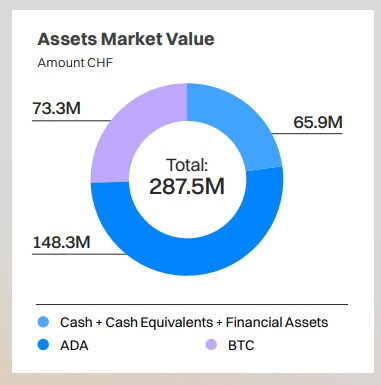 Cardano Foundation’s Assets Value (Source: Cardano Foundation)
Based on this, the Foundation’s holdings amounted to roughly $186 million in ADA, $92 million in Bitcoin, and $83 million in cash and financial assets.
This indicates that the Cardano-focused organization’s assets are no longer as heavily weighted in ADA as they were a year ago. Now, nearly half of the balance sheet is associated with Bitcoin, cash, and other financial assets.
How Bitcoin gained a foothold in Cardano’s Foundation assets
Bitcoin’s increased presence in the portfolio did not arise from an uptick in the Foundation’s BTC holdings.
In fact, the report revealed that the Foundation significantly decreased its BTC holdings last year, down 37% to 656 BTC from 1,054 BTC the previous year.
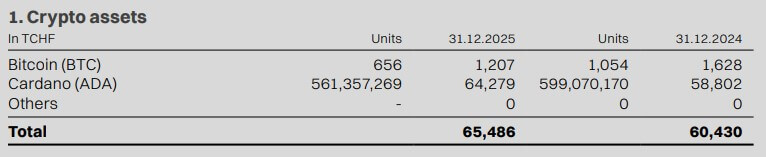 Cardano Foundation’s Bitcoin and ADA Holdings (Source: Cardano Foundation)
This means that BTC’s enhanced share of the treasury was influenced by relative performance and a broader restructuring of reserves, rather than an outright increase in BTC accumulation.
Market dynamics help clarify the shift. Data from CryptoSlate indicated that ADA has decreased by approximately 63% over the past year, while Bitcoin has demonstrated greater resilience, declining by around 25%.
This divergence meant that BTC did not need to increase in absolute terms to secure a larger position in the Foundation’s holdings. Instead, the leading cryptocurrency’s stronger resilience during the bear market allowed it to establish a more substantial presence.
Meanwhile, the report also suggests that the treasury is becoming more layered, with the Foundation identifying additional use cases for BTC and expanding its cash reserves.
The Foundation noted that part of its Bitcoin allocation was invested in loans and collective investment schemes during 2025.
Simultaneously, its financial assets, which include loans to third parties, investments, and shares, increased to 43.9 million Swiss francs (around $54.9 million) from 14.3 million Swiss francs (approximately $17.8 million) a year prior.
Related Posts
Additionally, the organization’s cash and cash equivalents totaled 20.1 million Swiss francs, or $25.1 million.
Collectively, these figures illustrate a reserve base evolving beyond a simple ADA-and-Bitcoin treasury into a more diversified and actively managed portfolio.
Spending priorities shift
The alteration in portfolio composition was accompanied by a clearer reset in the Foundation’s expenditure in 2025.
The report stated that 23.6 million Swiss francs (equivalent to $29.5 million) was allocated across three strategic pillars: technology, adoption, and governance.
Technology represented the largest share at 40.3%, or 9.5 million francs. Adoption followed closely at 39.6%, or 9.3 million francs, while governance spending accounted for 20.1%, or 4.8 million francs.
This marked a departure from 2024, when the Foundation categorized its efforts under adoption, operational resilience, and education. The new structure provides a clearer view of where resources are currently directed and how the Foundation envisions Cardano’s next phase.
Technology expenditures focused on protocol enablement, developer tooling, node diversity, interoperability frameworks, oracle infrastructure, and operational resilience.
The Foundation also emphasized community initiatives to enhance liquidity and adoption in decentralized finance. Concurrently, it expanded its Web3 adoption team with a focus on integrations, listings, and real-world asset initiatives.
A significant aspect of the technology and adoption narrative was linked to digital identity. In 2025, the Foundation introduced Veridian, a privacy-preserving identity platform designed to enable organizations to issue and verify digital credentials anchored on Cardano.
Meanwhile, adoption expenditures encompassed enterprise solutions, identity and traceability systems, regulatory collaboration, education, and ecosystem partnerships.
The report indicated that the Foundation made Originate available as an open-source traceability solution, advanced the Reeve platform through internal use and its first enterprise proof of concept, and expanded Veridian’s deployment, including a white-label rollout for the United Nations Development Program and the launch of the Veridian Wallet.
The Cardano Academy also grew through new courses, distribution partnerships, and multilingual deployment. The Foundation noted that course materials were extended to Binance Academy, which it stated reaches over 44 million learners, while collaborations also included the Blockchain Research Institute and Coursera.
Lastly, governance received a smaller portion of the budget compared to technology and adoption, but it remained a central focus of the Foundation’s 2025 agenda as Cardano deepened its commitment to decentralized decision-making.
The report highlighted support for the largest on-chain budget submitted to date on Cardano, resulting in 38 separate treasury withdrawal governance actions. It also noted the Foundation’s enterprise membership in Intersect and its involvement across committees related to civics, budget, technical matters, product, open-source enablement, marketing, and oversight.
This participation contributed to a series of initiatives, including work on the constitutional process, the Cardano 2030 vision and strategy, the Cardano Summit 2025 proposal, and the Cardano 2026 budget process.
The Foundation also mentioned its support for tools aimed at broadening participation in governance, including the open-source Cardano Voting Tool, a Proposal Examiner developed with Griffin AI, updated governance documentation, and dedicated sessions at Cardano Summit 2025.
The Foundation’s DRep Delegation Program allocated 140 million ADA to seven builder DReps, with an additional 220 million ADA allocation to adoption and operational DReps announced. It also published the Constitutional Committee’s cold keys and enhanced internal frameworks for delegation and elections as the governance transition progressed.
2026 will test whether the reset works
The next question is whether the Foundation’s repositioning can lead to a stronger operational narrative for Cardano itself.
Frederik Gregaard, the Foundation’s chief executive, stated that the organization’s focus in 2026 would continue to be on technology, governance, and enterprise and institutional adoption.
He mentioned that the group would persist in efforts to bolster Cardano’s role in real-world asset infrastructure, support the growth of stablecoin markets and DeFi liquidity, and develop the open-source tools necessary for broader adoption.
Notably, this aligns with the blockchain network’s recent initiatives to integrate the Pyth network, LayerZero, and Circle’s USDCx stablecoin. All of these efforts aim to expand Cardano’s DeFi ecosystem and stablecoin supply to attract institutional backing.
This sets the stage for Cardano to face a clearer test in 2026 to determine if a more diversified balance sheet, combined with increased spending on infrastructure, governance, and adoption, can help stabilize the economics surrounding ADA itself.
The post Cardano Foundation shifts away from ADA as Bitcoin and cash take larger share of reserves appeared first on CryptoSlate.
