Disclaimer: Information found on CryptoreNews is those of writers quoted. It does not represent the opinions of CryptoreNews on whether to sell, buy or hold any investments. You are advised to conduct your own research before making any investment decisions. Use provided information at your own risk.
CryptoreNews covers fintech, blockchain and Bitcoin bringing you the latest crypto news and analyses on the future of money.

Can markets rely on the employment report? An additional revision concern looms over Bitcoin’s macro evaluation.

At 8:30 AM on a Friday, the Bureau of Labor Statistics released one of the more unexpected jobs reports of the year. The US economy saw an addition of 178,000 jobs in March, while the unemployment rate decreased to 4.3%.
When compared to a Wall Street consensus predicting approximately 57,000 nonfarm payrolls, this figure represented a particularly significant exceedance. It marked the highest monthly increase since the conclusion of 2024, surpassing all estimates in Bloomberg’s recent polls.
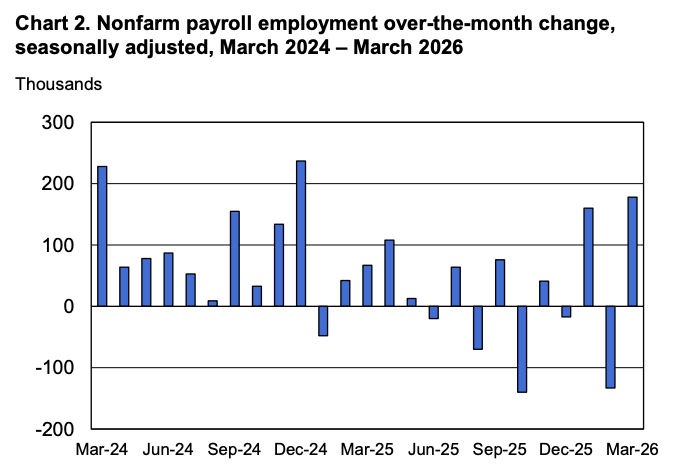 Chart illustrating the seasonally adjusted month-over-month change for non-farm payroll employment from March 2024 to March 2026 (Source: BLS)
However, there was a slight issue: Wall Street was unable to respond to it.
 Related Reading
161,000 US jobs just disappeared after a revision as Bitcoin navigates increasingly messy macro data
Nearly 1 million US jobs were found to be nonexistent, according to a significant government revision.
Mar 8, 2026 · Andjela Radmilac
Why this matters: A robust labor report typically extends rate-cut expectations, which can exert pressure on risk assets across both stocks and cryptocurrencies. With traditional markets closed, Bitcoin emerged as the sole major platform where this macro shock could begin to be factored in ahead of Monday.
NYSE, Nasdaq, and bond markets were closed in observance of Good Friday, effectively blocking all conventional channels through which a data surprise like this would usually be processed and adjusted.
For one of the most market-sensitive economic reports on the calendar, the timing was particularly inconvenient.
This sets the stage for a unique and educational moment: a forced experiment in price discovery occurring while all standard mechanisms are offline.
February had proven to be a setback. The economy shed 92,000 jobs that month, nearly double the anticipated figures, marking the fourth monthly job loss in nine months. The revisions exacerbated the situation: December’s numbers were revised down by 65,000, from +48,000 to -17,000, and January’s figures were adjusted down by an additional 4,000.
Leading up to Friday, even the most hopeful analysts were not predicting a rebound of this magnitude.
A significant portion of March’s increase stemmed from the healthcare sector. A strike by healthcare workers had reduced February’s payrolls, and the sector contributed 76,000 jobs in March, boosting overall job growth. Additional positions were also created in construction, transportation, and warehousing.
While the increase itself was genuine, it is crucial to recognize that a substantial part of the growth was mechanical, representing a recovery from prior disruptions rather than indicating a suddenly revitalized economy.
Nonetheless, 178,000 jobs against an expectation of 57,000 is not a trivial discrepancy. The immediate implications for the Federal Reserve’s policy were clear: if the figures are strong, cryptocurrency prices are likely to decline due to rising interest rate expectations.
Stronger labor statistics limit the Fed’s ability to lower rates, and tighter financial conditions affect all risk assets. Thus, the inquiry here was not whether markets would respond, but rather which markets were still available to react at all.
When the NYSE goes dark, Bitcoin becomes the market
Bitcoin remained the only significant financial market still active as the March report was released at 8:30 AM ET, with the NYSE closed and sentiment at extreme fear levels. The crypto Fear and Greed Index registered at 9 out of 100 on Apr. 3, a reading so low that it no longer indicates panic, but rather a state of exhausted resignation. Bitcoin reached $66,300 in the morning, with traders seemingly focused on the incoming data.
Related Posts
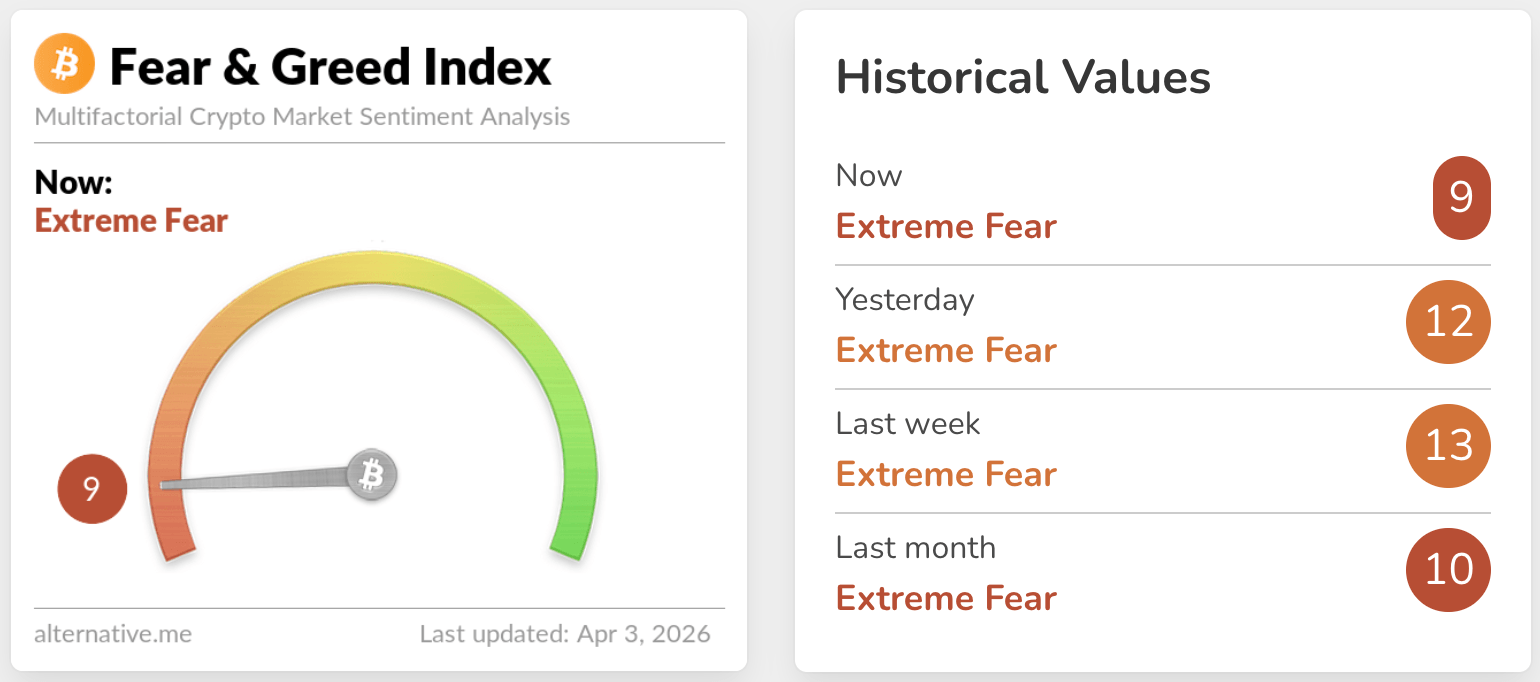 Crypto fear and greed index on Apr. 3, 2026 (Source: Alternative.me)
And when the number was released, Bitcoin remained unchanged.
The strong jobs report was neither overtly bullish nor bearish. It was complex, and Bitcoin’s stability reflected that complexity more accurately than a quick rally or selloff would have.
Consider the underlying details of the report. Long-term unemployment stood at 1.8 million, an increase of 322,000 over the year. Federal government employment, under ongoing contraction, continued to decline. The persistent conflict with Iran still poses a threat to a fragile labor market, and advancements in AI leading to mass layoffs add further uncertainty.
As noted by Moody’s chief credit officer, Atsi Sheth, their baseline for 2026 anticipates a weaker job market, but not one where unemployment rises sufficiently to push the economy into recession.
 Related Reading
Bitcoin just crossed into credit markets — with forced selling built in
The new bond structure provides BTC with credit utility, but links that access to clear liquidation thresholds if prices decline.
Apr 2, 2026 · Gino Matos
There is also an additional complication. The same report that indicated 178,000 jobs also revised December’s figure down by 65,000, and January’s down by 4,000, eliminating nearly 70,000 jobs that markets had already accounted for and moved past.
This could potentially establish a trend. The BLS has consistently revised recent months downward, meaning the March figure may appear significantly less impressive when April’s report is released.
Treasuries, the dollar, and the Fed’s rate-hold calculations all solidified on the basis of 178,000. If that number is adjusted to 130,000 next month, all of those reactions will have been based on inaccurate data.
The Fed has no chair, the market has no floor, and Monday has no script
Jerome Powell characterized the labor market in March as being in a “zero-employment growth equilibrium” with a sense of downside risk.
He made this statement prior to the release of this report. Now, with 178,000 jobs recorded, the Fed’s calculations shift, not dramatically, but noticeably toward maintaining higher rates for an extended period. With Powell’s term concluding on May 15 and no confirmed successor as of yet, the Fed must navigate one of the most critical data weeks of 2026 without clear leadership.
In this absence, the 10-year Treasury yield increased by approximately four basis points to 4.35%, and the dollar rose slightly: both consistent with a market interpretation that rate cuts are being pushed further into the future. These were the initial discernible reactions, not from the institutions that typically set the tone, but from the peripheral areas of the financial system.
Bitcoin will price this number independently for nearly three full days before equity trading resumes on April 6.
When the market opens on Monday morning, stocks will be processing not only a jobs report that surprised all analysts but also whatever transpires over the Easter weekend in a geopolitical landscape that remains highly fragile, with the ongoing conflict in Iran continuing to influence oil prices and the dollar simultaneously.
Bitcoin’s stability indicates that the market is maintaining a position, recognizing that any conclusions drawn now may need to be entirely revised based on what Monday brings.
The true assessment of March’s jobs report will emerge when the institutions that usually lead this discussion are finally permitted back into the conversation. Until then, the numbers are in the hands of the bond market, the foreign exchange desks, and the one financial market that does not observe holidays.
For three days, Bitcoin is the only clock still ticking. The question remains whether it keeps accurate time.
The post Can markets trust the jobs report? Another revision risk hangs over Bitcoin’s macro test appeared first on CryptoSlate.
