Disclaimer: Information found on CryptoreNews is those of writers quoted. It does not represent the opinions of CryptoreNews on whether to sell, buy or hold any investments. You are advised to conduct your own research before making any investment decisions. Use provided information at your own risk.
CryptoreNews covers fintech, blockchain and Bitcoin bringing you the latest crypto news and analyses on the future of money.


Bitcoin climbed back above $62,000 after a weak US jobs report cooled bets on a near-term Federal Reserve rate hike, creating a spot chart that reads as a relief rally. However, options desks trading Bitcoin futures are pricing in a more guarded outlook.
The US Bureau of Labor Statistics reported June payroll growth at just 57,000, significantly below the 110,000 economists had projected.
Labor-force participation slid to 61.5%, the government revised April and May payrolls down by a combined 74,000, and the unemployment rate held steady at 4.2%.
The US dollar was on track for its biggest weekly drop since early April, while CME FedWatch data indicated roughly a 45% chance of a September rate hike once the data was released.
| Macro input | Latest reading | Why it matters for Bitcoin |
|---|---|---|
| June payroll growth | 57,000 | Weaker labor data reduced pressure for another Fed hike |
| Reuters economist expectation | 110,000 | The miss helped drive the relief bid |
| April/May payroll revisions | -74,000 | Reinforced the cooling-labor-market signal |
| Labor-force participation | 61.5% | Added softness beneath the headline labor data |
| Unemployment rate | 4.2% | Stable, but not enough to offset the payroll miss |
| September hike odds | ~45% | Lower rate pressure supported risk assets |
| Dollar trend | Biggest weekly drop since early April | Softer dollar created a tailwind for BTC |
A softer dollar and lower odds of a rate hike provided crypto buyers with the macro setup they wanted heading into the July 4 weekend.
Options traders remain hedged, with Bitcoin puts trading at a premium to call options on Deribit. The one-week 25-delta put-call skew is near 16%, down from 25% ten days earlier, signaling that panic has eased.
This premium indicates hedging capital is crouched on the sidelines, ready to redeploy if Bitcoin slips.
Data from Laevitas flagged a large Bitcoin options block on July 17. The structure is a long call-option condor, constructed from long positions at $64,000 and $70,000 against short strikes at $66,000 and $68,000.
In simple terms, this trade pays off most if Bitcoin climbs, but only into the $66,000 to $68,000 band by expiration. If the price pushes past that range or falls short, the position loses value. This structure provides a visible range to watch for the weekend and acts as a soft ceiling on how far this rebound can run before meeting resistance from another major book.
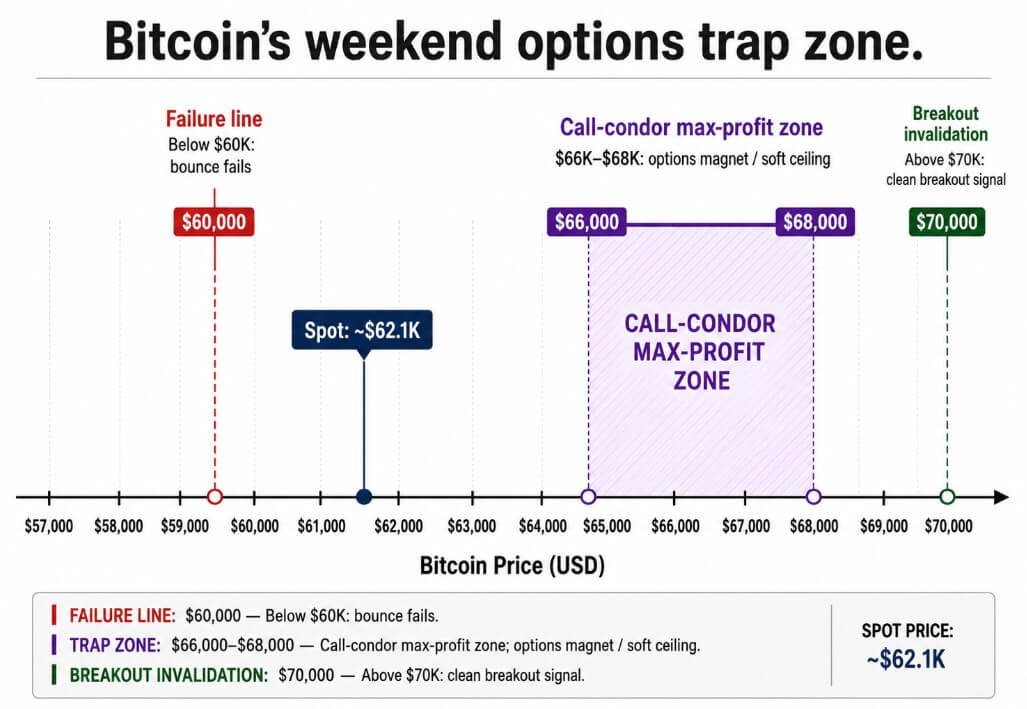
A price chart titled “Bitcoin’s weekend options trap zone” marks $60,000 as a failure line, spot near $62,100, and $66,000–$68,000 as the call-condor max-profit zone.
US equity markets closed on July 3 for Independence Day, so the NYSE calendar keeps most desks shut through the long weekend. This layers thin liquidity atop options positioning that is already capping the move.
Related Posts
Crypto trades around the clock regardless of holidays, but channels that usually confirm its moves—such as ETF volume, equity correlation, and deep futures books—go quiet when Wall Street steps away.
This leaves options positioning carrying more weight in indicating where price goes next, with fewer traditional-market checks available in real time.
Where the condor pays off
If Bitcoin holds above $62,000 through Saturday and Sunday, thin holiday liquidity could work in its favor as much as it could work against it.
This scenario would amplify the bounce and push spot toward the $66,000 to $68,000 band where the call condor sits. That band runs roughly 6% to 9% above the current spot, near $62,100.
Trading within that range would align with what large options money already expects. However, a clean push through $68,000 on real volume would convert the squeeze into an actual breakout, clearing the ceiling built into someone else’s math.
Anything short of that—a stall inside the band, or a fade once order books thicken on Monday—leaves the rebound as just a squeeze.
Where the skew is right
A rejection near $66,000 or a fresh break below $60,000 would flip the setup entirely. Either move would confirm what the elevated put skew has been pricing since before the jobs report.
Losing $60,000 would also reopen the low-$57,000s, about 8% under the current spot, a zone Bitcoin already tested during its second-quarter pullback.
| Weekend path | BTC level to watch | Approx. move from $62,100 | What it would signal |
|---|---|---|---|
| Bullish squeeze | $66,000–$68,000 | +6% to +9% | Thin liquidity amplifies the rebound into the condor zone |
| Confirmed breakout | Above $68,000, stronger above $70,000 | +9% to +13% | BTC clears the options ceiling instead of stalling inside it |
| Base-case chop | $60,000–$66,000 | -3% to +6% | Relief rally holds, but no breakout confirmation |
| Bearish failure | Below $60,000 | -3% or more | Elevated put skew was right; rebound becomes a trap |
| Deeper downside | Low $57,000s | Around -8% | Q2 pullback zone comes back into play |
The same thin weekend books that can fuel a squeeze higher can just as easily speed up a drop once stop orders start clearing.
Bitcoin’s climb back above $62,000 is genuine, and so is the caution sitting underneath it. Weak jobs data gave the dollar a reason to soften and the Fed a reason to wait, providing enough support to keep a bid under crypto through a holiday weekend.
One large options structure shaping a $66,000 to $68,000 range still leaves the lows open. Whichever way Bitcoin trades by Sunday night, the outcome will say more about who hedged correctly.
