Disclaimer: Information found on CryptoreNews is those of writers quoted. It does not represent the opinions of CryptoreNews on whether to sell, buy or hold any investments. You are advised to conduct your own research before making any investment decisions. Use provided information at your own risk.
CryptoreNews covers fintech, blockchain and Bitcoin bringing you the latest crypto news and analyses on the future of money.

Bitcoin’s status as a safe haven is challenged as geopolitical tensions raise the risk of a $10,000 drop if oil prices reach $150 per barrel.

Bitcoin, previously touted by certain investors as a safeguard against geopolitical instability, is currently exhibiting characteristics of a liquidity-sensitive risk asset during a period of rising energy costs and increasing macroeconomic stress.
This situation arises as tensions between the United States and Iran escalate, causing ripples through oil markets, the dollar, and overall financial conditions, ultimately affecting a cryptocurrency market that is already displaying signs of exhaustion.
This has reignited conversations about a significantly steeper downside trajectory than the market was prepared to consider just weeks prior.
Why this matters: This indicates a change in Bitcoin’s response to stress. Rather than drawing defensive investments in the face of geopolitical risks, it is reacting to tighter financial conditions, escalating oil prices, and a stronger dollar. This shift alters how investors position themselves in relation to macroeconomic shocks and increases the probability of more substantial declines if liquidity continues to diminish.
 Related Reading
Iran threatens major US companies in the Middle East creating new risk for crypto
Iran’s warning extends beyond a mere geopolitical headline. It could impact segments of the infrastructure and corporate balance sheets now associated with cryptocurrency.
Apr 1, 2026 · Oluwapelumi Adejumo
Oil shock drives the first wave of repricing
The latest phase of the market’s repricing intensified following President Donald Trump’s remarks on April 1, which dampened expectations for a near-term resolution in the Middle East.
By indicating that US military actions could escalate over the next two to three weeks, without providing a clear timeline for the cessation of hostilities, the administration pushed investors back into a defensive posture.
The initial response was evident across equities, although the more significant signal emerged from the energy sector.
US stocks experienced intraday declines before reducing losses by the end of the trading day, with the S&P 500 down 0.23% and the Dow Jones Industrial Average falling 0.39%. In Asia, the sell-off was more pronounced, with South Korea’s KOSPI dropping 4.2% and MSCI Emerging Asia declining 2.3%.
Oil prices reacted more decisively. Data from Oilprices.com indicated that West Texas Intermediate crude surged 11.41% to $111.54 a barrel, marking its largest absolute gain since 2020, while Brent crude increased by 7.78% to $109.03.
This surge followed US-Israeli strikes that commenced on February 28 and Iran’s effective closure of the Strait of Hormuz, a critical passage that accounts for approximately one-fifth of global oil and liquefied natural gas shipments.
These developments have considerable implications for the cryptocurrency market, as a sustained increase in crude oil prices directly influences inflation expectations, tightens financial conditions, and diminishes the market’s appetite for speculation.
With the dollar index rising by 0.48%, Treasury market spreads widening by 27%, and the VIX approaching 25, the broader macroeconomic landscape is turning unfavorable for risk assets that rely on ample liquidity and consistent investor interest.
 Related Reading
Bitcoin, stocks rally because of chatter that Iran is ready to ‘end the war' as Dollar Index sinks below 100
Bitcoin’s rebound above $68,000 is contingent on hopes for peace in the Middle East amid fluctuating oil prices.
Mar 31, 2026 · Oluwapelumi Adejumo
Bitcoin entered the shock already weakened
The escalation involving Iran may have hastened the recent sell-off, but it did not create the market’s vulnerability. Bitcoin was already losing support prior to the deterioration of the geopolitical landscape.
CryptoQuant data indicates that selling pressure has consistently outpaced institutional accumulation, despite earlier backing from spot exchange-traded funds and corporate buyers like Strategy. The firm’s 30-day apparent demand growth stands at -63,000 BTC, suggesting that new demand has not been robust enough to absorb the available supply.
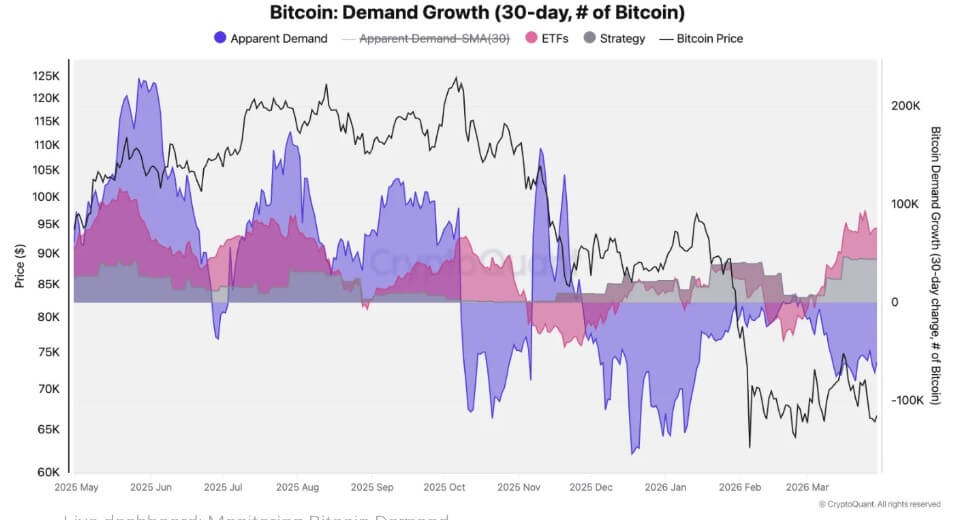 Bitcoin Apparent Demand (Source: CryptoQuant)
A similar trend is observable among large holders. Whale wallets containing between 1,000 and 10,000 BTC have transitioned from accumulation to one of the most pronounced distribution phases of the cycle. The one-year change in whale holdings has shifted from an increase of approximately 200,000 BTC at the 2024 peak to a deficit of 188,000 BTC.
Related Posts
Mid-sized holders have also reduced their positions. Wallets containing between 100 and 1,000 BTC, often regarded as a crucial layer of market support, have seen their holdings increase by only 429,000 BTC in the current market cycle, compared to around 1 million BTC in late 2025.
This weakness is particularly evident in the United States. Coinbase Premium, a typical measure of US spot demand, has remained negative even as Bitcoin fell into the $65,000 to $70,000 range. This indicates that American buyers, both retail and institutional, have not returned in sufficient numbers to stabilize the market.
Essentially, these figures illustrate a market that had already begun to lose resilience before the intensification of war-related headlines.
 Related Reading
Bitcoin ready to record fourth straight red month and the $81,000 floor is suddenly everything
Bitcoin is once again below its 2-year moving average, and traders are concerned that this signal could lead to a severe capitulation.
Jan 30, 2026 · Oluwapelumi Adejumo
Leverage is turning a weak market into a fragile one
Meanwhile, Bitcoin’s current weak spot demand has become more precarious as leverage plays an excessive role in the market.
In more stable markets, such positioning can help sustain price levels. However, it becomes a liability during a macroeconomic shock, as contracts that might otherwise have been rolled forward are more likely to be liquidated, either voluntarily or through forced actions.
This is how orderly weakness can escalate into a cascade. Prices decline, leveraged long positions are liquidated, further selling ensues, and the market begins to react to positioning stress rather than conviction.
Analysts at Bitunix informed CryptoSlate that Bitcoin remains trapped in a passive pricing environment, with resistance around $69,400 still unbroken and downside liquidity continuing to accumulate near $65,500. In a more adverse macroeconomic context, that lower boundary could trigger a broader liquidation wave.
Options markets are conveying a similarly cautious sentiment. Greeks.live data reveal that 28,000 BTC contracts expired on April 3 with a put-call ratio of 0.54 and a max pain point at $68,000, representing $1.8 billion in notional value.
According to the firm:
“Bitcoin performed poorly in both price and market sentiment during the first quarter of this year, and the first week of the second quarter has also been weak. Rebuilding confidence may require time and capital support; currently, all indicators point to bear market conditions.”
Why $10,000 is still a tail risk
Bitunix has characterized the current environment as a triple-constraint regime influenced by heightened inflation expectations, policy limitations, and escalating geopolitical risks.
This framework elucidates why cryptocurrency is responding so sharply, as liquidity cannot ease significantly if oil prices remain high. Simultaneously, market confidence cannot easily recover if the risk of war continues to rise, speculative positions become increasingly difficult to defend as the dollar strengthens, and volatility escalates across asset classes.
In this context, the more plausible scenarios for BTC still suggest lower price levels.
In a moderate scenario, where the conflict remains contained but inflation persists at elevated levels, unwinding leveraged futures could pull Bitcoin down from around $70,000 to $50,000, representing a correction of approximately 25% to 30%.
Conversely, a more severe bear-case scenario could emerge if ETF outflows increase, spot demand remains weak, and the dollar continues to tighten financial conditions. In such a situation, Bitcoin could decline into the $20,000 to $30,000 range, erasing 60% to 70% of its value from recent highs.
| Scenario | Price range | What could drive it | Market effect | Probability framing |
|---|---|---|---|---|
| Relief bounce | $71,500 to $81,200 | Geopolitical tensions ease, oil prices retract, and overall risk sentiment improves. | Bitcoin recovers toward resistance as liquidation pressure diminishes. | Possible, but reliant on macro stabilization. |
| Moderate downside | Around $50,000 | Conflict remains contained, but inflation stays elevated and leveraged futures positions unwind. | Approximately 25% to 30% correction from the recent $70,000 area. | Plausible downside case. |
| Mid-term bear case | $20,000 to $30,000 | ETF outflows accelerate, spot demand remains weak, and the U.S. dollar continues to tighten financial conditions. | Bitcoin enters a deeper contraction, erasing 60% to 70% from recent levels. | More severe, but still within historical drawdown patterns. |
| Tail-risk black swan | Around $10,000 | Prolonged closure of the Strait of Hormuz or a wider regional conflict drives oil prices to $150 to $200 a barrel and triggers a collapse in global liquidity. | Bitcoin experiences an extreme drawdown as speculative capital exits the market. | Tail risk, not the base case. |
The potential drop to $10,000 is considered a black swan outcome. It would likely necessitate a prolonged closure of the Strait of Hormuz or a broader regional conflict severe enough to push oil prices toward $150 to $200 a barrel, leading to a significant tightening of global liquidity and a decline in equities exceeding 30%.
Under such circumstances, speculative capital within the cryptocurrency market would diminish sharply, leaving Bitcoin vulnerable to the kind of 80% drawdown observed in previous cycle washouts.
For the time being, the key takeaway is that Bitcoin is not functioning as a safe haven amid conflict. Instead, it is behaving like a highly sensitive risk asset whose trajectory remains contingent on liquidity, leverage, and the market’s capacity to absorb macroeconomic shocks.
The post Bitcoin’s safe haven story breaks as war shock revives $10,000 risk if oil hits $150 a barrel appeared first on CryptoSlate.
