Disclaimer: Information found on CryptoreNews is those of writers quoted. It does not represent the opinions of CryptoreNews on whether to sell, buy or hold any investments. You are advised to conduct your own research before making any investment decisions. Use provided information at your own risk.
CryptoreNews covers fintech, blockchain and Bitcoin bringing you the latest crypto news and analyses on the future of money.

Bitcoin’s seven percent inflation since 2020 offset by 900 percent gains, while the USD experiences a 20 percent decline.

While Bitcoin is commonly regarded as a safeguard against inflation, it currently exhibits a favorable inflation rate of 0.83%. This rate is remarkably low when compared to the dollar’s peak inflation of 9.1% in 2022. However, when we analyze the cumulative inflation rates of both Bitcoin and the US dollar, the true strength of Bitcoin in wealth preservation becomes evident.
Between 2020 and 2025, Bitcoin experienced an approximate increase of 960%, whereas the US Dollar Index (DXY), which evaluates the US dollar against a selection of other currencies, saw only a 12% rise in nominal terms.
The inflation-adjusted value of Bitcoin and the DXY, when normalized for inflation, provide critical insights into the actual value dynamics of both assets. Although the nominal DXY indicates relative currency strength, its inflation-adjusted value reveals the ongoing decline in purchasing power.
The current nominal DXY is at 109.8, reflecting global demand for the dollar amid macroeconomic instability. However, when adjusted for cumulative US inflation since 2020—averaging over 2% annually and peaking above 8% in 2022—the true value of the DXY falls to 87.5. This signifies a 22.3-point difference, or approximately 20.3% of the nominal value, highlighting the dollar’s significant loss of purchasing power over time despite its relative strength against other currencies.
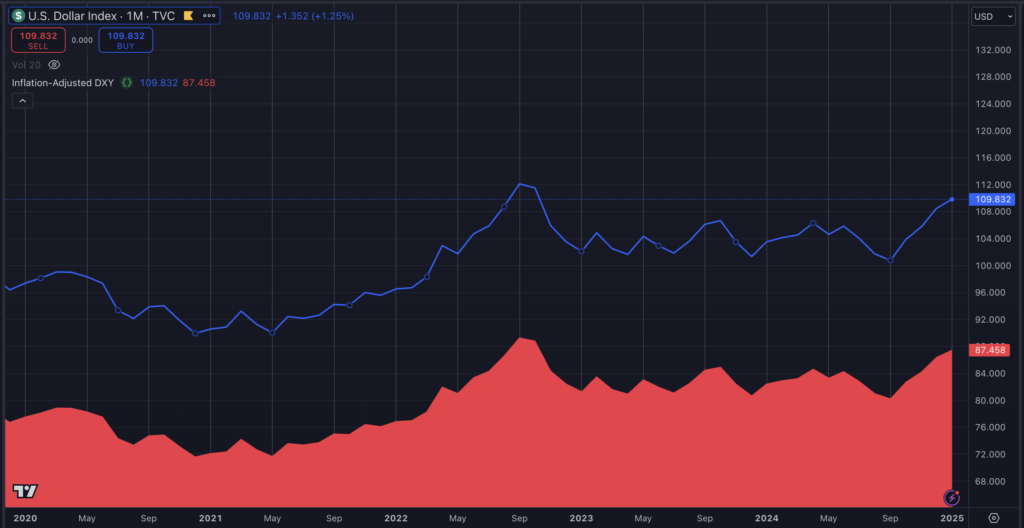 DXY adjusted for inflation (Source: TradingView)
Meanwhile, Bitcoin’s nominal price is around $91,000. When adjusted for its low supply inflation—1.74% annually from 2020 to 2024 and 0.83% in 2025—its inflation-adjusted price is approximately $84,365. The $6,635 difference accounts for only 7.3% of its nominal value, underscoring Bitcoin’s relative stability and its ability to maintain purchasing power over time compared to fiat currencies. This smaller adjustment emphasizes Bitcoin’s programmed scarcity and low inflation as crucial factors in its durability.
Related Posts
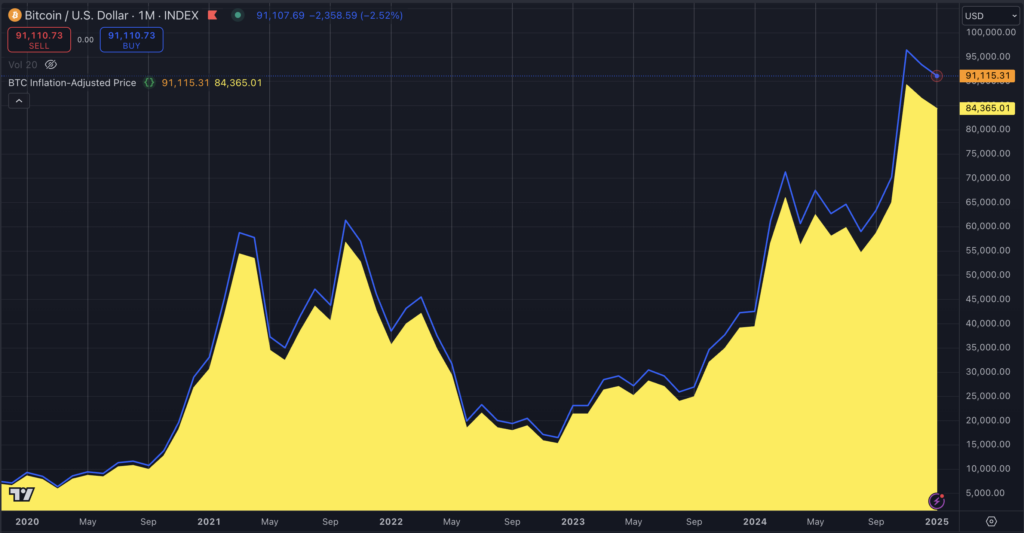 BTC adjusted for inflation (Source: TradingView)
The disparity between the inflation-adjusted metrics for the DXY and Bitcoin highlights a broader narrative. While fiat currencies like the dollar face significant devaluation due to inflation, Bitcoin’s controlled supply positions it as a hedge against currency debasement. The more pronounced inflationary impact on the DXY underscores the challenge of preserving purchasing power within a fiat system, especially during periods of high inflation.
The difference between nominal and inflation-adjusted metrics is crucial for assessing the long-term value of assets. The nominal strength of the DXY conceals the underlying erosion of the dollar’s purchasing power, while Bitcoin’s inflation-adjusted price reflects its ability to retain value over time. These insights reinforce the necessity of inflation-adjusted analyses in formulating effective strategies for navigating the macroeconomic environment.
Additionally, the inflation of the comparison currencies used to determine the DXY should also be taken into account to accurately identify the divergence. Nevertheless, the figures presented provide a rough assessment of Bitcoin’s enhanced strength against the dollar beyond nominal terms.
In simple terms, if you had invested $100 in Bitcoin in 2020 and $100 in the DXY today, your BTC would possess a purchasing power of $927, while your DXY would equate to $91 in real terms.
The post Bitcoin compound inflation of 7% since 2020 canceled out by 900% gains while USD declines 20% appeared first on CryptoSlate.
