Disclaimer: Information found on CryptoreNews is those of writers quoted. It does not represent the opinions of CryptoreNews on whether to sell, buy or hold any investments. You are advised to conduct your own research before making any investment decisions. Use provided information at your own risk.
CryptoreNews covers fintech, blockchain and Bitcoin bringing you the latest crypto news and analyses on the future of money.


Although Bitcoin’s value experienced a significant rise over the last two weeks, there was a concurrent decline in the generation of new addresses and the number of transactions on the network.
From Oct. 15 to Oct. 27, Bitcoin’s price increased from $27,140 to $34,160. Typically, such price increases are associated with increased network activity, as more users interact with the network by creating new addresses or executing transactions. However, during this timeframe, the 30-day Simple Moving Average (SMA) for both new addresses and transaction counts decreased.
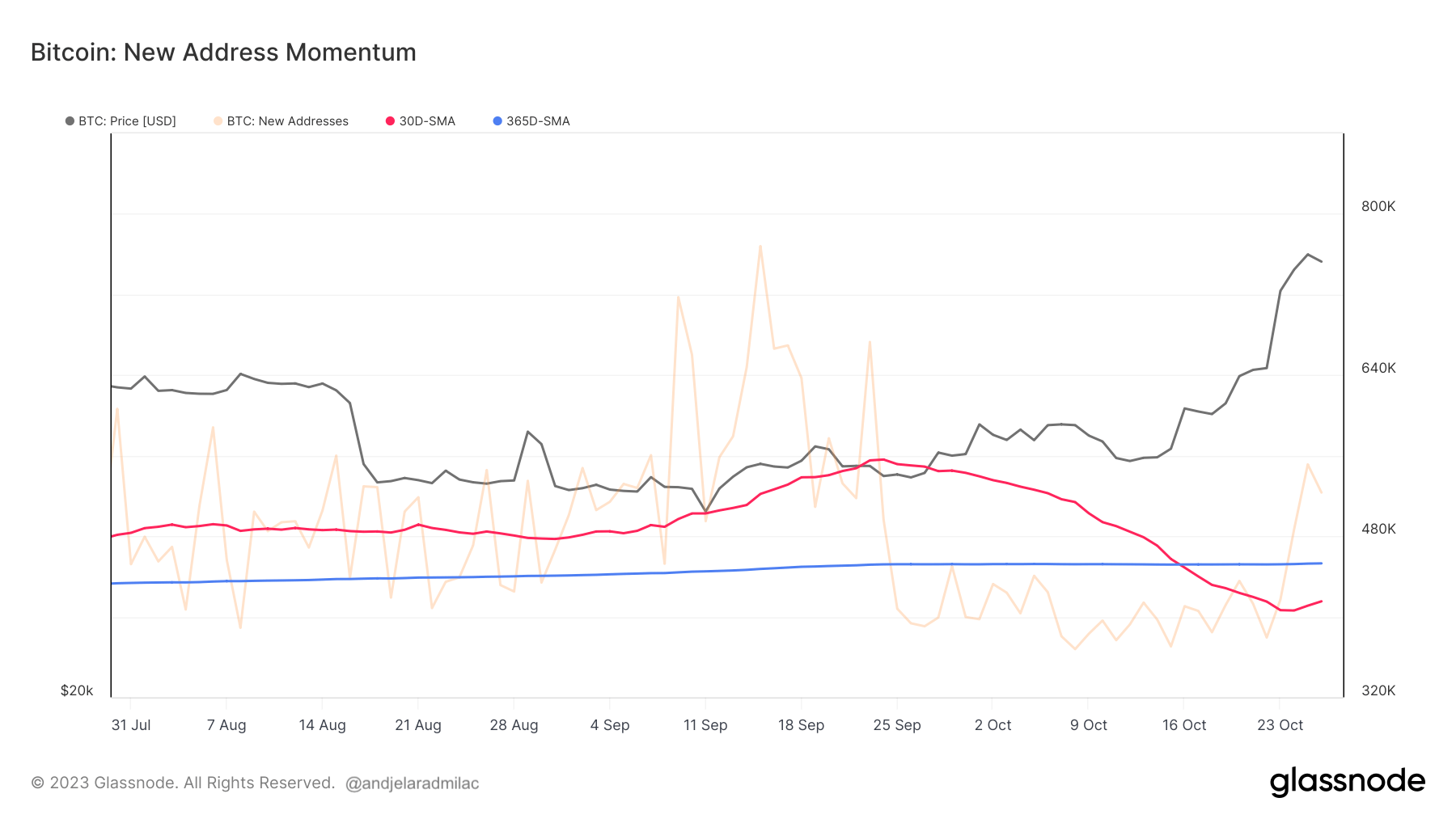 Graph illustrating the 30-day SMA (red) and 365-day SMA (blue) of new addresses on the Bitcoin network from Jul. 30 to Oct. 26, 2023 (Source: Glassnode)
Specifically, the 30-day SMA for new addresses fell from 457,371 to 415,336, with both metrics experiencing their 30-day SMA dropping below their corresponding 365-day Daily Moving Average (DMA), maintaining this condition.
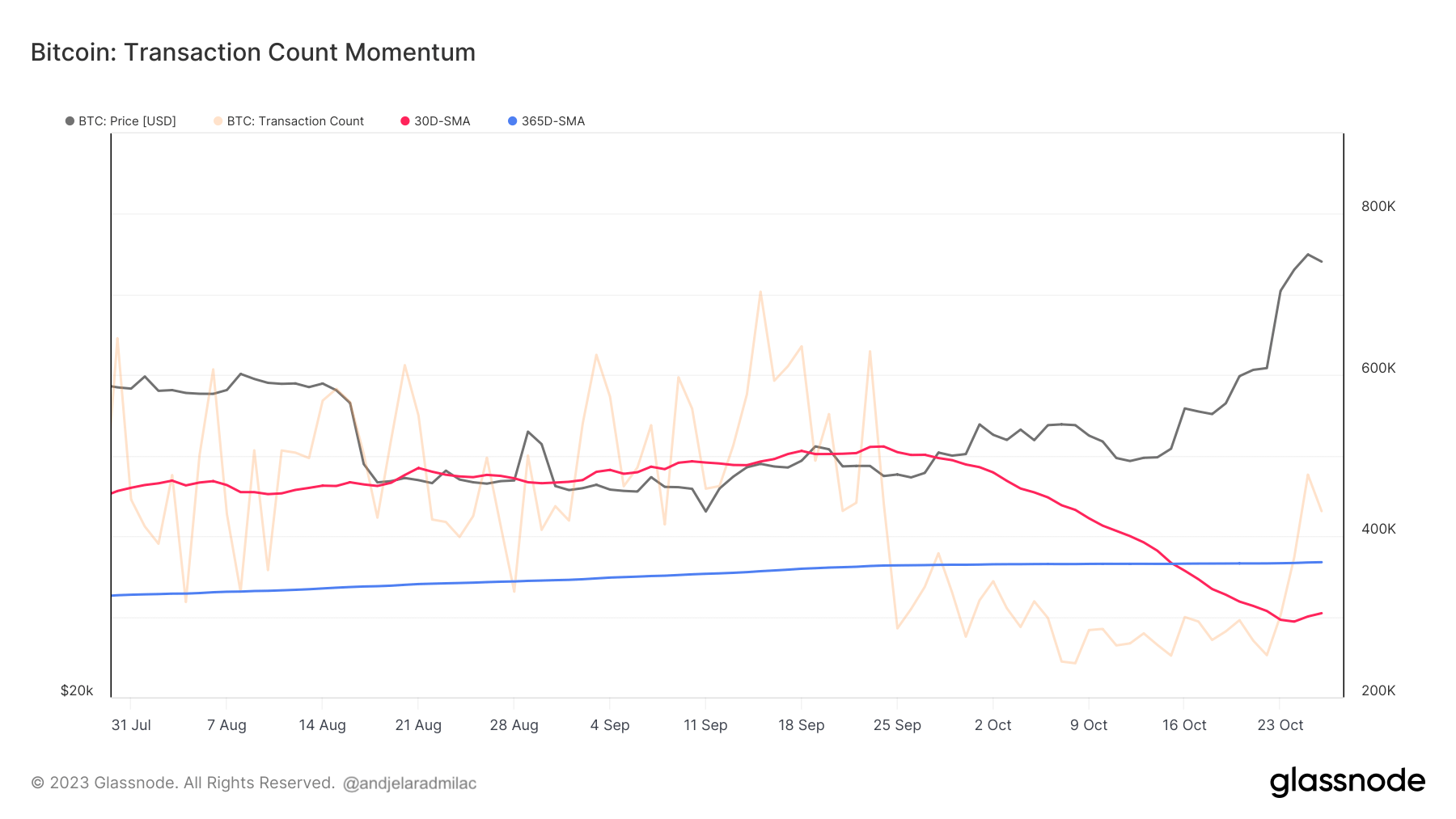 Graph depicting the 30-day SMA (red) and 365-day SMA (blue) of the transaction count on the Bitcoin network from Jul. 30 to Oct. 26, 2023 (Source: Glassnode)
Related Posts
In the cryptocurrency market, daily metrics frequently show considerable volatility due to numerous factors, rendering them less useful when analyzed in isolation. For example, daily on-chain activity can be affected by occurrences such as significant transactions by large holders, exchange maintenance, or short-term news events. Therefore, it is more beneficial to analyze moving averages to obtain a clearer understanding of the underlying trends. The 30-day (monthly) SMA provides a smoothed view of a month’s data, while the 365-day (yearly) DMA offers a wider perspective, encompassing a year of activity. By comparing these two, we can detect changes in prevailing sentiment and deduce whether network activity is increasing or decreasing in relation to historical standards.
The increase in Bitcoin’s price, contrasted with the decline in on-chain metrics, implies that the current price fluctuations may not be supported by a corresponding rise in on-chain usage. One possible reason for this inconsistency is the influence of speculative trading. The upward price movement might be driven more by speculative transactions on exchanges rather than authentic on-chain activity. Since centralized exchanges typically conduct trades off-chain, a surge in trading volume would not necessarily be reflected on the blockchain.
This speculation could stem from various external factors. Macroeconomic conditions, regulatory changes, or news within the wider cryptocurrency ecosystem may influence the price, independent of Bitcoin’s on-chain metrics. This situation indicates that Bitcoin’s value is affected by a broader array of elements beyond its network activity.
Moreover, the decline in on-chain activity might suggest a change in behavior among Bitcoin users. Current users may be holding onto their Bitcoin, anticipating future value increases. This indicates a long-term confidence in Bitcoin’s value proposition and a shifting view of its role within investment portfolios.
Finally, technological advancements may also be playing a role in the observed trend. The rise of second-layer solutions or sidechains, such as the Lightning Network, could lead to fewer on-chain transactions. These platforms facilitate transaction aggregation off-chain, reflecting a change in transaction methods without necessarily indicating a decrease in overall Bitcoin activity.
The post Bitcoin’s price surge not reflected by on-chain activity appeared first on CryptoSlate.
