Disclaimer: Information found on CryptoreNews is those of writers quoted. It does not represent the opinions of CryptoreNews on whether to sell, buy or hold any investments. You are advised to conduct your own research before making any investment decisions. Use provided information at your own risk.
CryptoreNews covers fintech, blockchain and Bitcoin bringing you the latest crypto news and analyses on the future of money.

Bitcoin’s attention transitions from oil to bonds as 10-year yields in the US and Japan rise ahead of a pivotal week.

Bond markets, not oil alone, may decide Bitcoin’s fate this week
The market continues to regard oil as the focal point of the ongoing macroeconomic disruption.
Market conditions following this weekend indicate a different direction. Oil serves as the catalyst, while bond markets act as the conduit, with Bitcoin trading within that conduit as the week commences.
This is the scenario currently confronting investors.
The geopolitical upheaval remains significant. Crude oil can alter inflation expectations, complicate decisions made by central banks, and impact risk sentiment in a single action. The more pressing concern, however, is the effect of this energy shock on sovereign debt markets at a time when investors were already questioning the extent of inflation relief they could realistically anticipate in 2026.
This shift in attention transitions the discussion from oil to yields, from yields to global bond valuations, and then directly to Bitcoin.
Bitcoin is functioning in a market where the long end of the yield curve has become increasingly significant.
Currently, the long end is experiencing pressure.
The fundamental premise is clear: markets have already accounted for war risk through energy, while the next phase of repricing focuses on whether this energy shock is persistent enough to sustain elevated long-term yields, postpone policy relief, and tighten financial conditions overall.
Every risk asset is influenced by this process, and Bitcoin is particularly affected as it still occupies two roles. In the short term, it behaves like a liquidity-sensitive macro asset. Over a longer timeframe, it retains the allure of a hard-asset hedge.
 Related Reading
Bitcoin price falls below $70k, foreshadowing US market open after threat to “obliterate” all Iranian power plants
Bitcoin’s significant decline corresponds with geopolitical tensions, as risk assets are repriced while traders evaluate potential conflict spillover scenarios.
Mar 22, 2026 · Liam 'Akiba' Wright
This tension is central to the current situation.
The Kobeissi Letter aligned more closely with the appropriate framework this weekend, suggesting that oil prices are no longer the sole threat to markets and that bond markets will significantly influence how long Washington can sustain pressure in the Iran conflict. The essential takeaway from this argument lies in the mechanics of the market.
The U.S. 10-year yield surged sharply following the onset of war on Feb. 28. Official Treasury data indicates it rose from 3.97% on Feb. 27 to 4.39% by March 20, with live trading pushing it back toward the 4.4% range on Monday. This movement is substantial enough to confirm that yields have increased rapidly and that the bond market is exerting real pressure on broader financial conditions.
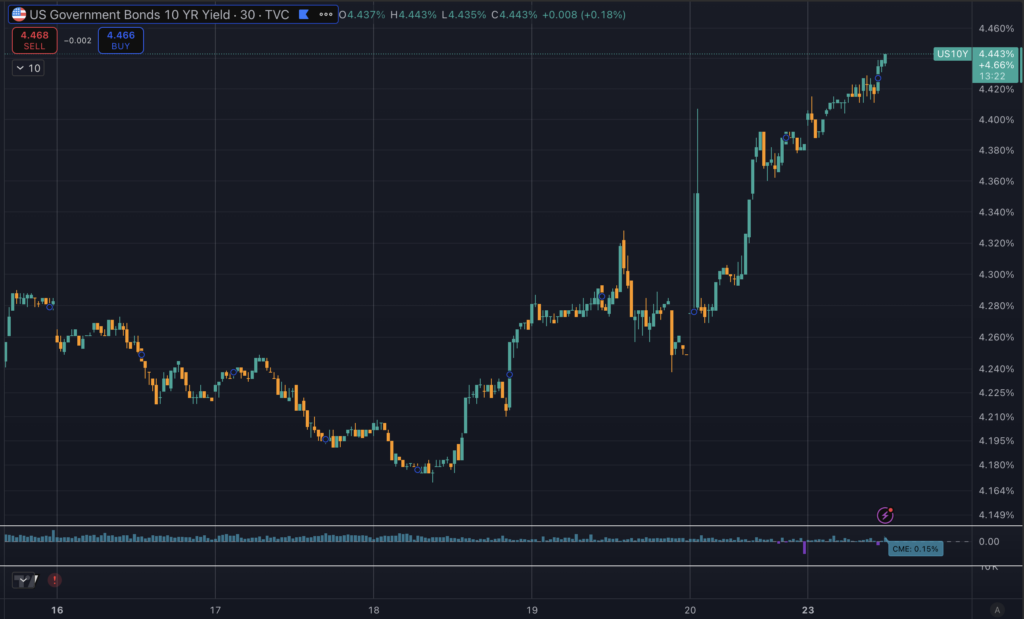 US 10Y explosion to 4.4%
Yield zone becomes the binding constraint for risk assets
The 4.50% to 4.60% range on the 10-year warrants a more detailed description. It is best understood as a politically and financially sensitive area, rather than a fixed threshold that necessitates an immediate reaction.
Markets seldom move with that level of precision. Nevertheless, recent experiences indicate that the White House closely monitors when the long end rises sufficiently to jeopardize broader risk conditions.
For Bitcoin, the implication is evident. The central question is no longer confined to whether oil prices will increase. The more critical issue is whether oil remains robust enough to sustain inflation fears and elevate yields into a range that simultaneously pressures duration, equity multiples, and speculative positioning.
This is why the yield response warrants the majority of investor focus.
The broader macroeconomic backdrop offers little respite.
The Federal Reserve maintained rates at 3.50% to 3.75% last week and indicated that the situation in the Middle East adds another layer of uncertainty to the policy outlook. The surrounding data reinforced this caution.
February CPI registered at 2.4% year over year, with core at 2.5%. February PPI showed stronger monthly growth. Payroll growth has slowed, and consumer sentiment has deteriorated. The University of Michigan’s preliminary March reading also indicated rising inflation expectations, with gasoline prices highlighted as a notable pressure point for households.
This combination presents markets with a challenging mix, as softer growth signals coincide with renewed inflation concerns.
Bitcoin typically struggles when this mix begins to directly influence the term premium.
 Related Reading
Britain’s bond panic is currently making the case for Bitcoin many people seem to have forgotten
Britain’s bond panic is demonstrating that Satoshi was correct all along as history begins to echo.
Mar 20, 2026 · Liam 'Akiba' Wright
Japan now deserves a much bigger place in the conversation
Related Posts
One of the most overlooked risks in the current landscape is that this situation has expanded beyond a U.S. Treasury movement. Japanese government bond yields have also increased since Friday, with the 10-year JGB rising from 2.264% on March 20 to approximately the 2.30% to 2.32% range on Monday.
Longer-dated yields have also risen, with both the 30-year and 40-year experiencing upward pressure.
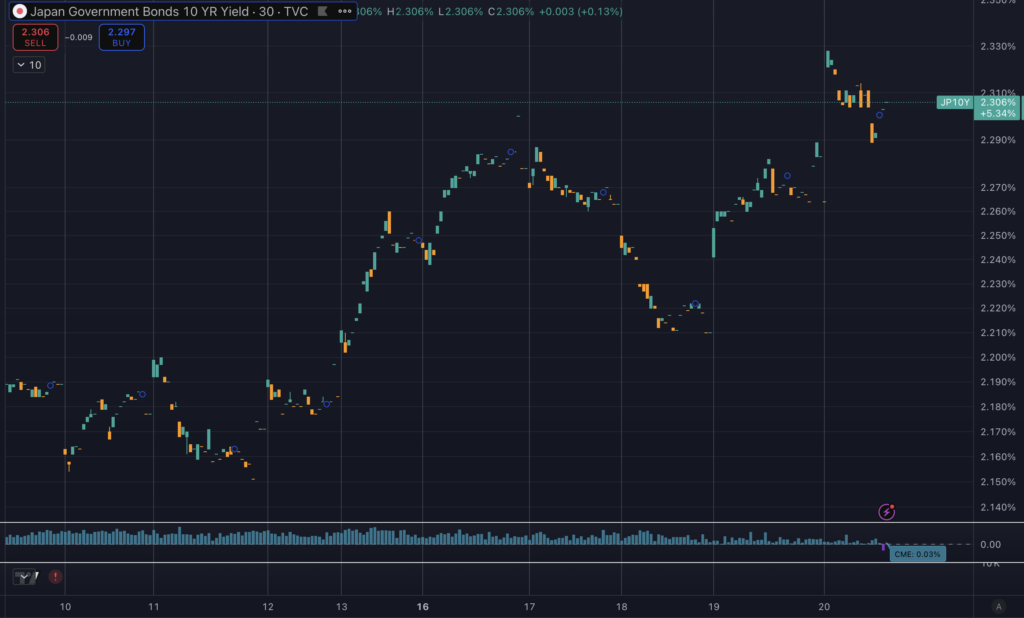 Japan 10Y price jump
Simultaneously, 10-year JGB futures remained near recent lows following Friday’s selloff instead of staging a convincing recovery.
This development adds another layer to the macroeconomic pressure.
Japan is significant in global duration markets because rising JGB yields can affect capital flows, relative-rate pricing, hedging strategies, and the overall cost of money worldwide.
When JGBs reprice higher while Treasuries and gilts remain under pressure, the market begins to perceive the energy shock as a global bond-market phenomenon rather than a localized oil panic.
This shift presents another challenge for Bitcoin.
The Bank of Japan underscored this theme last week when it acknowledged that crude prices had risen significantly and cautioned that higher oil would exert upward pressure on consumer prices.
The BOJ did not indicate panic, but it also did not alleviate concerns that inflation risk is broadening. Markets had already been pricing in significant odds of another BOJ rate hike, and reports suggesting Japan is contemplating reducing buybacks of inflation-linked bonds have only heightened the perception that local inflation expectations are reawakening.
This positions Japan as less of a stabilizer and more of an amplifier.
Bitcoin traders often desire the asset to be regarded as digital gold during geopolitical tensions. However, price movements have thus far indicated a more complex reality. When the oil shock occurred, traders sold Bitcoin instead of seeking refuge in it as a traditional safe haven. This response does not negate the hard-asset argument over a longer timeframe. It illustrates that timing is a critical factor.
Bitcoin can still attract a more defensive bid later, particularly if the policy response to weaker growth becomes more aggressive or if investors begin to focus more intently on fiat credibility and sovereign debt sustainability. In the initial phase of a liquidity shock, rising yields still create an unfavorable environment.
The week ahead carries unusual weight
This week does not feature the usual PCE inflation anchor, as February U.S. PCE has been postponed to April 9.
Consequently, markets will rely more heavily on secondary indicators. This elevates the significance of Treasury auctions, PMI data, jobless claims, and survey-based inflation expectations.
These releases will serve as the scoreboard for the week.
Tuesday’s flash PMIs will provide an early indication of whether business activity is absorbing the shock or beginning to falter. The 2-year Treasury auction is scheduled for the same day, followed by the 5-year on Wednesday and the 7-year on Thursday. Friday will bring the final University of Michigan sentiment reading and an updated assessment of inflation expectations.
If the auctions are weak and inflation-expectations data remain firm, the 10-year could quickly approach the mid-4% range. This environment would keep Bitcoin under pressure even if oil stabilizes. In that scenario, BTC would likely remain within the market’s liquidity bucket as investors adjust to higher-for-longer conditions.
An alternative scenario is also possible. If auctions perform well, PMIs soften enough to limit the long end, and inflation expectations ease, yields could stabilize even without a dramatic decline in crude. This would create a more favorable opening for Bitcoin.
Markets could begin to shift away from immediate concerns regarding persistent inflation and toward a broader perspective in which the growth impact from the shock eventually outweighs the energy spike itself.
This is the moment when Bitcoin’s hard-asset appeal can start to re-enter the discussion more prominently.
Bitcoin market structure still looks intact
Spot prices have retreated from recent peaks, yet institutional demand has continued to manifest in certain areas of the market. U.S. spot ETF flows for the week ending March 20 remained net positive overall (+$93 million), despite a weakening in the final sessions.
The futures basis also stayed positive. This combination indicates a market that is still engaged and remains highly responsive to macro conditions, rather than one facing a widespread internal collapse.
This brings the focus back to bonds.
Bitcoin’s next movement may depend less on the next increase in crude and more on whether the bond market perceives the inflation shock as temporary or enduring. Oil initiated the initial shock. Treasuries are influencing how tight financial conditions become, and Japan is increasingly reinforcing that repricing instead of alleviating it.
Bitcoin now faces a three-part macro test this week.
- Can oil stabilize quickly enough to prevent inflation fears from escalating?
- Can Treasury auctions avert another sharp increase in the long end?
- Can Japan avoid transforming a U.S. bond selloff into a broader global duration squeeze?
If these pressures continue to mount, Bitcoin is likely to remain under strain and trade like a high-beta macro asset. If these pressures begin to ease, even partially, BTC has the potential to recover as markets start to differentiate immediate war-driven stress from the broader monetary trajectory ahead.
The current situation therefore extends beyond crude alone. Oil ignited the fire, bonds are determining the extent of its spread, and Japan is providing evidence that the repricing in sovereign debt is global.
Until the rate market stabilizes, Bitcoin remains caught in the middle.
[Update 11:23 GMT: Rates nearing 4.5% have coincided with President Trump issuing a statement declaring “THE UNITED STATES OF AMERICA, AND THE COUNTRY OF IRAN, HAVE HAD, OVER THE LAST TWO DAYS, VERY GOOD AND PRODUCTIVE CONVERSATIONS REGARDING A COMPLETE AND TOTAL RESOLUTION OF OUR HOSTILITIES IN THE MIDDLE EAST.” Bitcoin jumped 4.5% immediately.]
The post Bitcoin focus shifts from oil to bonds as US and Japan 10-year yields spike into a critical week appeared first on CryptoSlate.
