Disclaimer: Information found on CryptoreNews is those of writers quoted. It does not represent the opinions of CryptoreNews on whether to sell, buy or hold any investments. You are advised to conduct your own research before making any investment decisions. Use provided information at your own risk.
CryptoreNews covers fintech, blockchain and Bitcoin bringing you the latest crypto news and analyses on the future of money.


Since the Nixon Shock, Bitcoin’s trading hours have exceeded those of the contemporary US fiat stock market; however, assertions that it has surpassed the entire history of US stock trading or global fiat would be hasty. A more detailed analysis reveals a complex landscape regarding market longevity and trading activity.
Recently, the crypto community was abuzz with a statistic indicating that Bitcoin had accrued more trading hours than the fiat stock market, following an analysis conducted by Cory Bates.
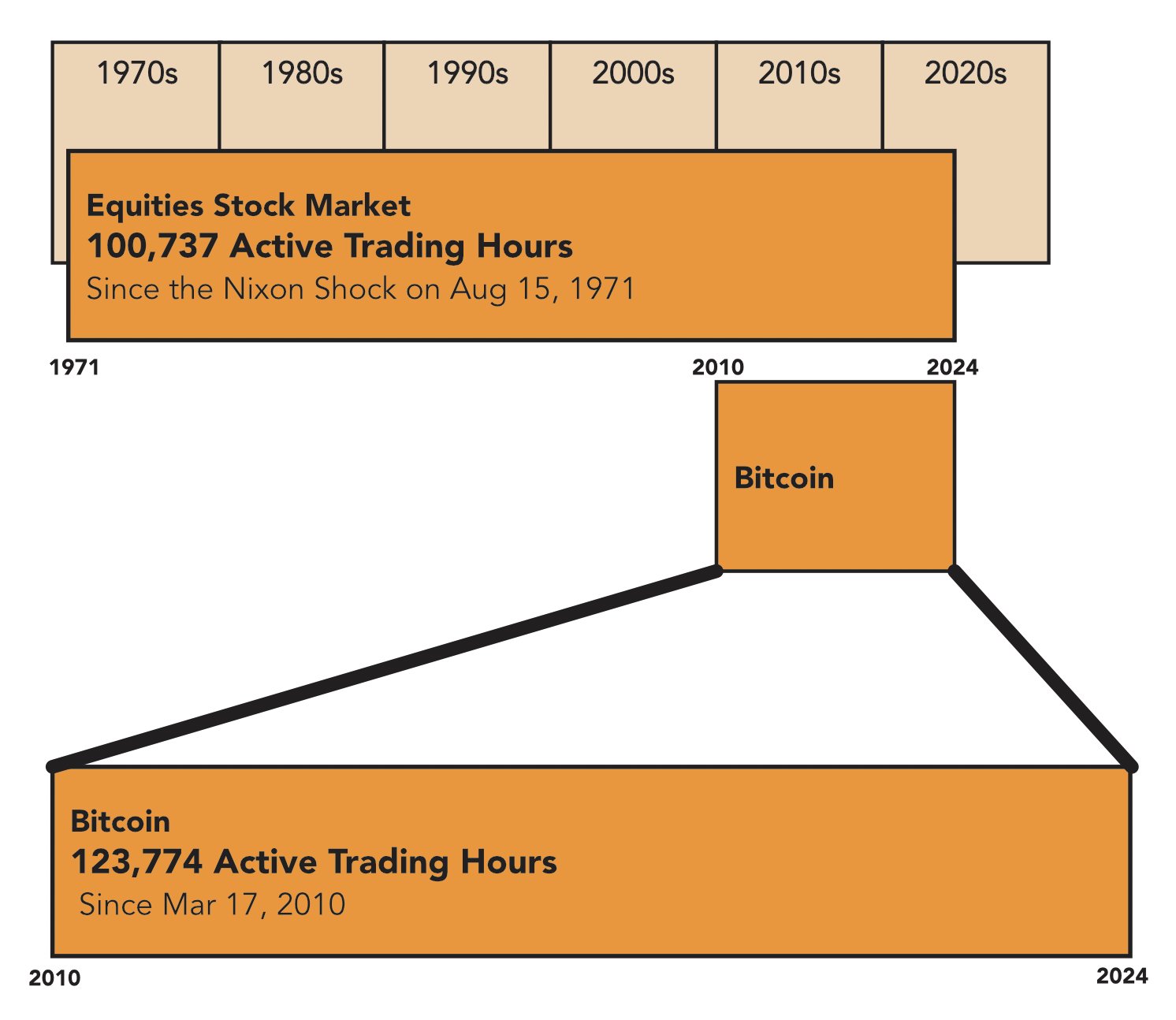 HODL Kamikaze image of Bitcoin vs Fiat stock market trading (HODL Kamikaze)
Bates points out that while Bitcoin trading has now outstripped the fiat stock market, it is essential to recognize that this does not imply it has surpassed the entire history of the US stock market. Nevertheless, it can be inferred that Bitcoin trading predates fiat trading in the US, although it is not older than fiat trading on a global scale.
The earliest documented use of fiat currency occurred in China during the Song Dynasty (960–1279 CE). The government introduced paper money that was not backed by tangible commodities such as gold or silver. Initially, this currency was supported by the state’s credit and became widely accepted for commerce and taxation.
Bitcoin trading hours vs US fiat stock market
Since its launch in 2009, Bitcoin has accumulated 123,774 active trading hours since its first recorded transaction on March 17, 2010. This figure surpasses the 100,737 hours recorded by US equities markets since August 15, 1971—the date of the Nixon Shock, which signified a pivotal change in global financial systems with the abandonment of the gold standard.
However, the history of the US stock market extends well beyond 1971. The New York Stock Exchange, established in 1792, boasts a legacy that spans over two centuries. When considering this entire history, the perspective shifts considerably.
Calculations based on the founding date of the NYSE indicate approximately 380,509 active trading hours up to September 6, 2024. This number significantly exceeds Bitcoin’s current total, despite the digital asset’s continuous trading availability.
Bitcoin’s 24/7 trading capability provides it with a notable advantage in accumulating trading hours. In contrast, the traditional stock market operates on a more restricted schedule, typically 6.5 hours per day, five days a week, excluding holidays.
Related Posts
Given Bitcoin’s continuous trading, projections suggest that it will take until around April 15, 2053, for the digital asset to genuinely surpass the total trading hours of the entire history of the US stock market. This assumes both markets continue to function under their current schedules without significant interruptions.
However, it is vital to understand that trading hours alone do not fully represent market depth, liquidity, or overall economic significance. The US stock market remains a fundamental component of global finance, characterized by a depth and breadth of listed companies and trading volume that Bitcoin has yet to achieve.
While Bitcoin has made significant progress in its brief existence, the extensive history of the US stock market serves as a formidable benchmark.
A complete history of fiat money trading
Although Bitcoin’s evolution has been swift, it still has decades ahead before it can legitimately assert that it has outlasted the cumulative trading hours of America’s historic stock markets. Furthermore, when evaluating the claim that it has also surpassed fiat, it is important to note that forex markets have been operational 24 hours a day on weekdays since 1971.
Estimating the total trading hours for fiat currency globally poses a unique challenge due to the staggered historical adoption of fiat systems. While some form of fiat currency has been utilized since ancient China, consistent modern trading hours only emerged in the 20th century, particularly following the transition away from the gold standard after the Nixon Shock in 1971.
Prior to 1971, global trading hours were localized, irregular, and varied across regions. Even as fiat systems became more prevalent, there was no unified global trading market, and exchanges operated with limited hours. However, post-1971, the rise of the foreign exchange (forex) market provided a more reliable standard for calculating trading hours.
Currently, modern forex trading operates for approximately 120 hours each week (24 hours a day, five days a week). Using this as a reference, it can be estimated that since 1971, there have been around 6,240 hours of fiat trading annually. Over the 53 years from 1971 to 2024, this would total approximately 330,720 trading hours for fiat in contemporary global markets.
In conclusion, while Bitcoin has exceeded the post-1971 US fiat equities market in terms of trading hours, the cumulative trading hours of global fiat trading since the establishment of organized global forex markets are considerably higher.
Thus, Bitcoin has not surpassed the total global trading hours of fiat currencies—neither in terms of modern forex trading nor when considering the extensive history of fiat money worldwide. Nevertheless, unless major forex markets also open for weekends, Bitcoin could theoretically catch up in the future. However, some brokerages permit limited weekend trading for the most popular forex pairs.
The post No, Bitcoin trading is not older than fiat or the US stock market, yet appeared first on CryptoSlate.
