Disclaimer: Information found on CryptoreNews is those of writers quoted. It does not represent the opinions of CryptoreNews on whether to sell, buy or hold any investments. You are advised to conduct your own research before making any investment decisions. Use provided information at your own risk.
CryptoreNews covers fintech, blockchain and Bitcoin bringing you the latest crypto news and analyses on the future of money.

Bitcoin traders sell off assets within 48 hours following Federal Reserve meetings as recent data indicates consistent FOMC vulnerabilities.

Bitcoin’s connection with the Federal Reserve has experienced a significant transformation in recent years, and this change is now evident enough to be regarded as a development in market structure rather than merely a fleeting observation.
A well-known version of this concept appears as a quick market statistic: Bitcoin frequently declines following Fed meetings.
The longer historical perspective provides much greater insight. By reviewing the Federal Reserve’s 2020 FOMC schedule and extending it through the current 2026 meeting calendar, it becomes clear that the market transitioned from inconsistent post-FOMC reactions to a more discernible downside bias during 2024, 2025, and the early part of 2026.
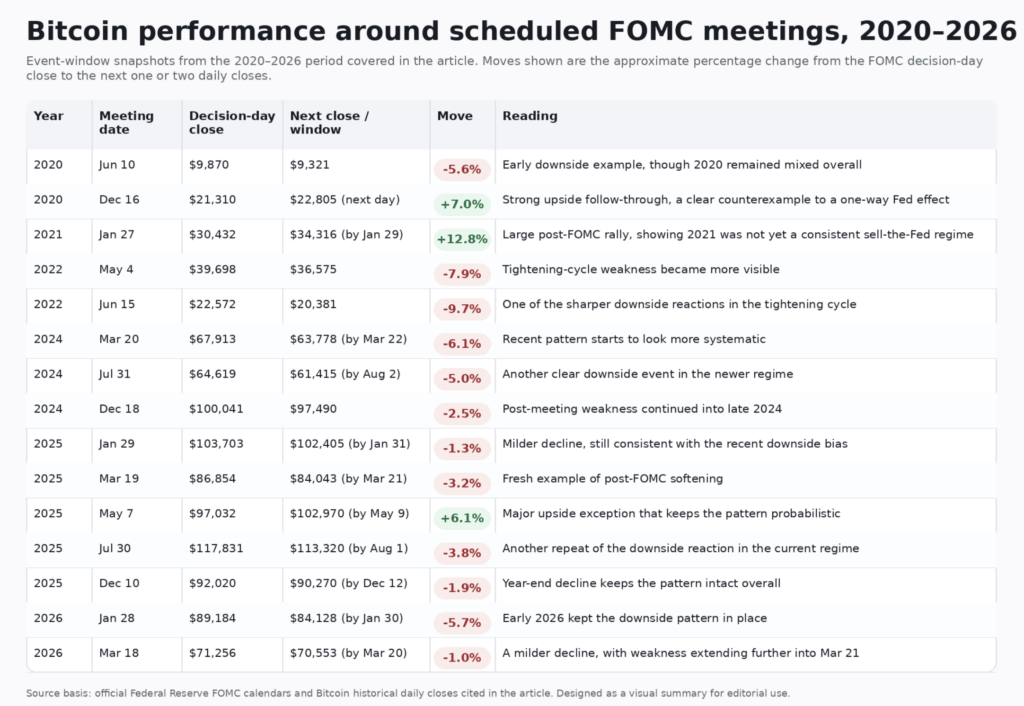 Market snapshot post Fed meetings
This evolution indicates a great deal about Bitcoin’s current position within the global asset landscape. Bitcoin now trades within the same calendar influences that affect equities, interest rates, foreign exchange, and overall risk sentiment. The Fed meeting itself has become an integral part of the pricing rhythm.
 Related Reading
Federal Reserve to abandon ‘boring' FOMC language, ending dovish vs hawkish analysis?
We are about to observe the effects of the Federal Reserve replacing traditional conservatism with populist messaging reminiscent of the Trump era.
Feb 1, 2026 · Liam 'Akiba' Wright
The history of Bitcoin performance after Fed meetings
Beginning in 2020, the situation appears loose, erratic, and heavily reliant on the surrounding macro environment. Scheduled FOMC meetings did not yield a consistent, repeatable downside reaction in Bitcoin.
On June 10, 2020, there was a sharp decline into the subsequent session, with BTC dropping from $9,870 to $9,321.
A trader observing that movement could easily formulate a bearish Fed thesis. However, the remainder of the year complicates that perspective. July 29 concluded roughly flat to up. November 5 remained near highs. December 16 opened the door for a strong continuation upward, with Bitcoin rising from $21,310 to $22,805 the following day and then to $23,137 the day after.
This serves as an early indication of what the extensive sample reveals. In Bitcoin’s earlier macro phase, Fed meetings acted as one catalyst among many.
Liquidity conditions, pandemic-era policy responses, narrative momentum, and overall speculative appetite all vied for control over price movements. The FOMC calendar exerted influence, but it had not yet established the rhythm of post-event positioning.
As we moved into 2021, the same inconsistencies persisted. January 27 was followed by a sharp rally, with BTC surging from $30,432 to $34,316 by January 29. July 28 also saw an increase toward the end of the month.
Other meetings leaned in the opposite direction. March 17, April 28, June 16, November 3, and December 15 all softened in the following one or two sessions.
The outcome was a mixed year where Bitcoin clearly acknowledged the Fed as a macro event, yet the reaction still lacked the persistent directional bias that traders seek for a calendar-based advantage.
This distinction maintains the historical context accurately. Bitcoin has been sensitive to macro factors for years.
 Related Reading
Bitcoin wipes $243 million longs as geopolitical shock reveals traders now price war risk before oil and Fed react
Bitcoin now responds more swiftly than traditional hedges, reflecting risk shifts across liquidity, flows, and macro stress in real time.
Mar 24, 2026 · Liam 'Akiba' Wright
A systematic sell-the-Fed tendency emerged later
By 2022, the landscape had shifted. The Fed entered an aggressive tightening cycle, inflation dominated the macro discourse, and risk assets across the board became increasingly susceptible to policy shocks.
Bitcoin mirrored that change. May 4 and June 15 resulted in notable declines. BTC fell from $39,698 to $36,575 after the May meeting. It decreased from $22,572 to $20,381 after June. These were significant reactions, particularly given the context of a market already under pressure from tighter liquidity and diminished risk appetite.
Even then, the pattern resisted any claim of total consistency. January 26 and July 27 both produced upside follow-through.
In 2022, Bitcoin behaved like an asset highly exposed to tightening conditions, while still capable of rallying around Fed events when positioning, expectations, and sentiment aligned favorably.
The broader takeaway from 2022 points toward the direction of travel. FOMC days were becoming increasingly sensitive and central to short-term risk management.
Then came 2023, another year that kept the transition visible without fully solidifying it.
February 1 faded. March 22 and June 14 pushed higher. July 26 remained close to flat. November 1 faded. December 13 slipped into December 15. Once again, mixed. Once again, macro sensitivity without a fully reliable one-way reaction.
Bitcoin still had the potential to surprise in either direction following a Fed decision. The event was significant. The directional pattern remained open.
 Related Reading
Fed decision tonight will likely decide whether Bitcoin gets past $80k or fall further
Bitcoin faces a test at $80,000 as the Fed meeting and oil shock dampen hopes for rate cuts.
Mar 18, 2026 · Oluwapelumi Adejumo
The real shift appears in 2024 and extends through 2025 and into 2026
This is where the ‘sell the Fed’ phenomenon begins to resemble an emerging behavior.
March 20, 2024 was followed by one of the clearest examples. Bitcoin dropped from $67,913 to $63,778 by March 22, a decline of approximately 6.1%. J
July 31 produced another clear post-event decline, with BTC sliding from $64,619 to $61,415 by August 2, around 5.0%. June 12 also softened. December 18 moved lower from $100,041 to $97,490 the next day.
Related Posts
These reactions draw attention due to their clustering. Once a market observes repeated downside opportunities following a recurring calendar event, participants begin to anticipate the pattern.
Anticipation then alters positioning. Positioning subsequently influences the event itself. This is how a loose tendency evolves into a more robust regime feature.
Then, in 2025, the pattern advanced further.
From January 29 to January 31, it drifted lower from $103,703 to $102,405. From March 19 to March 21, it fell from $86,854 to $84,043, a decrease of roughly 3.2%.
From June 18 to June 20, it edged lower. From July 30 to August 1, it dropped from $117,831 to $113,320, around 3.8%. From September 17 to September 19, it softened. From October 29 to October 31, it slipped. From December 10 to December 12, it moved down from $92,020 to $90,270.
However, there was a significant upside exception in May 2025.
Bitcoin increased from $97,032 on May 7 to $102,970 by May 9, a gain of about 6.1%. This movement merits full inclusion because a pattern can become systematic without being universal. In markets, these are very different concepts.
In the current year, two scheduled meetings have already occurred, on January 27 to 28 and March 17 to 18, with the next meeting planned for April 28 to 29.
The January 2026 Bitcoin daily close data indicates BTC at $89,184 on January 28 and $84,128 on January 30, a decline of approximately 5.7% across the next two daily closes.
In March, BTC was at $71,256 on March 18 and $70,553 on March 20, a decrease of about 1%, with the drawdown extending to $68,734 by March 21.
Thus, the downside bias that became much clearer in 2024 and 2025 has also persisted into 2026.
The follow-through in the current year suggests that the market continues to view Fed dates as opportunities to reduce exposure and de-risk post-event.
Bitcoin did not consistently sell off after Fed meetings throughout the entire 2020 to 2026 period. During this timeframe, Bitcoin increasingly treated Fed meetings as de-risking events, with this behavior becoming much more pronounced during 2024, 2025, and early 2026.
That shift opens up a more interesting macro conversation
Bitcoin’s post-FOMC behavior now resembles that of an asset that has matured into the core risk complex.
As institutional involvement deepened and macro desks paid closer attention, Bitcoin aligned more closely with the same event framework that governs other highly liquid assets. FOMC days became known quantities on the calendar. Known quantities invite pre-positioning.
Pre-positioning encourages profit-taking, volatility compression ahead of the event, and rapid reductions in exposure once the news is released.
In this context, the direction of the Fed decision becomes just one aspect of the equation.
The date itself begins to carry significance. A highly anticipated event can exert downside pressure even when the policy outcome aligns closely with consensus.
Once a decision is priced in, the market shifts its focus toward communication, tone, risk appetite, and whether investors wish to maintain exposure through the next 24 to 48 hours.
Bitcoin’s recent behavior surrounding Fed meetings indicates that calendar risk now plays a more substantial role in that assessment.
There is also a structural reason this dynamic possesses staying power. The Federal Open Market Committee holds eight regularly scheduled meetings each year. This creates one of the clearest recurring catalysts in global markets, characterized by extensive pre-positioning, intense cross-asset attention, and a significant information burst compressed into a narrow time frame.
Bitcoin’s increasing correlation with broader risk sentiment and its integration into institutional portfolios render that event window much more consequential than it was in earlier cycles.
Related Reading
Bitcoin wipes $243 million longs as geopolitical shock reveals traders now price war risk before oil and Fed react
Bitcoin now reacts faster than traditional hedges, mapping risk shifts across liquidity, flows, and macro stress in real time.
Mar 24, 2026 · Liam 'Akiba' Wright
The broader conclusion becomes clearer here. Bitcoin’s increasing sensitivity to FOMC dates indicates its ongoing evolution into an asset class that operates within macro time.
Earlier in its existence, Bitcoin often moved to its own rhythm, driven by internal cycles, crypto-native catalysts, and bursts of narrative momentum that appeared disconnected from the economic calendar.
Today, the calendar itself has become an integral part of Bitcoin’s pricing framework.
Bitcoin's development comes with trade-offs
Greater institutional relevance brings increased exposure to the same policy expectations that influence every major risk asset.
Deeper macro integration fosters more legitimacy, enhanced capital access, and increased cross-market participation. It also creates recurring pressure points. Fed meetings now seem to be one of them.
For traders, this implies that post-FOMC weakness should be included in their strategies, particularly in a regime where recent history has demonstrated repeated downside follow-through.
For investors and analysts, the more significant takeaway lies at a higher level. Bitcoin’s reaction function increasingly mirrors that of a mature global asset, one that responds to policy cadence, liquidity expectations, and the mechanics of event-driven positioning with growing consistency.
The market has progressed beyond a phase where Bitcoin simply reacts to favorable or unfavorable Fed news in a straightforward manner. It now operates through a more complex macro lens, where the event window itself can influence behavior before the market fully processes the decision.
This signifies development, integration, and the ongoing evolution of Bitcoin’s role within the financial system.
The extensive record eliminates the temptation to overstate the pattern as a permanent historical rule. The recent record illustrates why traders increasingly acknowledge it nonetheless.
When combined, these insights lead to a strong conclusion: the sell-the-Fed dynamic has emerged as a significant feature of Bitcoin’s current market structure, and its rise reflects as much about Bitcoin’s maturation as it does about any individual Fed meeting.
The post Bitcoin traders dump coins within 48 hours of Fed meetings as new data reveals systematic FOMC weakness appeared first on CryptoSlate.
