Disclaimer: Information found on CryptoreNews is those of writers quoted. It does not represent the opinions of CryptoreNews on whether to sell, buy or hold any investments. You are advised to conduct your own research before making any investment decisions. Use provided information at your own risk.
CryptoreNews covers fintech, blockchain and Bitcoin bringing you the latest crypto news and analyses on the future of money.


Bitcoin declines following Trump’s Truth Social threat, shifting ceasefire rhetoric into renewed tensions
In the early hours, Bitcoin experienced a significant decline of 2.8% after President Donald Trump made a Truth Social post threatening to “obliterate” Iran’s power facilities if the Strait of Hormuz was not reopened within 48 hours.
The price fell from approximately $70,400 to $68,200 before partially recovering to around $69,500. By the time of reporting, Bitcoin had decreased again to about $68,700. This sequence indicates a specific trigger, reflecting a rapid repricing linked to a live geopolitical event that expanded the escalation path just as markets were beginning to anticipate a less aggressive direction.
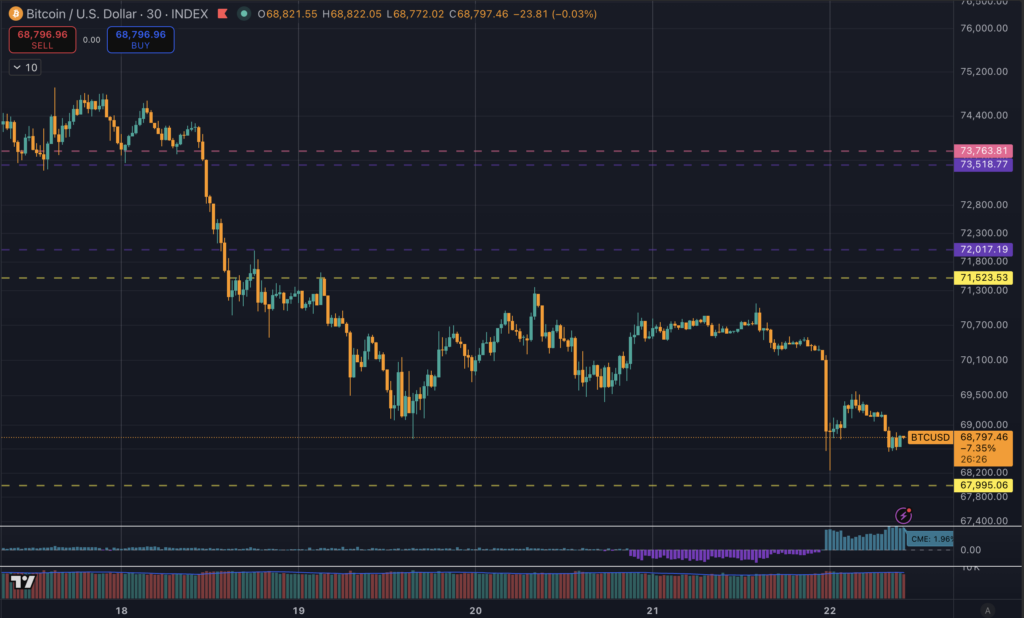 Bitcoin price decline over the weekend
The immediate inquiry is whether this movement was a fleeting air pocket or a more significant shift in market dynamics. This distinction is crucial as Bitcoin had not been behaving like a market in decline.
In the preceding two weeks, it had demonstrated a pattern of smaller pullbacks in response to major war-related events, and by last week, Bitcoin was outperforming most significant assets after an initial sell-off when the conflict began. Barron’s also highlighted that cryptocurrency had started to attract investments as a hedge against geopolitical risks associated with Iran.
This is why Trump’s post is noteworthy. It impacted a market that had already constructed a recovery narrative based on the notion that the initial panic had been absorbed.
The pertinent question is whether the post disrupted a still-valid recovery framework or reminded the market that the recovery had not yet achieved acceptance above the critical range.
The post also carries additional weight due to the context surrounding it. Less than 24 hours prior, Trump had been discussing the potential for de-escalation. While this did not equate to a ceasefire, markets had little reason to interpret it as such.
It still narrowed the perceived path of near-term escalation. The overnight shift back to a 48-hour ultimatum and a threat directed at Iranian power infrastructure abruptly reversed that signal.
The administration had floated the idea of de-escalation while simultaneously adopting tougher rhetoric and broader threats. Markets do not require a formal policy change to respond to such a reversal.
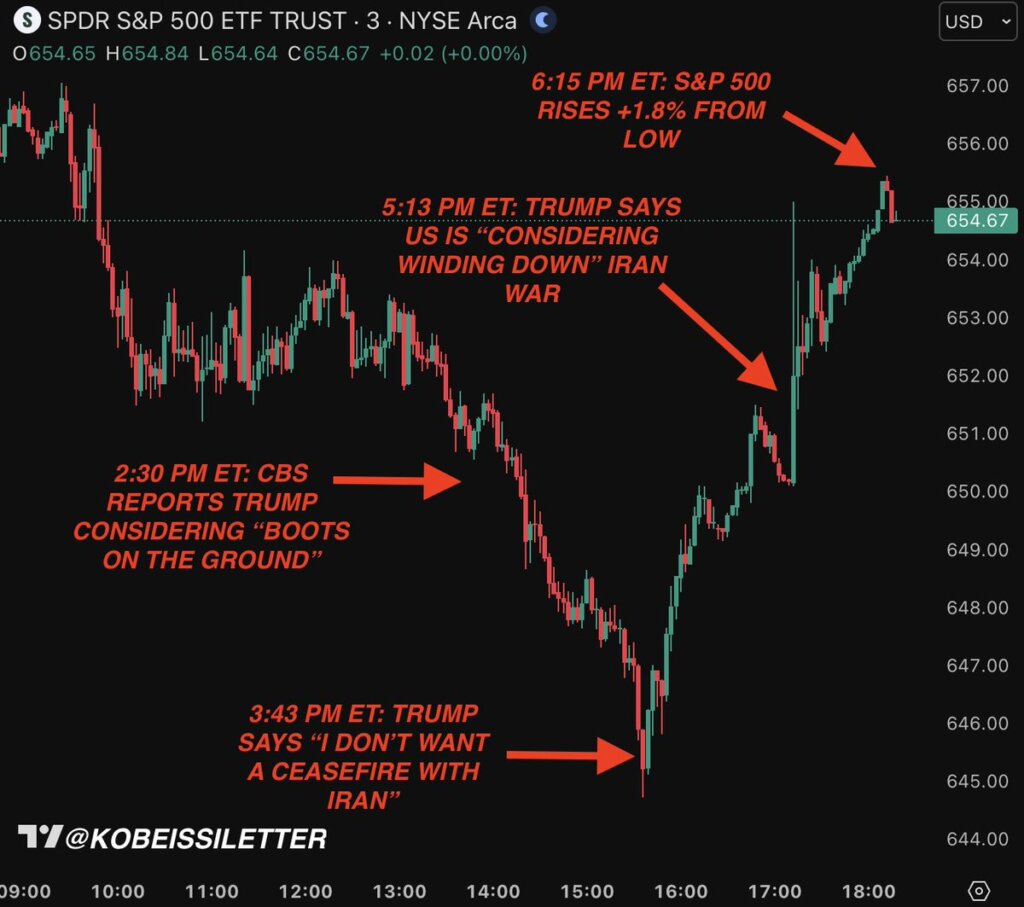 S&P reaction to Donald Trump social media posts (Source: @KobeissiLetter)
The wider context of oil and interest rates remains significant, although it is more of a background factor here. Weeks of reporting have already addressed Hormuz, crude oil, inflation sensitivity, and the ripple effects on broader risk assets. What changed overnight was the trigger.
The post introduced a more extreme rhetorical stance, targeted civilian energy infrastructure, and undermined the previous day’s softer tone. In market terms, this constituted new information. It altered the distribution of potential next moves, prompting Bitcoin to reprice that distribution immediately.
Bitcoin is particularly valuable in such moments because it trades continuously and reacts before other major markets can fully adjust. During the initial phase of the Iran conflict, Bitcoin was the first to sell off as it was the only large liquid market open when the situation escalated.
This positions it less as a settled safe-haven asset and more as a rapid transmission mechanism. The asset often prices in the shock first, then spends subsequent sessions determining whether the initial reaction was exhaustion, overreaction, or the beginning of a deeper repricing.
So what does the current structure indicate? Bitcoin had been consolidating within a broad range of $62,800 to $72,600, with repeated failures above $70,000 and a prevailing negative return skew until a decisive hold above that level is established.
Glassnode places the broader market between a Realized Price of around $54,400 and a True Market Mean near $78,400. In simple terms, Bitcoin had repaired a significant portion of the panic damage, while still falling short of a clean breakout. That limit continues to influence the interpretation of the latest movement.
Related Posts
This makes the post-trigger drop easier to analyze. A decline from $70,400 to $68,200 is significant as it pushed Bitcoin back below a level that still required acceptance. In this context, the market did not lose a confirmed breakout; it lost a test of one. This distinction is important.
A failed breakout has broader structural implications. A failed test serves as a warning, though it ranks lower on the severity scale. The data suggests this movement falls into the second category unless follow-through selling begins to impact the lower part of the range.
The second layer involves market composition. Bitcoin dominance remains near 58%, while institutional positioning has stayed concentrated in large-cap assets. It was also noted that options open interest had surpassed perpetual futures, with traders leaning more heavily on protective structures following prior deleveraging.
This helps clarify why the movement was abrupt without becoming disorderly. A more hedged market can still experience sharp declines in response to geopolitical shocks. What changes is the nature of the follow-through. The reaction becomes more targeted and less indiscriminate.
At the same time, there is little reason for complacency. The bear case is more straightforward than the bull case in this scenario.
If Trump’s post turns out to be the initial step in a new escalation sequence rather than a one-time threat, Bitcoin does not require a grand macro theory to decline. It only needs the market to conclude that the conflict path has become more challenging to assess.
This would maintain the asset’s role as a liquid shock absorber, pricing in geopolitical uncertainty before traditional markets have fully reopened or rebalanced.
The base case is more cautious. It presumes the market has already repriced the post itself while stopping short of confirming a larger structural breakdown. Within this framework, the critical threshold is not solely the intraday low.
Whether Bitcoin can regain acceptance near $70,000 after being pushed away by the Truth Social escalation is vital. If it can, the movement begins to appear as a violent but temporary rejection driven by weekend geopolitical flow.
If it cannot, focus will shift back to the lower half of Glassnode’s war range and the unresolved question of whether the recovery ever had genuine support behind it.
An upward breakout requires two conditions. First, the rhetoric must cool, or at least cease worsening. Second, Bitcoin must convert recovery into acceptance rather than merely making another brief visit to the upper band. This is where the earlier resilience narrative comes back into focus.
Before this post, the market had started to view Bitcoin less as a purely speculative beta trade and more as an asset capable of stabilizing after the initial geopolitical shock. This perception has been impacted by the latest movement, though it has not been entirely erased.
The broader takeaway is clear. Trump’s Truth Social post served as the active market trigger. It compelled a market that had begun to normalize the conflict to price in a new escalation path, immediately and significantly.
This is why the 2.8% drop warrants close scrutiny. The movement does not indicate Bitcoin’s weakness. It also does not resolve the debate regarding any safe-haven role.
It illustrates that sudden rhetorical shifts from the White House can still disrupt Bitcoin’s fragile recovery stance within minutes.
Bitcoin has not structurally broken, while still falling short of the criteria needed to disregard this type of geopolitical shock. The post clearly exposed that limit. The market had repaired damage but had not secured acceptance.
This leaves one critical test ahead of others: whether Bitcoin can reclaim the upper part of its range following a very public escalation shock, or whether this latest development will be remembered as the event that turned a recovery attempt back into a live credibility test.
The post Bitcoin crashes to $68,000 as US threatens to “obliterate’ all Iranian power plants appeared first on CryptoSlate.
