Disclaimer: Information found on CryptoreNews is those of writers quoted. It does not represent the opinions of CryptoreNews on whether to sell, buy or hold any investments. You are advised to conduct your own research before making any investment decisions. Use provided information at your own risk.
CryptoreNews covers fintech, blockchain and Bitcoin bringing you the latest crypto news and analyses on the future of money.

Bitcoin investors celebrate April’s record increases, but a specific date on the Federal Reserve’s calendar could reverse this upward trend at any moment.

The price of Bitcoin commenced April above $68,000 following a late-March relief rally linked to optimism regarding a potential de-escalation of the Iran conflict.
As per data from CryptoSlate, the leading digital currency increased by over 3% in the past 24 hours, reaching a peak of $69,170 before pulling back to approximately $68,456 at the time of reporting, as investors assessed whether this uptick signified the beginning of a more sustainable recovery or merely a temporary reprieve from a challenging first quarter.
This recovery came in the wake of a swift change in overall market sentiment. Reuters indicated that oil prices experienced significant fluctuations after reports emerged that Iranian President Masoud Pezeshkian was willing to conclude the war if Tehran received certain assurances, while US President Donald Trump suggested that the US could conclude the conflict within weeks.
Market analysts observed that the relief surrounding this possibility contributed to the rise of risk assets, including cryptocurrencies, even as traders continued to factor in high energy prices and ongoing geopolitical uncertainties.
Let’s examine the elements that could notably impact Bitcoin’s price movements in this new month.
 Related Reading
Bitcoin, stocks rally because of chatter that Iran is ready to ‘end the war’ as Dollar Index sinks below 100
The rebound of Bitcoin above $68,000 is contingent on hopes for peace in the Middle East amid volatile oil prices.
Mar 31, 2026 · Oluwapelumi Adejumo
Oil, inflation, and the Fed now play a central role in April trading
The mixed signals from the Middle East suggest that the macroeconomic environment will continue to exert significant influence this month.
Binance Research indicated that signals of a US-Iran ceasefire could prolong the recent recovery in cryptocurrencies, with assets like Ethereum likely to perform better if risk appetite continues to improve.
Nonetheless, the firm cautioned that vigilance is still required, as Iranian officials have characterized the communications as exchanges of messages rather than formal negotiations. The firm noted that Israel’s war objectives remain more stringent than those of Washington, and threats from the Islamic Revolutionary Guard Corps against major US corporations persist as a potential risk.
This perspective is crucial to acknowledge, given that the Iran conflict has led to the most significant rise in oil price forecasts, with analysts now predicting Brent crude to average $82.85 per barrel in 2026, an increase from $63.85 in February.
Importantly, both Brent and US crude have surged approximately 60% since the onset of the conflict, a development that has directly contributed to inflation concerns and adjustments in rates across global markets.
This situation presents a more demanding macroeconomic calendar than usual for Bitcoin traders in April. The Bureau of Labor Statistics has scheduled the March employment report for April 3, while the Federal Reserve’s April agenda includes minutes from the March 17-18 FOMC meeting on April 8, the Beige Book on April 15, and the next Fed meeting on April 28-29.
Any indication that rising energy prices are influencing inflation expectations, or that the Fed is becoming less inclined to ease, would complicate the narrative for a crypto rebound.
Bitcoin enters April with optimism and protective measures
In this context, cryptocurrency traders are entering the new month with optimism that Bitcoin’s historical performance in April will offer some relief.
 Related Reading
Bitcoin sets $88k ceiling for 2026: After a start this bad BTC has never finished a year positive
Historically, Bitcoin’s worst opening stretches set a ceiling of $88k for this year, with no precedent for recovery into a full-year gain.
Mar 27, 2026 · Liam ‘Akiba’ Wright
Related Posts
Data from CoinGlass indicates that April has frequently been one of Bitcoin’s stronger months, with an average return of 33.4% and a median gain of 7.57%.
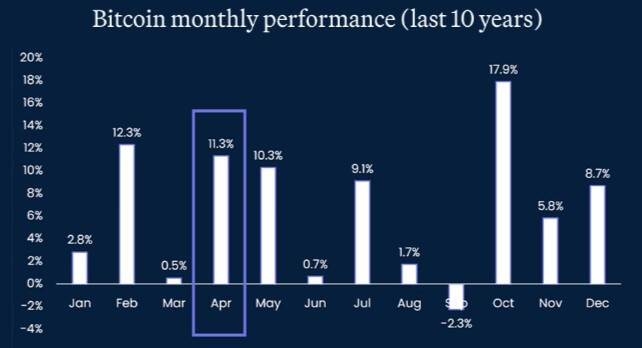 Bitcoin Monthly Performance in The Last 10 Years (Source: BIT Official)
However, BIT, previously known as Matrixport, pointed out that these trends have become less dependable in recent years, particularly when the asset begins the month with weak momentum.
The firm noted that BTC’s Relative Strength Index (RSI) at around 47% places the digital asset closer to last year’s starting point than to the overbought conditions that preceded sharper corrections in previous cycles.
In practical terms, the firm anticipates increased volatility compared to March’s range-bound trading as investors evaluate whether the recent selloff is stabilizing or expanding into a broader reversal.
Traders’ positioning in the options market supports this perspective. CME Group reported that March bitcoin options open interest showed approximately $660 million in calls against $240 million in puts, reflecting a nearly three-to-one ratio that indicated demand for a recovery by the end of the first quarter.
However, longer-term positioning appears more cautious, with the June expiry showing greater put open interest than calls.
This outlook aligns with Bitcoin’s trading behavior throughout the first quarter. The market has demonstrated sufficient buying interest to reclaim significant round numbers following sharp declines, but not enough follow-through to swiftly restore confidence.
ETF and institutional flows have weakened
This lack of conviction is evident in the institutional demand for the leading digital asset.
CoinShares reported that digital-asset investment products experienced their first outflows in five weeks during the week ending March 30, with $414 million exiting the sector. Bitcoin products accounted for $194 million of this total, although they still maintained a positive year-to-date net inflow of $964 million.
CoinShares attributed the reversal to a prolonged Iran conflict, heightened inflation risks, and a shift in market expectations towards the likelihood of rate hikes rather than cuts by June.
Data from Glassnode corroborates this trend. The analytics firm noted that the seven-day moving average of US spot ETF net flows turned negative early last week, with daily net outflows ranging from 200 to 500 Bitcoin.
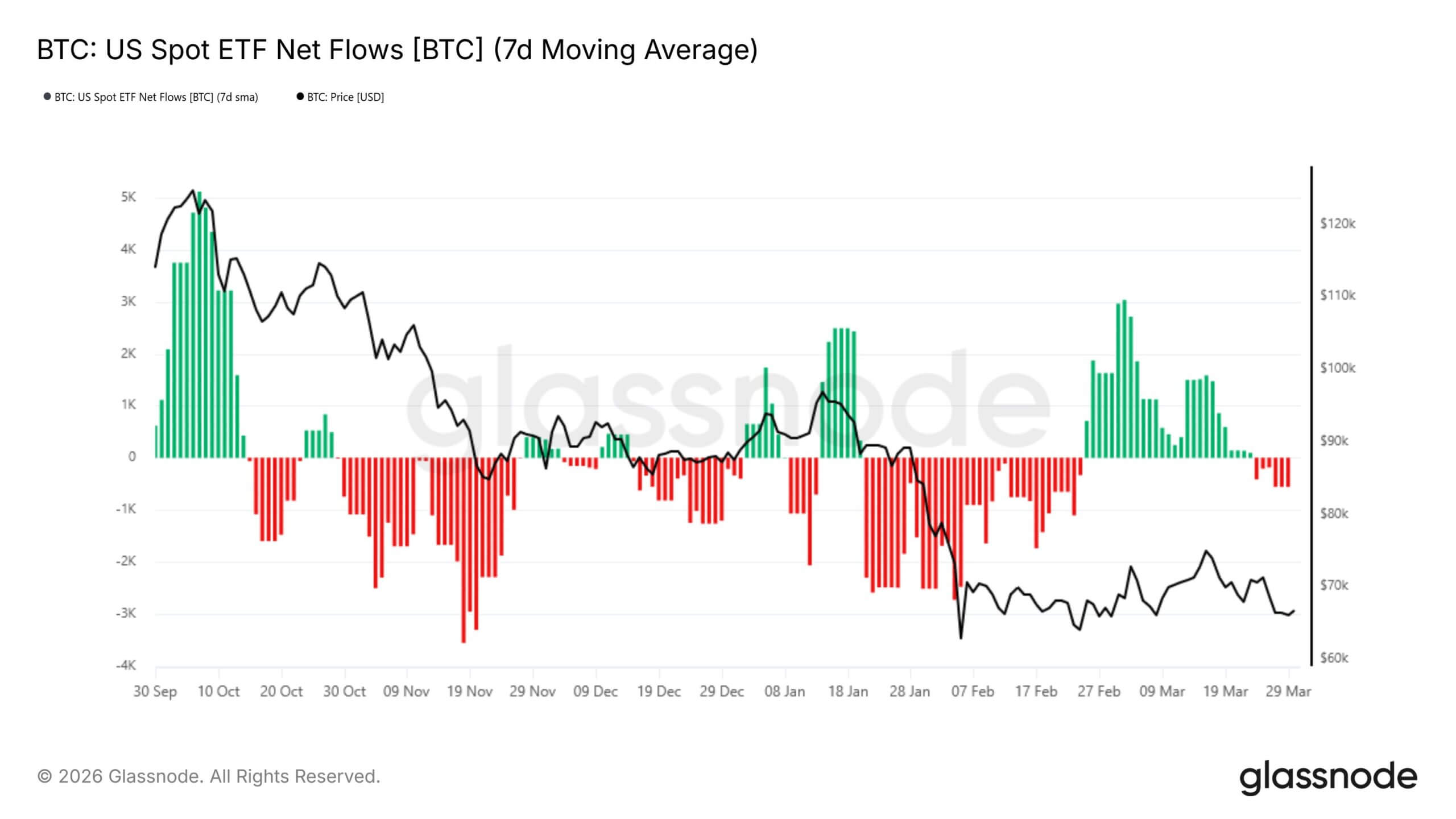 Bitcoin ETF Demand (Source: Glassnode)
While these figures are modest compared to the largest inflow weeks observed since the launch of spot ETFs, they indicate that institutional demand is no longer serving as a reliable stabilizer at current price levels.
Simultaneously, corporate treasury purchases have also significantly slowed outside of Strategy, formerly MicroStrategy, leaving Bitcoin without the same level of institutional backing that previously supported earlier recoveries.
With ETF flows diminishing and treasury demand contracting, the market enters April with reduced protection against another wave of macroeconomic stress.
What is the outlook for Bitcoin price in April?
Considering all these factors, Bitcoin enters April with some support, yet without a definitive signal of a clear recovery.
Rachael Lucas, an analyst at BTC Markets, indicated that $66,000 remains a crucial level to monitor this month. She noted that maintaining this level would bolster a consolidation argument following a volatile quarter, while a drop below would expose Bitcoin to further declines.
Meanwhile, crypto market maker Wintermute suggested that credible diplomatic advancements and oil prices retreating towards $100 could leave the short side vulnerable to a squeeze towards $70,000 to $74,000, after which resistance near $74,000 could become significant if de-escalation persists.
Conversely, a new escalation, coupled with oil prices approaching $120, would reopen the possibility of a decline towards the low $60,000s, with the high-to-mid $50,000s also back on the table if historical patterns hold.
Recent research from CryptoSlate indicates that while April seasonality may provide a slight advantage, it does not serve as a definitive signal. Historically strong monthly returns contrast with the broader trend that years beginning with similarly weak Q1 conditions have rarely concluded positively, placing the emphasis on macroeconomic factors and flows rather than calendar effects.
The post Bitcoin traders cheer April’s historic gains, yet one Fed calendar date could flip this rally overnight appeared first on CryptoSlate.
