Disclaimer: Information found on CryptoreNews is those of writers quoted. It does not represent the opinions of CryptoreNews on whether to sell, buy or hold any investments. You are advised to conduct your own research before making any investment decisions. Use provided information at your own risk.
CryptoreNews covers fintech, blockchain and Bitcoin bringing you the latest crypto news and analyses on the future of money.

Bitcoin fails to generate the same enthusiasm among the general public as it did in 2017, despite gaining acceptance on Wall Street.

Bitcoin has yet to regain the public interest seen in 2017
Bitcoin currently enjoys greater institutional access than ever before. The introduction of spot ETFs has created a regulated pathway for capital that has remained on the sidelines for years. Corporate treasury investments have further integrated the asset into boardroom discussions. The use of reserve terminology has entered political and market dialogues with notable intensity.
As a result, prices have risen in response to this shift. Visibility within the financial sector has increased accordingly. However, public search activity indicates a different trend.
 Related Reading
Bitcoin interest reaches a 5-year peak in the United States despite bear market price drops
Bitcoin searches are on the rise — but a critical $60k support level determines everything.
Feb 23, 2026 · Liam 'Akiba' Wright
Google Trends data for global web searches indicates that interest in “bitcoin” remains significantly lower than the peak observed in late 2017, despite years of ETF introductions, treasury accumulation, and adoption discussions.
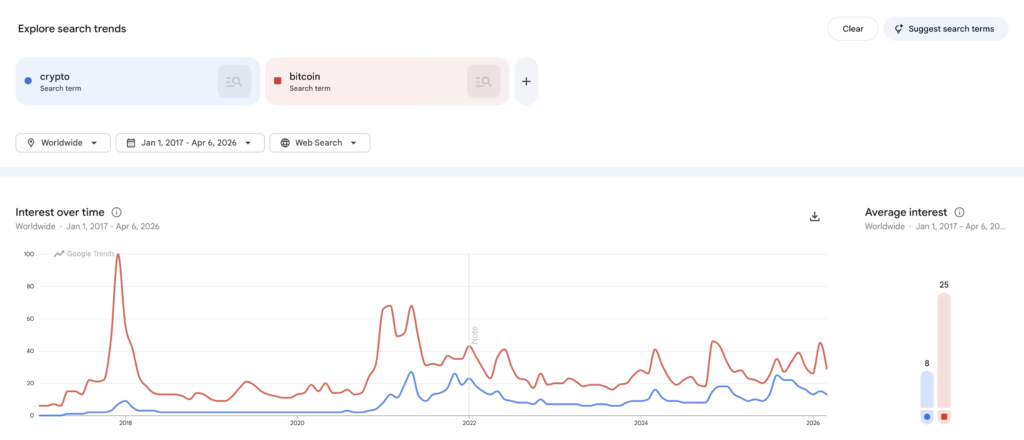 Google Trends chart comparing global search interest for Bitcoin and crypto since 2017, showing lower public engagement despite recent institutional adoption
This disparity represents a key tension. While Bitcoin has expanded into institutional channels, general public interest remains muted compared to the previous retail frenzy.
Why this matters: The recent strength of Bitcoin is increasingly driven by ETFs, treasury holdings, and professional market infrastructure rather than the mass public enthusiasm that characterized earlier cycle peaks. This alters the interpretation of the current rally, the entities propelling it, and what remains necessary for claims of widespread adoption to be deemed complete.
The 2017 cycle was marked by a widespread social pull. Search traffic surged, and first-time buyers flooded exchanges.
The asset transitioned from a niche financial subculture to mainstream conversation. The current cycle boasts stronger infrastructure, increased liquidity, and more formal ownership options.
Public intensity, as indicated by Google Trends, reflects earlier speculative waves, which still remain significantly below the 2017 peak.
The outcome is a market that appears more mature in structure yet narrower in public engagement. This divide has been evident for several months.
In May 2025, CryptoSlate reported Bitcoin closing above $106,000 without a retail surge.
Shortly thereafter, CryptoSlate highlighted that retail remained on the sidelines even as Bitcoin reached new highs, using app-download trends and search behavior to demonstrate that the cycle’s participation base differed from previous peaks.
Bitcoin’s institutional ownership is more substantial. Its regulatory framework is more robust. Its financial integration is broader.
However, regarding whether Bitcoin has regained the same level of mass public interest as in 2017, global search data still suggests the answer is no.
Search behavior continues to frame 2017 as the standard for widespread public interest
Google Trends methodology assesses relative search interest, not absolute search volume or a direct count of how many individuals are interested in a topic.
The data is sampled, normalized, and scaled from 0 to 100 within a specified location and time frame. This means the series captures comparative intensity.
It indicates when a term dominates search behavior within the defined frame. It does not provide exact search counts.
Despite this limitation, the chart remains impactful. In a global comparison from 2017 through early April 2026, “bitcoin” reached its defining peak in late 2017.
Subsequent spikes in 2021 and later periods do not reach the same heights. Recent recoveries have raised interest above local lows, yet none approach the peak intensity of that earlier retail phase.
For those attempting to gauge public engagement rather than institutional product growth, this gap carries significant analytical implications.
This significance increases when combined with CryptoSlate’s recent analysis. In February 2025, CryptoSlate monitored the recovery of retail demand following a January low, using smaller transactions as a proxy for non-institutional participation.
This illustrated a market where retail had not vanished, yet had also not returned with the vigor that characterized prior peaks.
In May 2025, the picture became clearer, revealing record price behavior without a corresponding increase in broad retail interest.
The trend persisted later in the cycle. In December 2025, CryptoSlate described a Bitcoin market increasingly influenced by banks, custodians, ETFs, and institutional market infrastructure.
This helps clarify why prices can rise while search interest remains relatively subdued.
A larger portion of ownership and access now resides within formal channels. The asset can gain visibility through financial advisors, brokerage accounts, treasury policies, and fund mandates without generating the same surge of search activity that accompanied millions of first-time retail entrants attempting to learn how to purchase Bitcoin on an exchange.
This represents a structural shift. The previous cycle relied on public curiosity to attract capital into the market.
The current cycle can operate with a greater share of capital arriving through products and institutions that are one layer removed from retail discovery. Search behavior reflects this transformation.
It illustrates a market where legitimacy has expanded more rapidly than mass fascination.
The reserve narrative warrants closer examination for the same reason. Reserve terminology implies a stage of adoption that transcends speculative enthusiasm.
ETFs indicate mainstream financial acceptance. Both developments can coexist.
However, broad public demand remains a distinct issue. Search data suggests that public attention continues to lag behind the 2017 benchmark by a considerable margin.
This creates a disparity between how Bitcoin is marketed rhetorically and how it is engaged by the general public.
Institutional adoption has increased, while retail enthusiasm appears limited
Related Posts
The market’s center of gravity has shifted. This point is hard to contest.
Spot ETFs have normalized Bitcoin exposure for a class of investors who prefer brokerage infrastructure, regulated custody, and familiar frameworks. Treasury accumulation introduced a corporate balance-sheet aspect that was virtually nonexistent in the 2017 cycle.
Banks, custodians, and fund managers have established a professional layer around the asset that has changed who holds it, how it is traded, and where demand enters the system.
This institutionalization can support higher prices without generating a corresponding surge in public search activity.
A portfolio manager allocating through an ETF is unlikely to create the same search trail as a first-time retail buyer attempting to understand wallets, exchanges, private keys, and market cycles. A treasury desk building strategic exposure through regulated channels behaves differently from a late-cycle retail crowd pursuing momentum.
These distinctions help clarify why price and attention can diverge.
CryptoSlate’s May 2025 report on record closes without retail excitement argued that Bitcoin’s price discovery had detached from the traditional indicators of a public mania.
Retail remains on the sidelines, supported by app-download trends and muted public interest.
By December 2025, bank-led market infrastructure provided the structural explanation. The market had become more accessible for professionals and less reliant on noisy retail onboarding at the margins.
This is why the current rhetoric can outpace the evidence. ETF adoption is frequently presented as proof of widespread social acceptance.
These are separate concepts. Treasury accumulation is often framed as a sign of universal conviction.
This is also a different assertion. Political discussions surrounding reserves add another layer of symbolic legitimacy, yet symbolism does not automatically translate into public participation.
Search behavior continues to serve as a valuable reality check, as it captures whether people are actively seeking out Bitcoin in significant numbers.
At present, that check is sobering. Global public attention remains weaker than at the previous retail peak.
This does not diminish the importance of ETFs. It does not negate Bitcoin’s integration into mainstream finance.
However, it does narrow the interpretation. Institutionalization has progressed, while mass public re-engagement remains incomplete.
There is an additional nuance here. In February 2026, CryptoSlate reported that US Bitcoin search interest had reached a five-year high even as global search interest still lagged behind earlier peaks.
This divide suggests that the asset may be regaining attention in key financial markets without recreating the same global search shock seen in 2017.
Even so, the overarching point remains. Global public attention has not yet returned to its previous extremes, and the worldwide context remains the appropriate lens for any claims regarding mass curiosity.
The next milestone is a broader public resurgence, not a louder institutional narrative
Bitcoin does not require a 2017 repeat to maintain its institutional relevance. It already occupies a position within regulated portfolios.
It is already part of treasury and ETF discussions. These elements are already in motion.
Can Bitcoin transform formal legitimacy into a new phase of widespread public demand, or does this cycle continue to be characterized by professional capital operating through institutional frameworks?
This question is significant because public attention still acts as an indicator of social reach. Search interest is imperfect, yet it captures a form of intent.
Individuals search when they wish to learn, transact, compare, explain, or participate. In earlier cycles, that behavior surged as Bitcoin entered mainstream public awareness.
The current cycle has achieved substantial financial milestones without igniting the same level of curiosity. This gap is one of the clearest indicators that the market’s nature has shifted.
It also challenges one of the most prevalent assumptions in the current narrative. This assumption posits that ETFs, reserve terminology, and increasing financial integration should naturally draw retail behavior back toward previous highs.
This outcome has not yet materialized in the global search data. Public curiosity has improved from its lows.
However, it has not transitioned into a new regime. The peaks remain lower, the spikes shorter, and the overall profile more restrained than the late-2017 benchmark.
For analysts and investors, this distinction should influence how this cycle is characterized. Bitcoin has achieved deeper financial acceptance.
It has not yet regained the same level of public fascination. These are separate conditions, and the market continues to affirm the divide.
Capital can flow through ETFs. Treasuries can accumulate. Politicians can reference reserves.
Search behavior can still remain significantly below the previous mania ceiling.
This highlights the next threshold clearly. A genuine return of mass retail participation would likely manifest across multiple public-facing indicators simultaneously.
Global search interest would need to rise significantly. Demand for exchange apps would need to accelerate.
Retail-sized activity would need to strengthen on-chain and through brokerage platforms. Social curiosity would need to extend beyond finance-native circles.
Until these signals converge, the more prudent interpretation is that Bitcoin’s current strength is being driven more by structural factors than by widespread public re-engagement.
This is the central point the market continues to revolve around. Bitcoin has gained more legitimacy, more infrastructure, and more access. It still has not regained the full scale of public attention that characterized 2017.
Anyone asserting that adoption has already transitioned into a new universal phase must address this gap, as global search data continues to indicate a market whose institutional growth is genuine, yet whose mass public appeal remains incomplete.
The post Bitcoin still cannot get regular people as excited as 2017 even after winning over Wall Street appeared first on CryptoSlate.
