Disclaimer: Information found on CryptoreNews is those of writers quoted. It does not represent the opinions of CryptoreNews on whether to sell, buy or hold any investments. You are advised to conduct your own research before making any investment decisions. Use provided information at your own risk.
CryptoreNews covers fintech, blockchain and Bitcoin bringing you the latest crypto news and analyses on the future of money.

Bitcoin enters its most significant loss phase ever as 59% of its supply experiences declines.

As Bitcoin fluctuates in the low-$60,000 range, the data indicates that nearly half of its holders are experiencing losses.
According to Newhedge’s profit supply metric, 51.78% of coins are currently profitable with BTC priced around $63,275, suggesting approximately 10.35 million BTC are in profit compared to 9.64 million BTC at a loss.
However, this weekend, analyst DurdenBTC’s profit supply tracker revealed an even more severe statistic: 44.2% of coins were profitable while Bitcoin was still around $68,000, marking a 0th-percentile reading.
This figure carries significant implications. It condenses years of market behavior into a single percentage, framing the current situation as a balance-sheet issue.
Durden’s analysis connects this reading to previous capitulation benchmarks: December 2018 at $3,359 with 43% in profit; the COVID crash at $4,959 with 48%; and the FTX collapse at $15,778 with 49%.
He further states,
“BTC near $68k, more people underwater than when it traded near $3k.”
The essence of this assertion is straightforward.
A complete cycle purchased at high prices, and the unwind manifests as overhead supply. Each rally has a seller waiting to return to break-even.
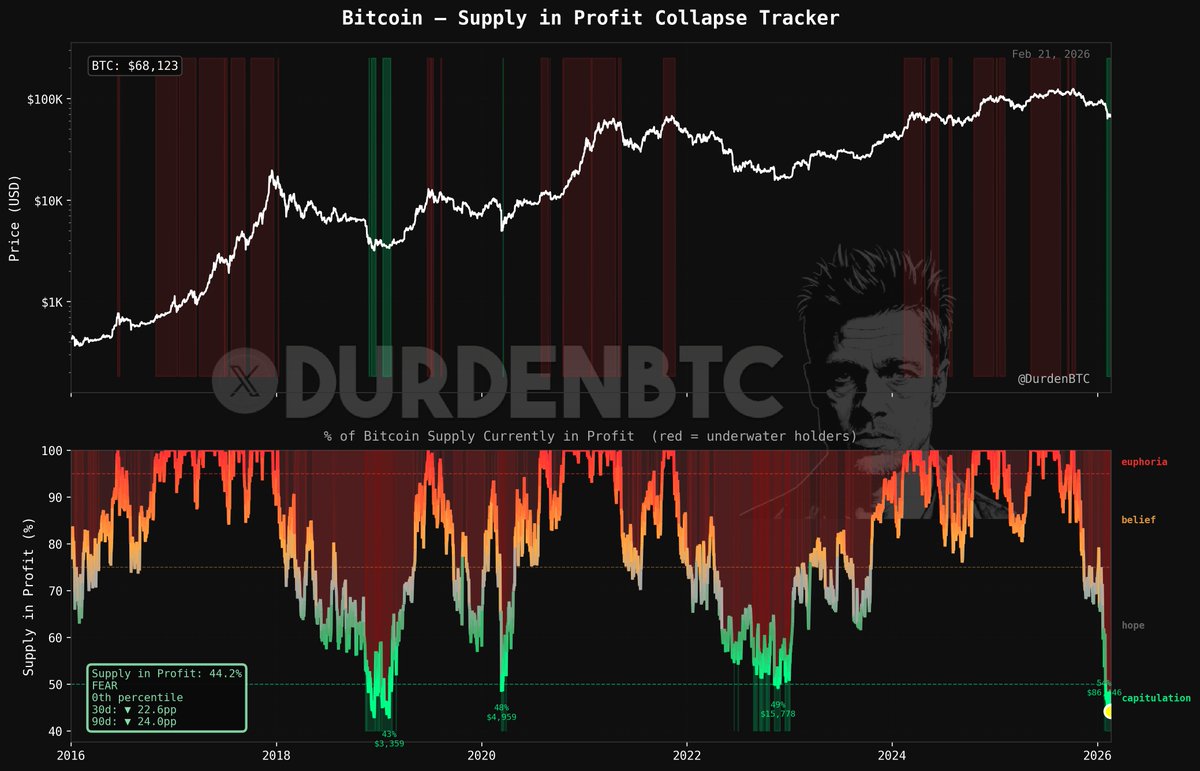 Bitcoin supply in profit (Source: DurdenBTC)
This approach indicates that this is the most challenging cycle for Bitcoin investors since before 2016, when this specific tracker commenced. DurdenBTC’s methodology aligns with that of BGeometrics, which has since dropped to 41.2%.
 Bitcoin supply in profit (Source: BGeometrics)
To clarify the differences in percentages, it is essential to understand the definitions accurately to emphasize which group we are assessing.
For instance, CryptoQuant’s dashboard for percent supply in profit currently indicates 51.6%.
 Bitcoin supply in profit (%) (Source: CryptoQuant)
This significantly different perspective highlights a division between dormant coins and those actively transacting in the market.
CryptoQuant’s framing assists in understanding how this gap can exist. It characterizes it as an “active circulating supply” cost basis that omits long-inactive coins, focusing on investors with recent transactions and current losses.
This is where the narrative shifts from paradox to a roadmap. The long tail of older coins may appear profitable on paper, while the active float still resembles a room full of buyers trapped above the current price.
DurdenBTC’s assessment is lower because, similar to BGeometrics, he effectively evaluates profitability based on the coins that actually changed hands in this cycle, linking supply to the market price at each coin’s last on-chain transaction, resulting in a score influenced by UTXOs minted at 2021–2024 cost bases that now exceed the current price.
Dashboards like CryptoQuant, in contrast, aggregate profitability across the entire live UTXO set in a value-weighted manner, allowing large, long-dormant outputs with very low cost bases to maintain a larger portion of the supply “in profit” and elevate the percentage.
In other terms: Durden’s perspective focuses on the churned float and recent transactions; the broader UTXO-sum trackers still reflect the cushioning effect of older coins that haven’t needed to “reprice” on-chain.
Why this matters for Bitcoin’s next move
Moreover, the realized price for short-term holders is approximately $91,000, while the realized price for long-term holders is around $38,000. The overall realized price is about $54,000.
 Bitcoin STH / LTH realized price (Source: CryptoQuant)
Currently, BTC is around $63,275, representing a decline of about -48.766% from the previous all-time high.
This decline is significant enough to loosen leverage, yet shallow enough to sustain the perception that “this is still expensive” within the broader public discourse.
The emotional dissonance arises from this combination: a high nominal price alongside a low profitability ratio.
This scenario often leads to quiet capitulation. It unfolds gradually, through forced sales, smaller wallets becoming inactive, and larger wallets awaiting liquidity to return.
The corridor the market keeps trading back into
Glassnode’s latest analysis slightly adjusts the corridor lower: the True Market Mean is approximately ~$79,000, and the Realized Price is around ~$54,000.
These figures serve as structural indicators for active cost basis and historical re-engagement behavior, as noted in Glassnode’s Week On-chain.
Consider it a corridor formed by receipts. The upper boundary indicates where active buyers, as a collective, regain their footing.
The lower boundary signifies where longer-term capital has typically entered when the market appears broken.
Within that corridor, Glassnode previously emphasized a dense URPD cluster from $66,900 to $70,600.
At a spot price of $63,000, that cluster appears less as a place to “settle” and more like the initial overhead shelf that a rebound must reclaim before any recovery narrative can gain traction.
More broadly, Glassnode’s recent Week On-chain outlines a dense demand zone between $60,000 and $69,000 that is absorbing sell pressure, a broader cluster that is now significant because it is the range the market is currently relying on.
This is crucial for a profitability-collapse narrative because the primary task of any rebound is mechanical.
The price must navigate through dense cost-basis zones, and it must do so with sufficient volume to absorb sellers rather than rewarding them for waiting.
The ledger already indicates stress as a cash-flow reality. Glassnode reports realized losses with a seven-day SMA exceeding approximately $1.26 billion per day, with spikes above $2.4 billion per day during sharp sell-offs.
This is what capitulation resembles when measured in transactions rather than sentiment.
Simultaneously, front-end implied volatility has adjusted to around 70%, and downside skew has steepened.
Together, this suggests a market that is paying for near-term protection and treating discontinuity as a standard operating condition.
This volatility level provides a clear framework to discuss range using a simple implied cone.
BTC around $63,300 with 70% annualized IV corresponds to roughly ±9.7% over one week (approximately $57,100 to $69,400) and roughly ±20.1% over one month (approximately $50,600 to $76,000).
This indicates potential turbulence and serves as a reminder that the market’s mechanisms continue to operate swiftly even when the narrative slows.
Related Posts
Flows, overhead supply, and the bid that flickers
Profitability declines become significant when they intersect with flow regimes, and recent weeks appear to reflect a regime that has lost some of its consistent demand.
Glassnode notes a softening in allocator demand and structurally weak spot volume, which transforms relief rallies into corrective movements that struggle to evolve into trend changes.
The ETF narrative helps contextualize this shift in daily increments.
Since the all-time high in October, billions have exited ETFs in outflows, with coins departing on the majority of trading days this year, interspersed with occasional inflows.
 Bitcoin ETF flows (Source: Farside Investors)
Stablecoins provide a second flow perspective as they act as the market’s wrapper, maintaining value on-chain while investors decide when to take exposure.
This month, CryptoSlate reported over $4 billion in net stablecoin withdrawals from exchanges, including approximately $3.1 billion from Binance.
This followed an earlier period in October 2025 with about $9.7 billion in average monthly net inflows.
Together, this paints a picture of capital retreating from immediate deployment and shifting to a more defensive stance.
Mining introduces a third pressure point, as miners face real-world cost curves and a treasury that can become a seller in stressed markets.
Hashrate Index estimated the USD hashprice at around $34.05 per PH per day and indicated that the forward market implies about $28.73 on average over six months.
This creates a tight operating environment that could lead to forced sales if prices drop below key demand clusters and financing remains costly.
Overhead supply is the outcome that connects these elements.
CryptoSlate’s supply guide from earlier this month identifies overhead supply between $93,000 and $110,000 and highlights a short-term holder cost basis near $98,300.
These levels can function like taped seams in the market’s plumbing, maintaining pressure until sufficient volume is traded through them to seal the leaks.
In a profitability-compression environment, these seams delineate where break-even selling occurs.
They also clarify why rallies can feel burdensome even when the headlines become more favorable.
Macro context, the outside weather that seeps into the pipes
Cryptocurrency operates within the global risk budget, and recent macro stress has manifested in the usual cross-market indicators.
A U.S. tariff legal headline coincided with a movement characterized as USD down, gold up, and Bitcoin down.
This aligns with the pattern of liquidity sensitivity during stress events.
Regarding interest rates, the Bank of England maintained a rate of 3.75% with a 5–4 split and indicated that the Bank Rate is “likely to be reduced further” depending on inflation.
This reflects an easing bias amid ongoing uncertainty.
U.S. rate expectations are similarly positioned.
BlackRock’s iShares outlook noted a shift in the anticipated 2026 trajectory from 3.50–3.75% toward approximately 3% and highlighted leadership uncertainty as part of that context.
Morgan Stanley Research outlined additional 25-basis-point reductions to a terminal range of 3.0–3.25%.
This was coupled with a perspective that tariffs temporarily elevate inflation and that unemployment is expected to peak around 4.7% in Q2 2026.
This macro layer is significant for the supply-in-profit narrative in a practical sense.
Easing expectations could facilitate a rebound, but the on-chain landscape still relies on crypto-native liquidity, ETF flows, stablecoin deployment, and spot demand.
These are the conduits that channel new risk appetite into the market’s actual order books.
Scenarios, framed as triggers and corridors
Glassnode outlines three scenarios that are relevant here: the $60,000–$69,000 demand zone that the market is leaning on, the $66,900 to $70,600 dense URPD shelf, and the True Market Mean near ~$79,000, with the Realized Price near ~$54,900 serving as the deeper structural floor.
A base case looks like absorption and range.
The price oscillates within the $60,000–$69,000 demand band, realized losses stabilize from their recent pace, ETF flow days approach flat, and volatility gradually decreases from elevated levels.
In this scenario, the market’s “tell” is whether it can reclaim the $66,900–$70,600 shelf and maintain it, not merely as a wick, but as a sustained level.
A downside case looks like deeper capitulation.
The price breaks below the lower end of the demand zone with momentum, liquidations accelerate, miner economics tighten leading to increased treasury selling, and the market trades down toward the Realized Price near ~$54,900.
This is the historical zone where longer-term capital has typically re-engaged and where the market often attempts to rebuild credibility following a break.
An upside case looks like a violent rebound into overhead supply.
The price reclaims the True Market Mean near ~$79,000, the market tests higher cost-basis bands, and the next significant seam lies within the $93,000 to $110,000 overhead region.
The short-term holder cost basis near $98,300 is a level where break-even selling can emerge quickly if liquidity remains inconsistent.
Across all three scenarios, the profitability collapse acts as a behavioral constraint.
Underwater holders tend to sell when they see an opportunity, meaning each rally must exert additional effort to absorb inventory from recent buyers seeking to recover their investment.
The post Bitcoin slides into worst profit cycle in history as 59% of supply turns red appeared first on CryptoSlate.
