Disclaimer: Information found on CryptoreNews is those of writers quoted. It does not represent the opinions of CryptoreNews on whether to sell, buy or hold any investments. You are advised to conduct your own research before making any investment decisions. Use provided information at your own risk.
CryptoreNews covers fintech, blockchain and Bitcoin bringing you the latest crypto news and analyses on the future of money.


Business activity in the US experienced a slowdown in March, and the latest PMI data issued a cautionary note that markets are beginning to factor in: growth is losing steam just as inflationary pressures are resurging.
This presents a challenging environment for Bitcoin trading. When the economy decelerates while inflation remains high, traders anticipate that the Federal Reserve will maintain elevated interest rates for an extended period, a scenario that typically has adverse effects on risk assets.
S&P Global’s flash composite PMI decreased to 51.4 in March, down from 51.9 in February.
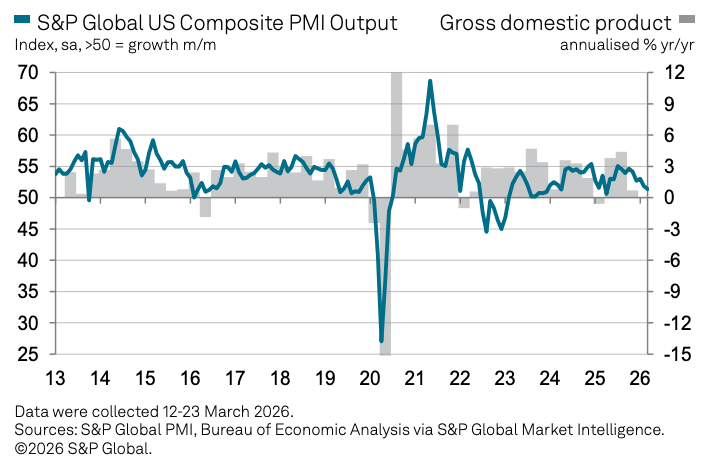 Graph illustrating the S&P Global’s flash composite PMI for March 2026 (Source: S&P Global)
Services, which constitute a significant portion of the US economy, declined to 51.1 from 51.7. Conversely, manufacturing saw an increase, rising to 52.4 from 51.6. Simultaneously, companies reported the fastest rise in input costs in ten months, while employment decreased for the first time in over a year.
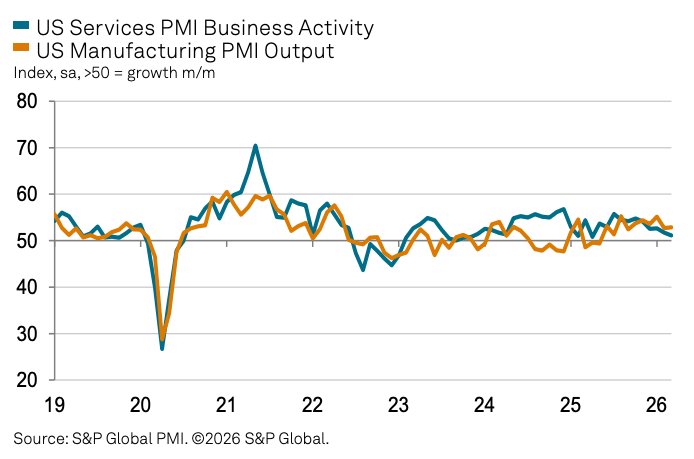 Graph depicting the S&P Global’s Services PMI business activity and manufacturing PMI output for March 2026 (Source: S&P Global)
While the headline figure indicates slower growth, the most significant takeaway from this release is much deeper and more concerning than that.
Segments of the economy linked to consumer demand are beginning to weaken, while manufacturers are advancing as companies strive to secure supplies and protect themselves from rising costs and increased energy prices due to conflict.
This divergence helps clarify why investors reacted with unease. The report indicated an economy preparing for potential disruptions.
Bitcoin experienced a slight decline following the release, falling below $70,000 as traders processed the information.
The broader market response was nearly identical. Oil prices remained high, Treasury yields increased, and the DXY stayed relatively stable as investors adjusted to the possibility of persistent inflation even as growth decelerates. The absence of a significant market reaction does not imply that this is now a favorable environment for Bitcoin.
A cautionary note within the PMI report
Related Posts
The most critical insight from the report is the expanding gap between manufacturing and services.
In theory, stronger factory activity appears positive. However, in this context, it signals strain, as it indicates that companies increased purchases and built inventories in an effort to get ahead of supply issues and rising costs. Supplier delivery times also lengthened, reinforcing the notion that businesses were responding to stress rather than a new surge in demand.
In contrast, services presented a weaker outlook. New business growth slowed, exports declined, and confidence among service providers diminished. Companies cited higher living expenses, elevated borrowing costs, and uncertainty related to conflict as factors impacting activity.
S&P Global noted that the survey aligned with the US economy growing at approximately a 1% annualized rate in March, while price trends in the report indicated that inflation could be trending back toward 4%. This combination brings stagflation concerns back into focus: weaker growth coupled with rising inflation.
And this will influence crypto.
Historically, Bitcoin has thrived when traders anticipated looser monetary policy and improved liquidity conditions.
However, this report suggests otherwise. It indicated that the Fed may have less capacity to lower rates than many investors had hoped, as inflationary pressures are not subsiding quickly enough even as the economy begins to slow.
The report also emerged at a particularly tense time for global markets. Energy prices have surged due to the conflict in Iran, making the inflation aspect of the equation harder to overlook. When oil prices rise, and companies begin to warn about increased costs and supply delays, markets become more sensitive to any indication that the Fed could maintain a restrictive stance, regardless of how minor or vague it may be.
This situation places Bitcoin in a more challenging macroeconomic environment. Whether one agrees or not, it is still viewed by most as a high-risk asset, which means it may struggle when yields rise and the dollar strengthens.
Some crypto proponents still contend that Bitcoin could ultimately benefit if confidence in the broader policy framework begins to wane, but Tuesday’s PMI data provided little support for that argument. The immediate implication was that markets remain focused on rates staying elevated for an extended period.
The next assessment will come from the forthcoming inflation and labor data. If those reports corroborate what the PMI is beginning to indicate—that the economy is cooling while inflationary pressures persist—Bitcoin may continue to face downward pressure from a macro backdrop that is impossible to overlook.
The post Bitcoin faces a new threat after US PMI reignites stagflation fears appeared first on CryptoSlate.
