Disclaimer: Information found on CryptoreNews is those of writers quoted. It does not represent the opinions of CryptoreNews on whether to sell, buy or hold any investments. You are advised to conduct your own research before making any investment decisions. Use provided information at your own risk.
CryptoreNews covers fintech, blockchain and Bitcoin bringing you the latest crypto news and analyses on the future of money.

Bitcoin declines towards $65k as Trump’s Iran postponement causes oil prices to rise, resulting in a $200M loss.

Bitcoin retreated toward $65,000 on Friday as investors reduced their exposure to risk assets following another escalation of tensions in the Middle East, which kept oil prices high, pushed Treasury yields to their highest levels in months, and strengthened the dollar.
As per data from CryptoSlate, BTC dropped nearly 5% to approximately $66,484, marking its lowest price since the start of the month. This continues a pattern where the leading cryptocurrency consistently struggles to maintain its value when macroeconomic pressures resurface.
An analyst at Bitunix shared with CryptoSlate:
“BTC has completely transitioned into a reflection of liquidity structure. Price movements remain restricted within a broad range of $65,000–$72,000, with volume distribution indicating clear supply above $70,000, while the $65,000 area continues to gather passive demand.”
Data from CoinGlass indicated that the price movement resulted in nearly $200 million being wiped from crypto traders within the last hour, with long traders incurring the majority of the losses.
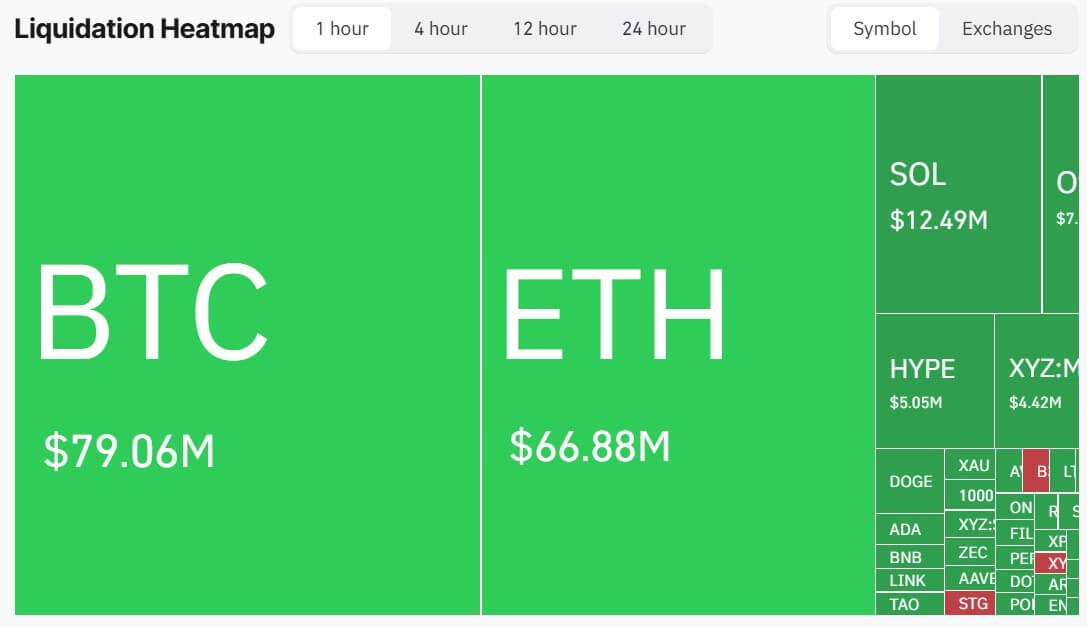 Crypto Market Liquidation in The Last 1 Hour on March 27 (Source: CoinGlass)
What is causing the decline in Bitcoin price?
The current decline in BTC is not attributed to a crypto-specific shock. Instead, it can be associated with geopolitical tensions that have unsettled the global market.
 Related Reading
Bitcoin price just collapsed because the macro selloff collided with a $14 billion options expiry this morning
Approximately $14.1 billion in Bitcoin options and $2.2 billion in Ethereum options expired on Friday, Mar. 27. Historical trends indicate increased volatility around expiry dates.
Mar 27, 2026 · Gino Matos
In a post on Truth Social, President Donald Trump announced that he was delaying plans to target Iran’s energy facilities by another 10 days, extending the deadline to April 6 as discussions continued. This marked the second significant pause he had implemented amid the ongoing conflict with Iran.
The new announcement unsettled global markets, with Brent crude approaching $110 a barrel, the US 10-year Treasury yield rising to 4.456%, its highest since July, and the Nasdaq remaining in correction territory after a decline of 11% from its recent peak.
Simultaneously, the dollar was on track for its strongest month since July 2025 as investors sought safety and markets adjusted to tighter financial conditions.
In this context, market analysts noted that Bitcoin’s drop indicated that the leading digital asset was still behaving more like a high-beta risk asset rather than a hedge against geopolitical stress.
When oil prices surge, investors perceive not only a war narrative but also the potential for higher inflation, fewer rate cuts, and a more challenging environment for highly valued assets. In such scenarios, Bitcoin may decline alongside technology stocks rather than rise with gold or other defensive investments.
 Related Reading
Market swings by $3 trillion as Bitcoin price explodes upward in 5 minutes
Bitcoin surpassed $70k because a Trump Iran headline triggered broader market panic, not due to a sudden bullish sentiment in crypto.
Mar 23, 2026 · Liam 'Akiba' Wright
Oil and yields reset the macro backdrop
The most effective way to understand the current market movement is to examine the changes in oil and interest rates following Trump’s announcement. The pause on military actions altered the immediate timeline of the conflict, but it did not convince markets that the inflation threat had diminished enough to relieve pressure on risk assets.
Data from Oilprices.org reveals that oil benchmarks remain significantly higher since the onset of the conflict, with Brent increasing by 52% and US crude by 43% since the war began.
These substantial gains have been sufficient to sustain inflation concerns even during periods when diplomatic efforts seem to progress.
This is the primary transmission channel for Bitcoin. Rising oil prices not only indicate geopolitical risks but also reflect worries that inflation will persist, compelling central banks to maintain tighter policies for an extended period.
For context, a Reuters poll conducted on March 26 found that most economists still anticipate the Federal Reserve to keep rates steady until at least September, yet financial markets have shifted significantly, moving from expectations of cuts to discussions about the possibility of another rate hike later this year.
Related Posts
On Friday, Reuters reported that markets were pricing in a 70% likelihood that the Fed would raise rates in 2026. For Bitcoin, this presents a challenging combination: high energy costs, increased real-world borrowing rates, and a market increasingly focused on persistent inflation rather than new liquidity.
The dollar’s robust performance this month has further contributed to that pressure.
Data from TradingView indicates that the dollar index was on track for a 2.4% monthly increase, its best performance since July, as investors sought safe-haven assets and adjusted the US rate outlook. A stronger dollar typically tightens global financial conditions independently and makes speculative trades less appealing.
Bitcoin, which had already been losing momentum in recent weeks, was vulnerable to this shift as the broader market began to reduce risk.
ETF support has turned less reliable
Meanwhile, BTC’s movement toward $65,000 also highlighted that the post-ETF market still requires consistent institutional inflows to absorb selling pressure.
The US spot Bitcoin ETF sector did not completely lose its demand this month, but the flow pattern became inconsistent just as macro conditions deteriorated.
Data from SoSoValue indicates that the funds, after experiencing strong inflows of around $2 billion during the early part of this month, have encountered a notable slowdown.
 US Bitcoin ETFs Daily Inflow in March (Source: SoSoValue)
For context, US-listed investment vehicles have recorded net outflows exceeding $70 million in this trading week compared to the week ending March 13, when the funds saw inflows of $767.33 million.
These figures illustrate a market where institutional demand is no longer arriving in a consistent manner.
This is because strong ETF inflows can provide support to crypto when macro headlines worsen, but inconsistent inflows leave Bitcoin more susceptible to the same fluctuations in yields, equities, and the dollar that are impacting the broader risk complex.
A large options expiry sharpened the move
Friday’s selloff coincided with one of the largest derivatives events of the year.
Data from Greeks.live indicates that around $13 billion in Bitcoin options were set to expire, with a put-call ratio of 0.56 and a maximum strike price of $74,000.
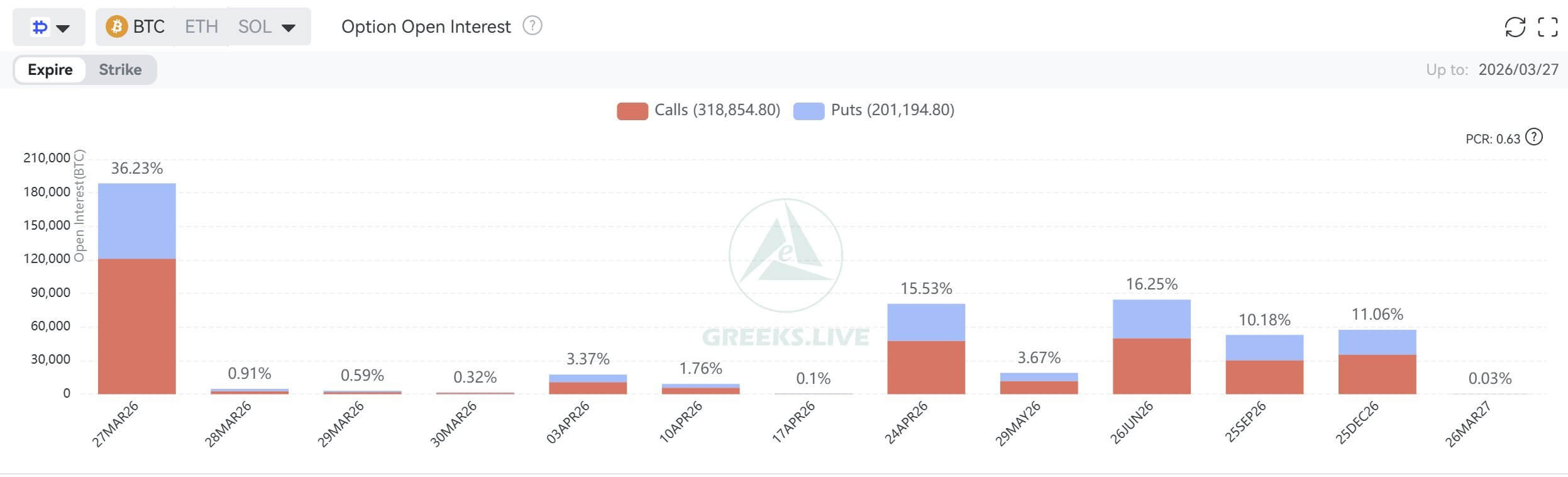 Bitcoin Options Expiry on March 27 (Source: Greeks.Live)
According to the firm:
“Despite market volatility, trading activity for Bitcoin remains relatively low. Key options data shows Bitcoin’s main-term implied volatility (IV) at 51% and Ethereum’s at 70%. As risk premium (RV) continues to decline, the volatility risk premium (VRP) has been increasing; during the first half of this week, the 15-day VRP reached nearly 20%. Bitcoin performed poorly in both price and trading activity during the first quarter of this year, and market confidence remains low.”
A Bitcoin options contract provides its holder the option to purchase BT at a predetermined price before or on a specified future date, without obligating them to complete the purchase.
This means the buyer can opt out when the contract expires if the trade no longer makes sense, or exercise the option if it does.
As expiration approaches, the crypto market may experience sharper price fluctuations as traders often adjust positions, roll contracts forward, or close trades entirely.
Thus, significant options expiries, like today’s, have frequently coincided with substantial market sell-offs, although that outcome is not guaranteed.
What the break indicates now
The movement back toward $65,000 reflects less about a decline in confidence in Bitcoin and more about the surrounding market environment. Bitcoin continues to be influenced by inflation expectations, central bank policies, oil volatility, and the strength of the dollar.
When these factors move against risk assets simultaneously, BTC does not receive preferential treatment. It is sold alongside the rest.
For the time being, this positions Bitcoin within a narrow yet significant framework. Analysts at Bitunix informed CryptoSlate:
“In the near term, if war dynamics remain ‘delayed but unresolved’ and rate expectations continue to tighten, BTC is more likely to experience high-frequency range-bound volatility, redistributing liquidity between $65,000 and $72,000 to facilitate position adjustments. A genuine directional breakout will necessitate alignment across key macro variables, rather than being triggered by any single event.”
The post Bitcoin drops toward $65k after new Trump Iran delay sends oil higher, triggering $200M wipeout appeared first on CryptoSlate.
