Disclaimer: Information found on CryptoreNews is those of writers quoted. It does not represent the opinions of CryptoreNews on whether to sell, buy or hold any investments. You are advised to conduct your own research before making any investment decisions. Use provided information at your own risk.
CryptoreNews covers fintech, blockchain and Bitcoin bringing you the latest crypto news and analyses on the future of money.

Bitcoin declines as Rubio indicates privately that the conflict with Iran could extend for weeks, maintaining elevated oil prices.

Marco Rubio met with G7 foreign ministers and privately informed them that the conflict with Iran might extend for another two to four weeks, providing Washington’s closest allies and the market with a timeline.
Reports indicated that Rubio publicly stated the operation should wrap up in “weeks, not months,” and the disparity between these two statements highlights a timeframe sufficient to maintain macroeconomic pressure where Bitcoin is currently trading.
On Mar. 27, Bitcoin hit an intraday low of $65,571.07, reflecting a decline of approximately 4.4% for the day. In contrast, Brent crude was priced at $111.52, marking a 53% increase since the conflict began on Feb. 27.
The Nasdaq has entered correction territory, the 10-year Treasury yield was at 4.44%, and Fed futures indicated virtually no chance of a rate cut this year. This combination accurately accounts for Bitcoin’s losses during the session.
| Asset / Indicator | Latest level / status | Move / context |
|---|---|---|
| Bitcoin (BTC) | $65,571.07 | Down ~4.4% on Mar. 27 |
| Brent crude | $111.52 | Up 53% since Feb. 27 |
| Nasdaq Composite | Correction territory | Risk assets under pressure |
| U.S. 10-year Treasury yield | 4.44% | Higher yields tightening financial conditions |
| Fed futures | ~0% probability of a rate cut this year | Markets pricing a rate-cut freeze |
The transmission chain
Oil prices exceeding $100 elevate freight costs across all supply chains simultaneously.
EIA data revealed that tanker rates for VLCCs traveling from the Middle East to Asia reached their highest level since at least November 2005 in March. Persistently high inflation expectations follow, as the University of Michigan consumer sentiment index dropped to 53.3, while one-year inflation expectations rose from 3.4% to 3.8%.
Fed Governor Lisa Cook stated that the conflict in Iran has shifted the risk balance toward inflation, reinforcing a rate-cut freeze that directly impacts Bitcoin.
Bitcoin has begun to behave like a high-beta liquidity asset. The IMF has noted that its correlation with equities surpasses its correlations with gold, bonds, or major currencies.
A 2024 study published in Finance Research Letters indicated that Bitcoin returns and volatility are responsive to political uncertainty shocks, especially during times of financial stress. Bitcoin is currently trading lower because an extended conflict sustains the oil shock, which in turn keeps liquidity constrained.
Rubio’s private estimate of two to four weeks transforms a series of daily military updates into a time-constrained repricing: traders are now factoring in the duration of the shock, treating each military update as a data point in a prolonged repricing cycle.
Duration is the key
Traders are currently assessing the duration of the conflict, considering each military or diplomatic update as a data point in a longer repricing cycle.
ICE reported its highest-ever crude trading and open interest through March, indicating ongoing repricing.
When President Donald Trump postponed strikes on Iranian energy infrastructure and hopes for de-escalation increased, global equity funds attracted $37.77 billion in the week ending Mar. 25. Conversely, when Iran rejected negotiations and hopes for a ceasefire diminished, equities declined once more.
The market fluctuates based on perceptions of the energy shock’s duration, and Rubio’s private timeline has shifted expectations toward a more prolonged situation.
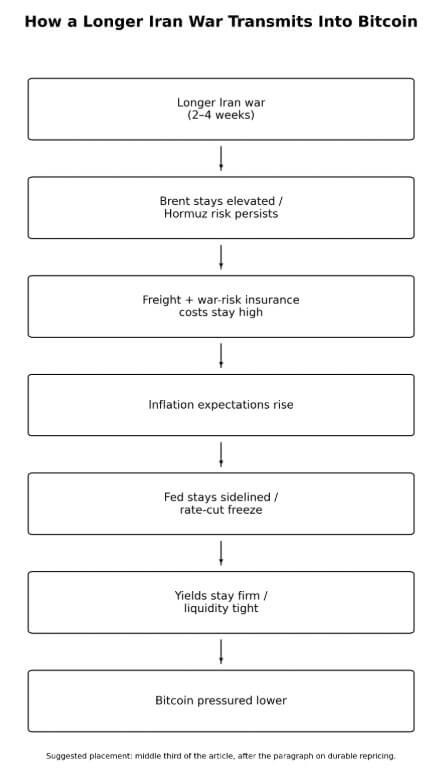 A flowchart depicting the seven-step transmission chain from an extended Iran conflict through rising oil prices, inflation, and tighter liquidity to declining Bitcoin values.
A Reuters analyst survey projected Brent prices between $100 and $190 under sustained disruption, with an average of $134.62. Simultaneously, the EIA’s March forecast anticipates Brent prices above $95 for the next two months. Bitcoin’s near-term range currently falls within this spectrum.
Flows through the Strait of Hormuz averaged around 20 million barrels per day in 2024, accounting for approximately 20% of global petroleum liquids consumption, with about 84% of that crude directed to Asia.
Related Posts
The primary macroeconomic impact is felt in the region most critical to industrial demand, emerging-market foreign exchange, and the technology supply chain.
Foreign investors withdrew approximately $25.28 billion from Taiwan, $13.5 billion from South Korea, and $10.17 billion from India this month. Bitcoin is situated within the same global growth and technology framework that is currently experiencing foreign outflows, and these movements reflect the same liquidity dynamics that are driving crypto prices lower.
The EIA notes that only about 2.6 million barrels per day of Saudi and UAE pipeline bypass capacity is readily available.
Physical navigation through Hormuz influences the macroeconomic calculations more than any diplomatic statement, which is why a ceasefire that leaves shipping compromised offers limited relief.
War risk insurance alone maintains elevated freight costs, extending the inflation pass-through even if military operations are paused.
The countdown
For the potential scenarios in the upcoming weeks, the most favorable outcome involves diplomatic efforts to bridge the gap within approximately seven to ten days.
Shipping normalization commences, Brent prices decline toward $95-$110, and the “no cuts in 2026” narrative softens as inflation expectations decrease. Goldman Sachs has suggested that a definitive conclusion to military actions would swiftly diminish the oil risk premium.
On this trajectory, Bitcoin’s exposure to macroeconomic pressures would rapidly reverse. This relief could position Bitcoin within the $69,000-$75,000 range, bolstered by the EIA’s easing post-disruption base case and by the speed at which equity funds re-entered the market when de-escalation hopes rose in late March.
The same liquidity sensitivity that prompted the selloff also drives the recovery.
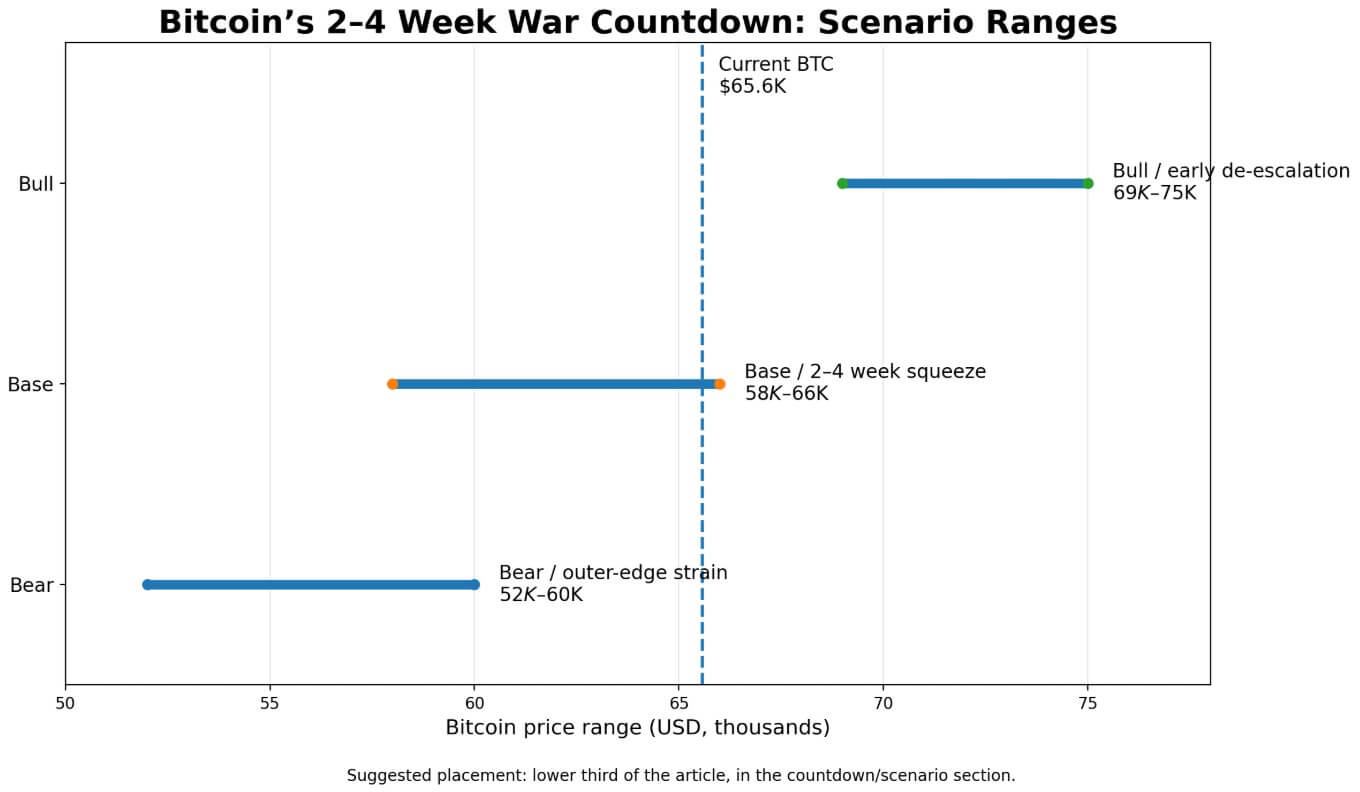 A horizontal range chart illustrating three Bitcoin price scenarios: bull ($69K–$75K), base ($58K–$66K), and bear ($52K–$60K), compared to the current price of $65.6K during the projected two-to-four week countdown of the Iran conflict.
In the worst-case scenario, the conflict extends to the outer limit of Rubio’s four-week estimate. Friction in Hormuz continues, war-risk insurance remains high, and no credible ceasefire materializes.
Brent prices stabilize in the $110–$135 range, aligning with Goldman’s expectations for March-April and the Reuters average under sustained disruption. Inflation remains elevated, the Fed remains inactive, and Bitcoin trades within a $58,000-$66,000 range as risk assets are constrained by the same liquidity ceiling that has been in place since Feb. 27.
Academic literature supports this perspective over any instinctive safe-haven narrative.
A 2025 quantile analysis paper indicated that gold, the US dollar, and oil more consistently hedge geopolitical risk than cryptocurrencies across various risk levels. Another 2025 study found that Bitcoin’s defensive characteristics activate under conditions of geopolitical-driven market crashes, a threshold that the current oil-and-yield squeeze has not yet reached.
In the bear scenario, the squeeze lasts long enough to affirm that conditional framing: Bitcoin’s safe-haven behavior is dependent on the regime, and a prolonged environment of high oil prices, inflation, and yields is the least favorable context for those properties to manifest.
Two to four additional weeks of conflict implies at least one more inflation report, one more Fed meeting, and one more month of high freight and energy costs before the macroeconomic landscape begins to improve.
For Bitcoin, this timeframe signifies the period during which oil prices remain elevated and rate cuts are off the table, the two factors that impose a liquidity ceiling on risk assets.
The bullish scenario closes this window early and reverses the compression, while the bearish scenario keeps it open long enough to validate the liquidity-asset dynamics that have influenced Bitcoin’s price movements since February.
Markets are already factoring in the countdown without accounting for the optimistic scenario.
The post Bitcoin drops as Rubio privately signals Iran war may last weeks, locking in high oil prices appeared first on CryptoSlate.
