Disclaimer: Information found on CryptoreNews is those of writers quoted. It does not represent the opinions of CryptoreNews on whether to sell, buy or hold any investments. You are advised to conduct your own research before making any investment decisions. Use provided information at your own risk.
CryptoreNews covers fintech, blockchain and Bitcoin bringing you the latest crypto news and analyses on the future of money.

Bitcoin briefly surpassed $70,000 amid optimism over an Iran agreement, while Trump’s threat regarding Hormuz maintains a fragile rally.

Bitcoin experienced an increase alongside the broader cryptocurrency market on Monday following President Donald Trump’s mixed signals regarding a potential agreement with Iran to reopen the Strait of Hormuz. This prompted a relief rally that elevated prices, although the overall market conditions remained uncertain.
As per data from CryptoSlate, the leading cryptocurrency momentarily surpassed $70,000 before retracting to approximately $69,500. This movement contributed to raising the total cryptocurrency market capitalization to $2.5 trillion, marking an 11-day peak.
The shift came after two contradictory statements from Trump over the weekend. In a post on Truth Social, he cautioned that Iran would be “living in Hell” if the Strait of Hormuz was not reopened. Conversely, in a later interview with Fox News, he mentioned that Iran was “negotiating now” and indicated a “good chance” of reaching a deal within 24 hours.
Importantly, Trump had initially provided Iran with a 10-day timeframe to reopen the Strait of Hormuz. His recent comments implied that Tehran now had until Tuesday, with threats of US strikes on Iranian power plants and bridges if the waterway remained closed.
Simultaneously, his statements regarding negotiations introduced a tentative possibility that the situation could transition toward diplomacy instead of immediate escalation.
This was sufficient to enhance sentiment in a market that had become significantly cautious after over a month of conflict, rising oil prices, and increasing concerns about broader economic repercussions.
Crypto traders reacted to this potential by raising prices across the market; however, Monday’s movement did not signify a definitive departure from the trend that has characterized trading since the onset of the conflict.
 Related Reading
Bitcoin’s support system snapped in Q1 — and the buyers that used to hold it up stepped back
Widespread macroeconomic pressures, aggressive sales from miners, and diminishing institutional interest significantly impacted the market as geopolitical tensions escalated.
Apr 1, 2026 · Oluwapelumi Adejumo
Why this Bitcoin rally is still fragile
The recent surge brought Bitcoin closer to the upper limit of the range that has contained every significant rally and selloff since the conflict began. The movement was sharp enough to indicate that positioning had become overly pessimistic, yet it was not robust enough to establish a new trend.
Timothy Misir, head of research at BRN, informed CryptoSlate that BTC‘s price movements remained constrained, as the digital asset continues to be confined within the broader $60,000 to $70,000 range.
Jurrien Timmer, Fidelity’s director of global macro, supported this perspective, noting that Bitcoin continues to maintain the $65,000 to $70,000 range as it attempts to establish a base. He elaborated that the current zone is bolstered by previous highs, the Bitcoin-gold ratio, and the token’s deviation from its power-law curve.
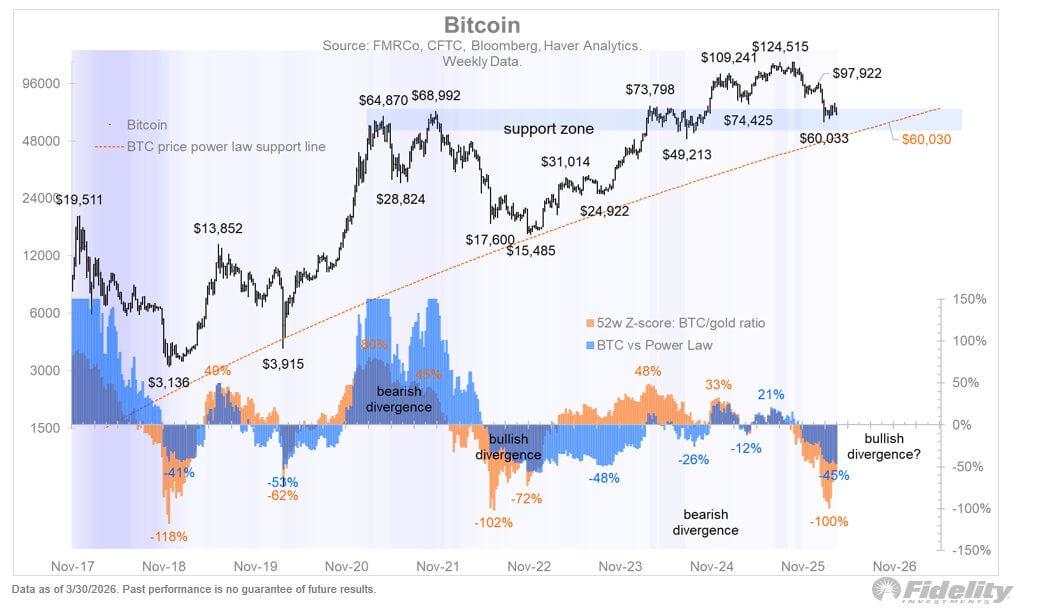 Bitcoin Price Action (Source: Jurrien Timmer)
This assessment aligns with the current market conditions. Bitcoin has rebounded toward the upper end of its five-week conflict range, yet the overall structure remains unchanged. The approximately $65,000 to $73,000 channel that has defined recent price movements persists, making today’s recovery appear more like a rebound within an established range rather than the initiation of a clear breakout.
Timmer also highlighted a shift in exchange-traded product flows that clarifies why Bitcoin reacted swiftly once the geopolitical tone softened. When Bitcoin reached its peak last October, he noted, flows shifted away from Bitcoin and towards gold.
Now, as gold loses some momentum and Bitcoin begins to regain its footing, those flows have started to reverse. According to him, gold has begun to behave more like Bitcoin, while Bitcoin has started to behave more like gold.
 Related Reading
Bitcoin derivatives flash warning as $46B market pulls back from Iran ceasefire rally
Stocks surged on ceasefire optimism, but derivatives positioning indicates traders are reducing risk rather than increasing it.
Apr 4, 2026 · Andjela Radmilac
This provides a clearer context for the rally. Bitcoin is not moving independently of macroeconomic conditions, nor is it trading as an asset that has completely escaped the war-induced pressures affecting risk markets.
Related Posts
It is responding to the same blend of sentiment, positioning, and evolving expectations that have influenced oil, equities, and broader cross-asset trading since the conflict escalated.
This left Monday’s rally reliant on a shift in headlines rather than a definitive change in underlying market strength.
The movement was sufficient to close short positions and push Bitcoin back toward the upper end of its range, but not strong enough to dispel doubts about whether the market could sustain those gains if ceasefire discussions faltered or oil prices began to rise again.
A prolonged conflict could still put $10,000 back on the table
In the meantime, this BTC rebound did not eliminate the deeper downside scenario that has been developing around the leading cryptocurrency as the conflict has continued.
Bloomberg Intelligence analyst Mike McGlone has suggested that Bitcoin could still decline toward $10,000 in 2026 if the macroeconomic environment worsens.
McGlone indicated that Bitcoin may be reverting to the price levels where it was most actively traded following the launch of futures in 2017, while contending with a market now saturated with alternative tokens and increasingly dominated by the rise of dollar-backed stablecoins.
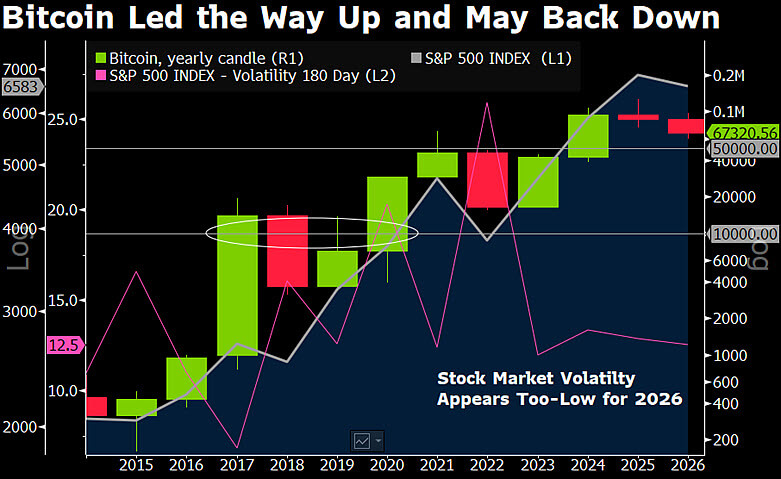
He linked the downside scenario to the risk of a downturn in the equity market and a renewed increase in volatility, conditions that would exert additional pressure on Bitcoin if macroeconomic stress escalates.
This scenario remains well outside the range suggested by Monday’s price movements, but it has not been dismissed by a single relief rally.
CryptoSlate previously reported that a prolonged US-Iran standoff, a continued closure of the Strait of Hormuz, or a wider regional conflict severe enough to push oil prices toward $150 to $200 per barrel would sharply tighten global liquidity and could lead to a decline in equities by more than 30%.
Under such circumstances, the $10,000 scenario would no longer appear as an extreme outlier but rather as a stress scenario that markets would need to take more seriously.
 Related Reading
Bitcoin, stocks rally because of chatter that Iran is ready to ‘end the war' as Dollar Index sinks below 100
Bitcoin’s recovery above $68,000 relies on hopes for peace in the Middle East amid fluctuating oil prices.
Mar 31, 2026 · Oluwapelumi Adejumo
Misir also advocates for caution, emphasizing that the same market that can rise on headlines suggesting negotiations are advancing remains vulnerable to the pressures from conflict, oil, and a weaker risk appetite.
If the diplomatic opportunity diminishes and the energy crisis escalates, the support that buoyed Bitcoin at the beginning of the week will become significantly harder to maintain.
Notably, oil remains central to this assessment. Crude oil prices climbed back toward $112 a barrel on Monday morning as the conflict and the disruptions surrounding Hormuz heightened concerns about supply and inflation. The Kobeissi Letter estimated that if these levels persist for another seven weeks, US CPI inflation could rise to approximately 3.7%.
According to Misir:
“Inflation risk is alive, policy flexibility is limited, and growth has to absorb the shock.”
In this context, Misir concluded that BTC’s next movement will hinge on inflation data and the Federal Reserve’s actions.
He explained that the upcoming FOMC meeting and CPI Index will indicate whether policymakers still perceive inflation as manageable following the oil shock, or whether the conflict is reinforcing expectations that rate cuts will remain off the table.
The post Why Bitcoin briefly jumped above $70,000 on Iran deal hopes as Trump’s Hormuz threat keeps rally fragile appeared first on CryptoSlate.
