Disclaimer: Information found on CryptoreNews is those of writers quoted. It does not represent the opinions of CryptoreNews on whether to sell, buy or hold any investments. You are advised to conduct your own research before making any investment decisions. Use provided information at your own risk.
CryptoreNews covers fintech, blockchain and Bitcoin bringing you the latest crypto news and analyses on the future of money.

Bitcoin advocates are targeting $100,000, but the futures market suggests a potential decline before reaching that level.

Bitcoin traders are reestablishing positions anticipating a rise toward $80,000 as reduced geopolitical tensions, stronger institutional interest, and a bounce back above $70,000 rekindle enthusiasm for upward exposure following weeks of cautious strategies.
On Deribit, the largest platform for crypto options owned by Coinbase, the $80,000 call has emerged as the most significant strike by open interest this week, with approximately $1.5 billion invested in contracts that yield returns if Bitcoin surpasses that threshold.
 Related Reading
Coinbase agrees to acquire Deribit in landmark $2.9 billion deal
Coinbase aims to enhance its presence in the offshore derivatives market amid a favorable regulatory environment in the U.S.
May 8, 2025 · Liam 'Akiba' Wright
This trend is also visible on the on-chain options platform, Derive, where open interest at the $85,000 strike has risen to around $60 million, while $100,000 calls are close to $45 million.
The shift signifies a marked change in sentiment after a period where traders focused primarily on acquiring protection against further declines.
However, Bitcoin has since bounced back from early-week lows near $67,000, trading above $70,000, aided by a temporary ceasefire between the U.S. and Iran that alleviated pressure on oil prices and stabilized broader risk sentiment.
Nevertheless, the market has not completely relaxed its caution, as downside protection remains sought after across longer maturities, and segments of the futures market continue to adopt a defensive stance.
Options traders rotate back to upside
The most compelling evidence of improved market sentiment has emerged from traders adjusting their positions following the ceasefire announcement.
On April 8, Deribit Insights indicated that one of the prevailing strategies leading into Easter involved purchasing April 24 puts at the $61,000 and $62,000 strikes, suggesting that investors were still bracing for a more significant downturn.
However, after the geopolitical situation improved, those positions were rolled up on a premium-neutral basis into the $65,000 and $66,000 strikes, reducing downside notional by over half.
Simultaneously, traders acquired an April 10 call condor spanning $74,000 to $80,000 to position for short-term gains.
This repositioning was also mirrored in the options surface. In maturities of less than seven days, skew shifted from favoring puts to a more balanced profile as demand for calls returned. Implied volatility, which had increased leading up to the Trump deadline, remained stable even as prices rose, enabling long-gamma holders to exit positions with profits linked to both price direction and volatility.
 Related Reading
Why traders poured $3 billion into Binance as Bitcoin soared on ceasefire headlines
The buying surge was immediate, yet options signals appear to reflect a fading fear of a crash rather than a confident new breakout.
Apr 8, 2026 · Oluwapelumi Adejumo
Glassnode reported that volatility compression has intensified across the curve, with front-end implied volatility dropping into the low 40s as immediate stress pricing unwinds.
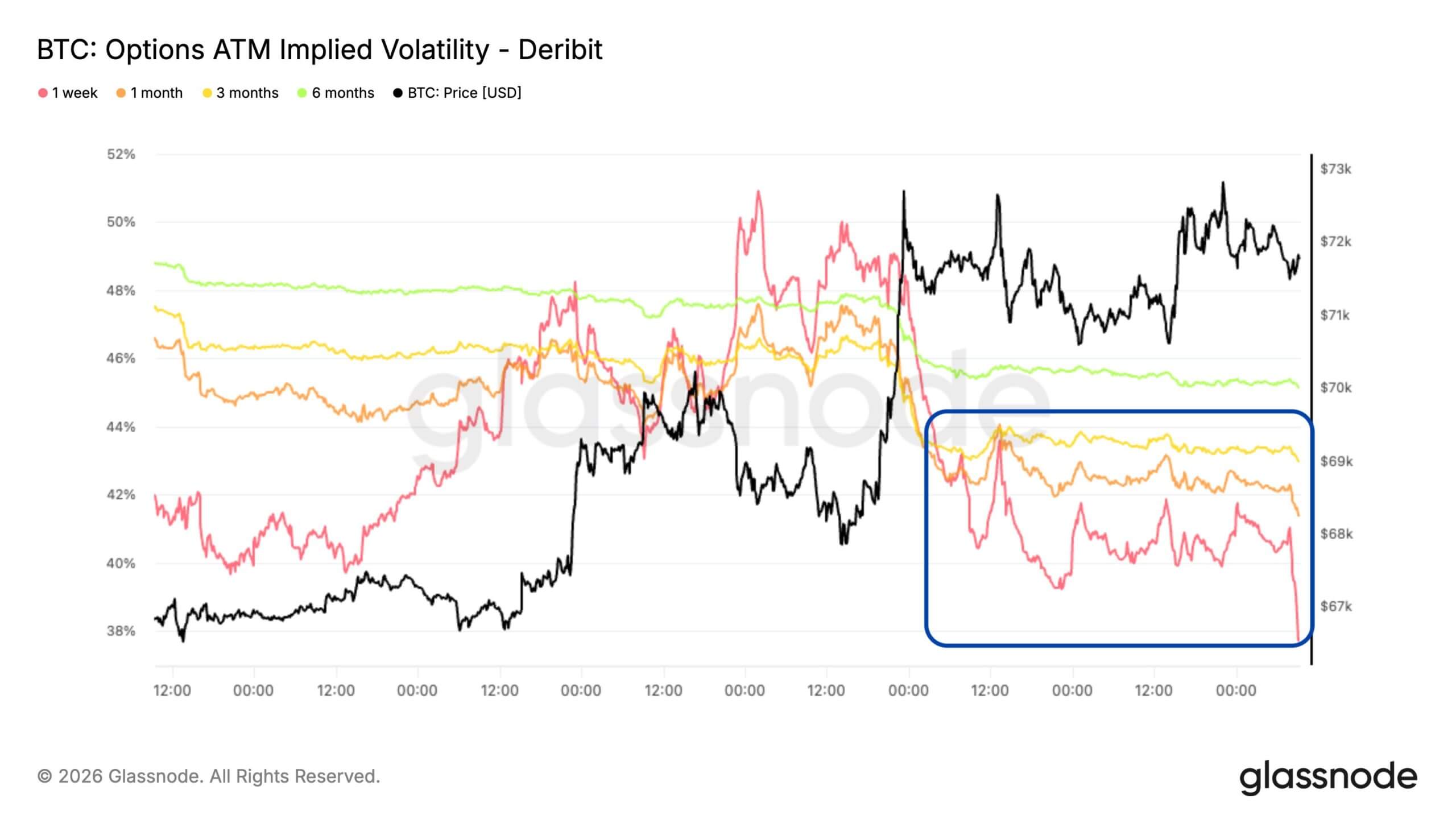 Bitcoin's Implied Volatility (Source: Glassnode)
The firm noted that the ceasefire bolstered expectations for a calmer short-term environment, even though overall positioning remains light and cheaper options could attract new activity in light of upcoming macro events.
Ceasefire relief eases one pressure point
The macro environment helps clarify why the crypto market was inclined to shift toward more bullish positions.
Market analysts observed that Bitcoin’s recent recovery coincided with a decline in oil prices after the temporary ceasefire between the United States and Iran alleviated concerns of a deeper supply shock in the Middle East. Lower oil prices mitigated one of the more immediate inflation risks confronting global markets and contributed to stabilizing sentiment across risk assets.
For Bitcoin, this movement was significant as the market had spent weeks behaving more like a macro-sensitive asset. Traders were monitoring oil, bond yields, and Federal Reserve expectations alongside crypto-specific indicators.
 Related Reading
Bitcoin holds as Trump’s Iran deadline lifts oil and raises risk of a sharper move
Bitcoin is maintaining support for now, but rising oil prices are making the next move more precarious.
Apr 7, 2026 · Oluwapelumi Adejumo
Thus, a pause in geopolitical tensions provided a rationale for traders to reduce some of the defensive positioning that had accumulated during the conflict.
However, the macro landscape remains mixed. The latest U.S. consumer price index indicated inflation at 3.3%, the highest since May 2024, while the monthly index increased by 0.9%, the largest rise since mid-2022.
These figures maintained pressure on expectations for aggressive Federal Reserve easing. Markets are currently pricing in about a 30% likelihood of at least a quarter-point rate cut in December.
Related Posts
These developments create sufficient room for relief rallies when geopolitical pressures diminish, and oil ceases to drive the inflation narrative higher.
Bitcoin’s options market appears to be reflecting that potential. The concentration of interest at $80,000, $85,000, and even $100,000 indicates a market willing to price in a test of higher levels if macro pressures continue to recede. On-chain price models help clarify why those strikes are attracting attention.
Glassnode’s key reference levels position the active investors’ mean at $85,000, the short-term holder cost basis at $81,300, and the true market mean at approximately $78,000.
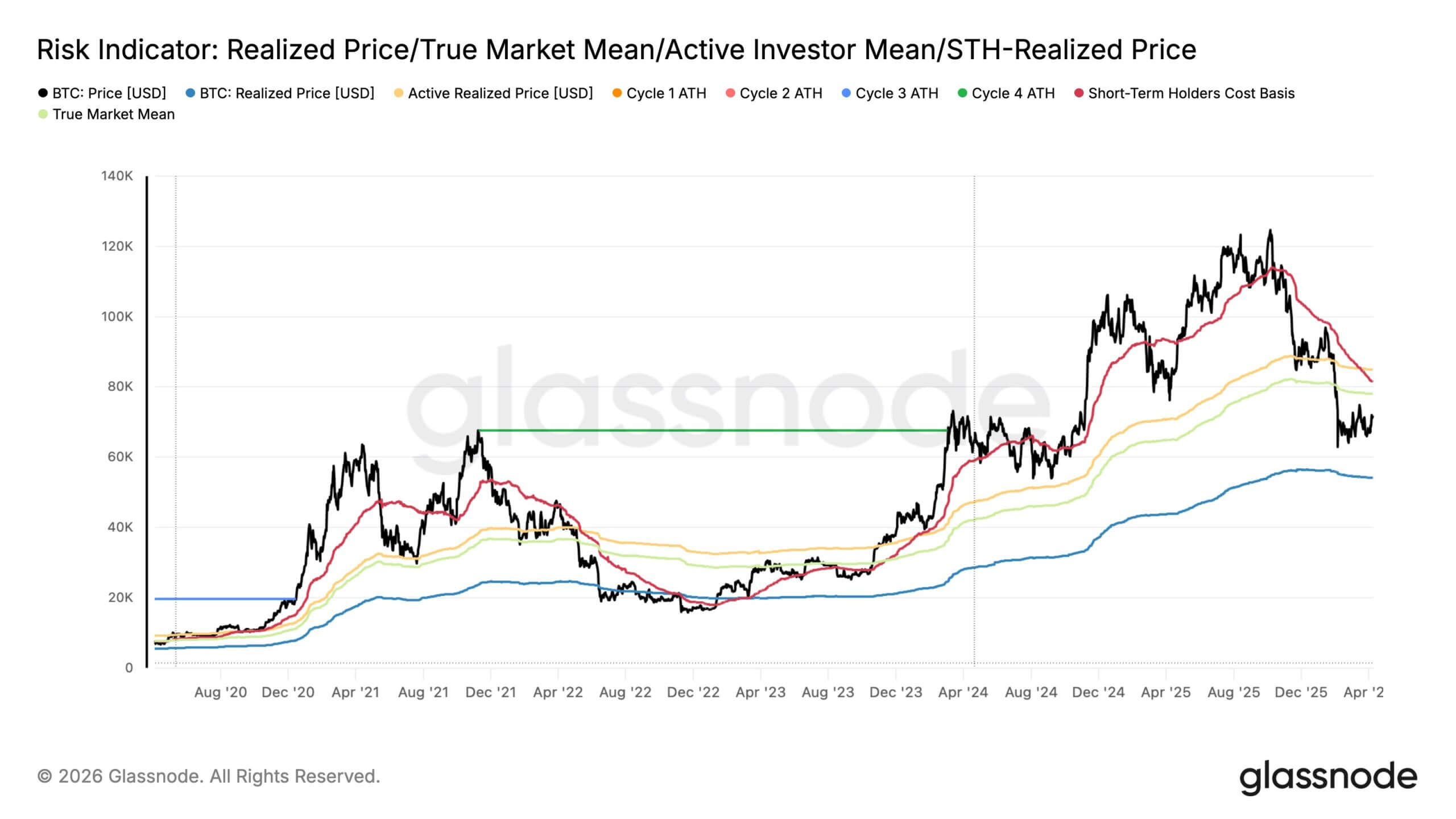 Bitcoin Risks Indicator (Source: Glasnode)
With spot prices recently around $71,800, these levels create a dense band of overhead resistance and potential price discovery if buyers persist. In contrast, the realized price remains significantly lower at $54,200, indicating how far the market is above the aggregate cost basis even after the latest downturn.
Essentially, that cluster between $78,000 and $85,000 elucidates why $80,000 has become a focal point. It lies within a zone where several market-wide cost bases converge.
Bitcoin’s on-chain data still point to a repair phase
However, the bullish shift in options does not resolve the broader debate regarding Bitcoin’s position in the cycle.
Joao Wedson, founder of blockchain analytics firm Alphractal, stated that one of his key indicators still suggests the risk of another decline before a more sustainable advance takes hold.
He pointed out the crossover of investor price below the long-term holder realized price, a pattern he noted has historically emerged during prolonged accumulation phases rather than at the onset of renewed momentum.
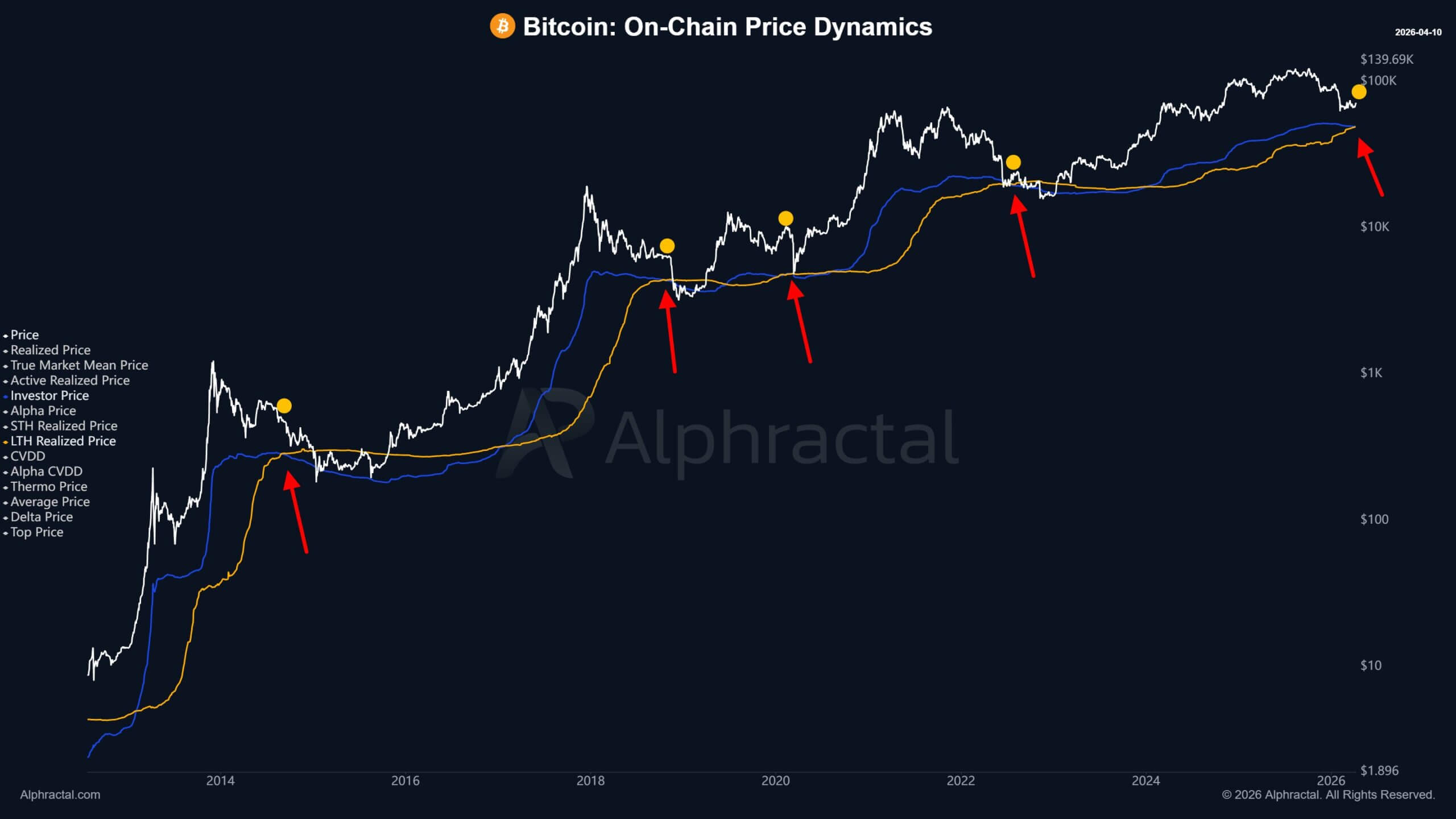 Bitcoin On-chain Price Dynamics (Source: Alphractal)
In practical terms, this means that newer and more active capital has accepted lower prices than long-term holders paid. When this occurs, market control typically shifts from speculative participants to those with longer time horizons.
This implies that while volatility may decrease, sustaining upward movement becomes more challenging as rallies encounter selling pressure from investors aiming to exit closer to breakeven.
CryptoQuant characterized the current phase similarly. The firm’s data indicate that stress conditions in Bitcoin seem to be easing, but demand has not yet reestablished itself robustly enough to signal a clear reversal.
The blockchain firm noted that BTC‘s buy-and-sell pressure delta has moved away from extreme sell levels, indicating that capitulation may be waning, yet it has not yet reclaimed buy-pressure territory. This leaves the market in a state between forced selling and new directional demand.
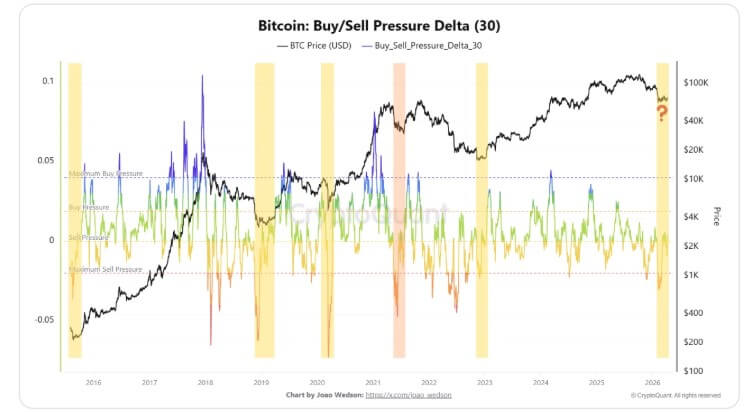 Bitcoin Buy/Sell Pressure Delta (Source: CryptoQuant)
Moreover, BTC’s derivatives positioning remains far from one-sided. Glassnode reported that the seven-day taker flow has become more balanced, but it still leans negative due to short calls and long puts.
This indicates that BTC rallies continue to attract hedging activity at higher levels, while bursts of strength are still being utilized to sell upside.
Notably, the leading asset’s gamma positioning reveals a similar division. Long gamma between $69,000 and $70,000 provides near-term support around the spot price.
Above that, a larger concentration of short gamma exists overhead. If support fails, the market could swiftly revert to the mid-$60,000s as hedging flows accelerate in the opposite direction.
Can Bitcoin reach $80,000?
If Bitcoin is to achieve a sustained advance toward $80,000, options positioning alone is unlikely to suffice. The rally will require backing from spot flows, particularly through ETFs and wealth-management channels that can absorb supply over an extended period.
That support has started to improve. Data from SoSoValue indicates that U.S. spot Bitcoin ETFs are on track for their largest weekly inflow in five weeks, accumulating $545.9 million over the past week.
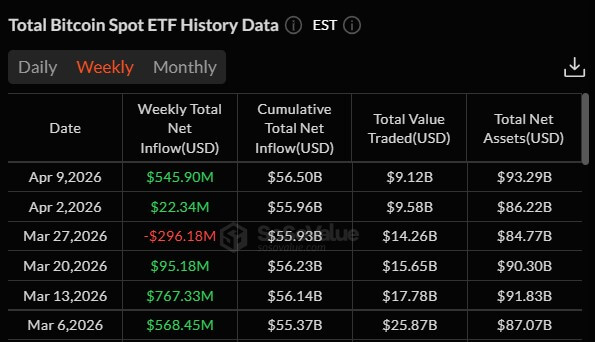 US Bitcoin ETFs Weekly Inflow Since March (Source: SoSo Value)
Morgan Stanley’s new Bitcoin ETF has contributed to that momentum after attracting over $46 billion in inflows during its first two trading days, with Bloomberg ETF analyst Eric Balchunas projecting that the fund could amass more than $5 billion in assets within its inaugural year.
Morgan Stanley’s reach adds broader significance to that launch. The bank’s 16,000 financial advisers manage approximately $6.2 trillion in assets, creating a distribution channel that few competitors can match.
Thus, these inflows suggest that institutional investors are once again inclined to increase their BTC exposure rather than waiting for all geopolitical risks to dissipate first.
Still, this does not imply that the path is unobstructed for BTC. CryptoQuant’s data reveal that futures positioning on Binance, the largest crypto exchange by trading volume, is increasing, with bearish bets on the rise.
According to the firm, open interest on Binance surged by about $350 million over seven days, marking the largest increase since March 20, while cumulative net taker volume did not rise with the same vigor.
This divergence may indicate that a significant portion of the new leverage is linked to short exposure or at least reflects a more cautious stance than the spot movement alone would suggest.
In essence, the market is no longer positioned for an immediate collapse, but it is not fully aligned behind a breakout either.
Notably, crypto traders on prediction markets exhibit the same divide. On Polymarket, users assign a 26% probability that Bitcoin will exceed $80,000 this month and a 9% chance that it will reach $85,000. However, over 30% of bettors still anticipate the token returning to around $65,000.
For the moment, the clearest indication is that traders have begun to price in a higher ceiling. The $80,000 strike has become the focal point of that perspective, bolstered by the recent price rebound, diminished macro stress, and improving institutional inflows.
The lingering hesitation in skew, futures positioning, and on-chain data suggests the market still seeks confirmation. Until that confirmation is provided, Bitcoin’s upward movement is likely to remain a recovery trade initially and a breakout subsequently.
The post Bitcoin bulls are eyeing $100,000, yet the futures market hints at another dip first appeared first on CryptoSlate.
