Disclaimer: Information found on CryptoreNews is those of writers quoted. It does not represent the opinions of CryptoreNews on whether to sell, buy or hold any investments. You are advised to conduct your own research before making any investment decisions. Use provided information at your own risk.
CryptoreNews covers fintech, blockchain and Bitcoin bringing you the latest crypto news and analyses on the future of money.

Analysis of the $1.4 billion cryptocurrency prediction market sector’s growth in 2024 – report

Prediction markets are witnessing expansion, with platforms such as Polymarket propelling the industry forward. Castle Capital indicated in its recent analysis that these markets allow users to wager on upcoming events using cryptocurrency, transitioning traditional betting into a decentralized framework. This transformation enables participants to trade amongst themselves instead of relying on a centralized entity, enhancing transparency and reducing the risk of manipulation.
Castle Capital detailed that prediction markets were previously centralized, which restricted user involvement and adaptability. The advent of blockchain technology has facilitated the decentralization of these markets, empowering users to establish their own markets and terms. Since the debut of another prediction market, Augur, in 2015, prediction markets have emerged as a significant application of blockchain technology, although mainstream focus has only recently surged.
The total value locked in the sector has reached $162 million, marking a notable rise in user participation and transaction activity. Platforms like Azuro and Polymarket have contributed to this growth by presenting varied methodologies. Polymarket, which operates on Polygon, employs an order book model, concentrating on major political and news-related occurrences. It has processed over $1.4 billion in volume, establishing itself as a pivotal platform for wagering on events such as the US presidential elections.
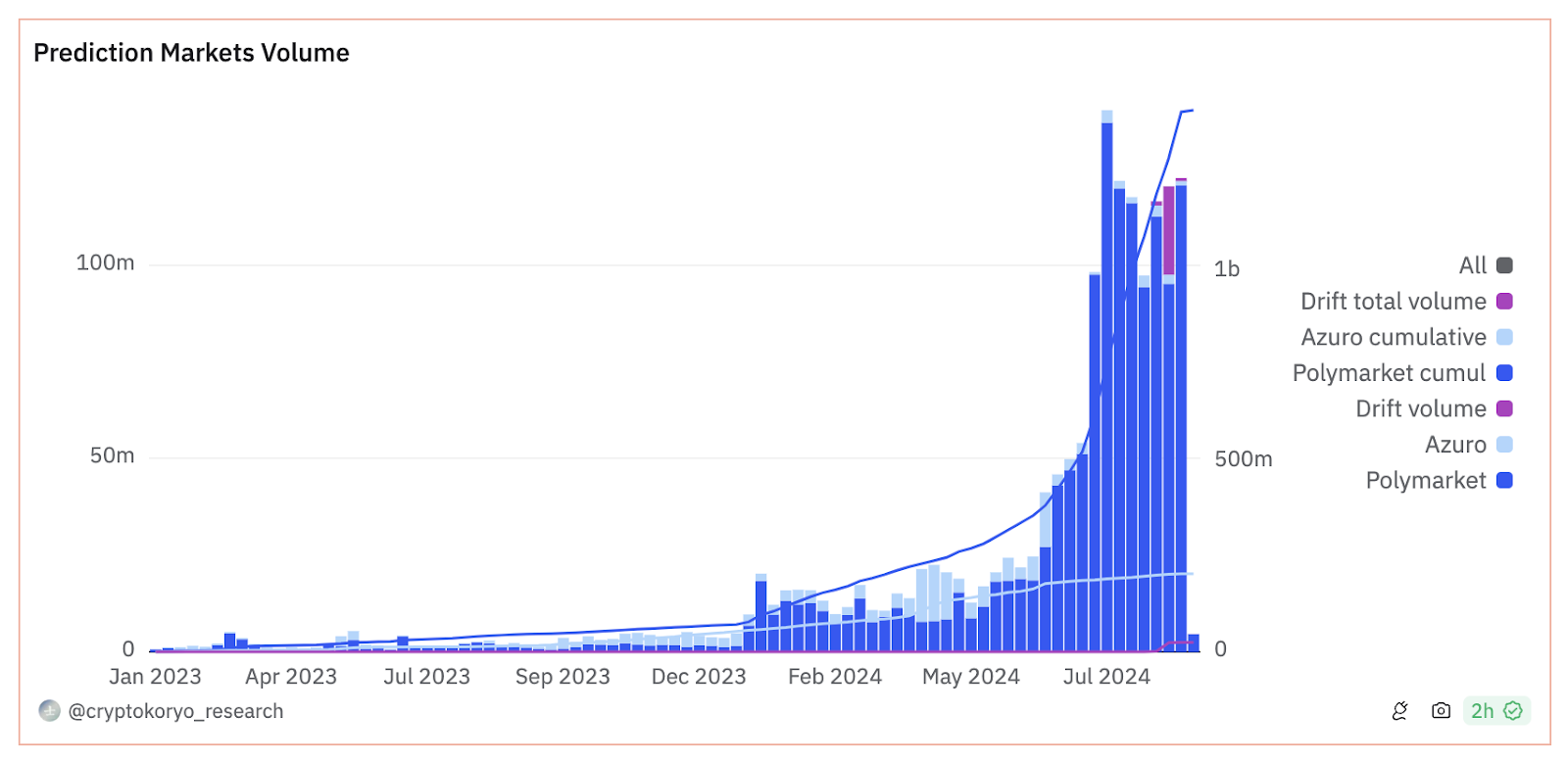 Prediction Markets Volume (Castle Capital)
Castle Capital clarified that Azuro employs a peer-to-pool structure, enabling users to supply liquidity to pools that cater to multiple markets. This approach mitigates risk and enhances capital efficiency, primarily focusing on sports betting. Azuro has managed over $200 million in prediction volume, drawing users who participate in recurring wagers across various sporting events.
Both platforms are looking to broaden their market offerings. Polymarket aims to lessen its dependence on political events by introducing a wider array of markets, while Azuro is reportedly planning to incorporate political and news markets in addition to sports. The expansion of these platforms underscores the growing interest in decentralized prediction markets as instruments for assessing public sentiment.
Related Posts
Castle Capital highlighted the challenges that persist for mainstream acceptance, including liquidity challenges, regulatory ambiguities, and the necessity for enhanced user experiences. Ensuring dependable oracles and data precision is vital, as is addressing scalability issues on blockchain networks. Surmounting these challenges necessitates innovation and collaboration with regulatory authorities.
As noted by Castle Capital, prediction markets hold the potential to deliver accurate public sentiment on various subjects, evolving beyond temporary trends to become essential tools for decision-making. The integration of artificial intelligence and broader market offerings may augment their functionality and attractiveness. Prediction markets could provide news organizations with decentralized sentiment data and impact political discussions.
The outlook for prediction markets seems optimistic, with platforms like Azuro and Polymarket leading the charge. Their ongoing growth and adaptability may reinforce their standing in the crypto ecosystem, offering valuable insights and opportunities for users anticipating future events.
According to Castle Capital’s report, the progression of prediction markets mirrors a wider trend of growing adoption of decentralized applications. However, whether these platforms can maintain their momentum and navigate the challenges ahead to achieve mainstream recognition remains uncertain.
Castle Capital’s comprehensive deep dive report is accessible as part of its Castle Chronicles series.
The post How the $1.4 billion crypto prediction market industry took off in 2024 – report appeared first on CryptoSlate.
