Disclaimer: Information found on CryptoreNews is those of writers quoted. It does not represent the opinions of CryptoreNews on whether to sell, buy or hold any investments. You are advised to conduct your own research before making any investment decisions. Use provided information at your own risk.
CryptoreNews covers fintech, blockchain and Bitcoin bringing you the latest crypto news and analyses on the future of money.


The cryptocurrency market has recently faced a significant decline, with the overall market capitalization decreasing by 10% from Aug. 14 to Aug. 23, hitting its lowest level in over two months at $1.04 trillion. This shift has resulted in considerable liquidations of futures contracts, marking the highest level since the FTX collapse in November 2022.
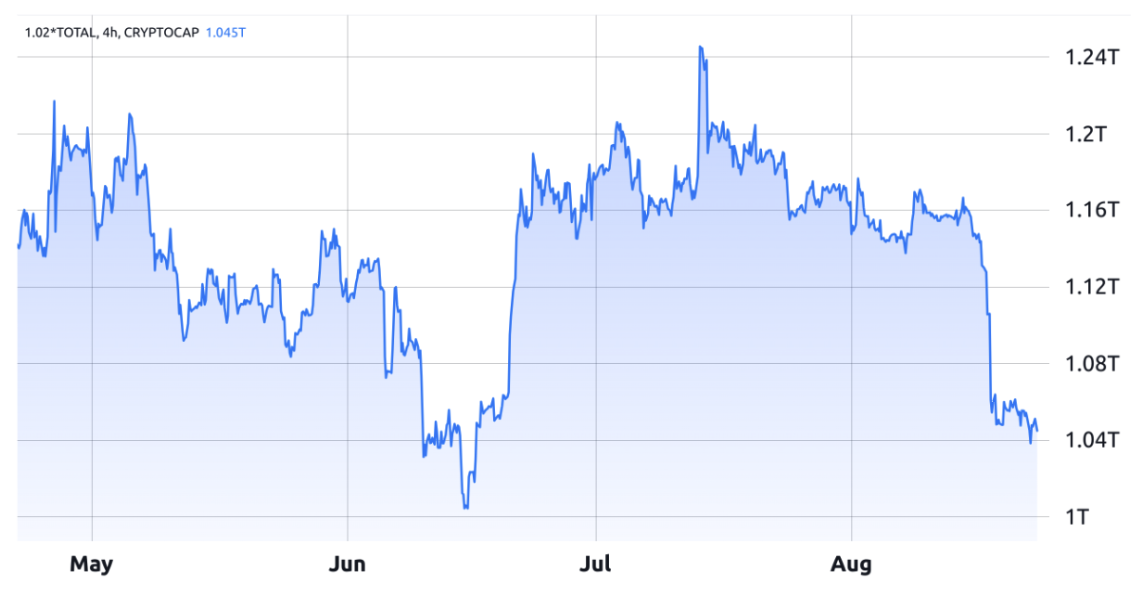 Total cryptocurrency market capitalization, USD. Source: TradingView
Multiple economic factors have played a role in this downturn. With interest rates exceeding 5% and inflation remaining above the 2% target, borrowing expenses for households and businesses have increased, exerting pressure on consumer spending and economic growth. This situation results in reduced funds available for savings, potentially compelling individuals to liquidate their investments to manage monthly expenses.
Given that inflation expectations for 2024 are at 3.6% and average hourly earnings have risen by 5.5% year-over-year, the fastest increase since 2020, the Federal Reserve is expected to either maintain or raise interest rates in the near future. As a result, a high interest rate environment tends to favor fixed-income investments, which negatively impacts cryptocurrencies.
Inflation has decreased from its peak of 9% to the current 3%, while the S&P 500 Index remains only 9% below its all-time high. This may suggest a “soft landing” orchestrated by the Federal Reserve, indicating that the chances of a prolonged and severe recession are lessening, temporarily undermining Bitcoin’s investment rationale as a hedge.
Factors emerging from the cryptocurrency industry
Investor anticipation had been elevated regarding the approval of a spot Bitcoin exchange-traded fund (ETF), especially with strong endorsements from BlackRock and Fidelity. However, these expectations were thwarted as the United States Securities and Exchange Commission (SEC) continued to postpone its decision, citing concerns over inadequate protections against manipulation. Additionally, a significant volume of trading persists on unregulated offshore exchanges utilizing stablecoins, raising doubts about the legitimacy of market activity.
Financial challenges within the Digital Currency Group (DCG) have also adversely affected the situation. A subsidiary of DCG is facing a debt exceeding $1.2 billion owed to the Gemini exchange. Furthermore, Genesis Global Trading recently filed for bankruptcy due to losses linked to the collapses of Terra and FTX. This precarious scenario could result in forced liquidation of positions in the Grayscale Bitcoin Trust if DCG fails to fulfill its obligations.
Related Posts
Regulatory tightening further exacerbates the market’s difficulties. The SEC has brought a series of charges against Binance and its CEO, Changpeng "CZ” Zhao, alleging deceptive practices and the operation of an unregistered exchange. Similarly, Coinbase is under regulatory scrutiny and facing a lawsuit regarding the classification of certain cryptocurrencies as securities, highlighting the uncertainty in U.S. securities policy.
U.S. dollar strengthening despite global economic slowdown
Signs of trouble arising from reduced growth in China have also surfaced. Economists have downgraded their growth projections for the country, with both imports and exports experiencing declines in recent months. Foreign investment in China fell by over 80% in the second quarter compared to the previous year. Alarmingly, unpaid debts from private Chinese developers total a staggering $390 billion, posing a significant risk to the economy.
In spite of the potential for a weakening global economy, which could enhance Bitcoin’s attractiveness due to its scarcity and fixed monetary policy, investors are gravitating towards the perceived safety of U.S. dollars. This is reflected in the movement of the U.S. Dollar Index (DXY), which has risen from its July 17 low of 99.5 to its current level of 103.8, reaching its highest point in over two months.
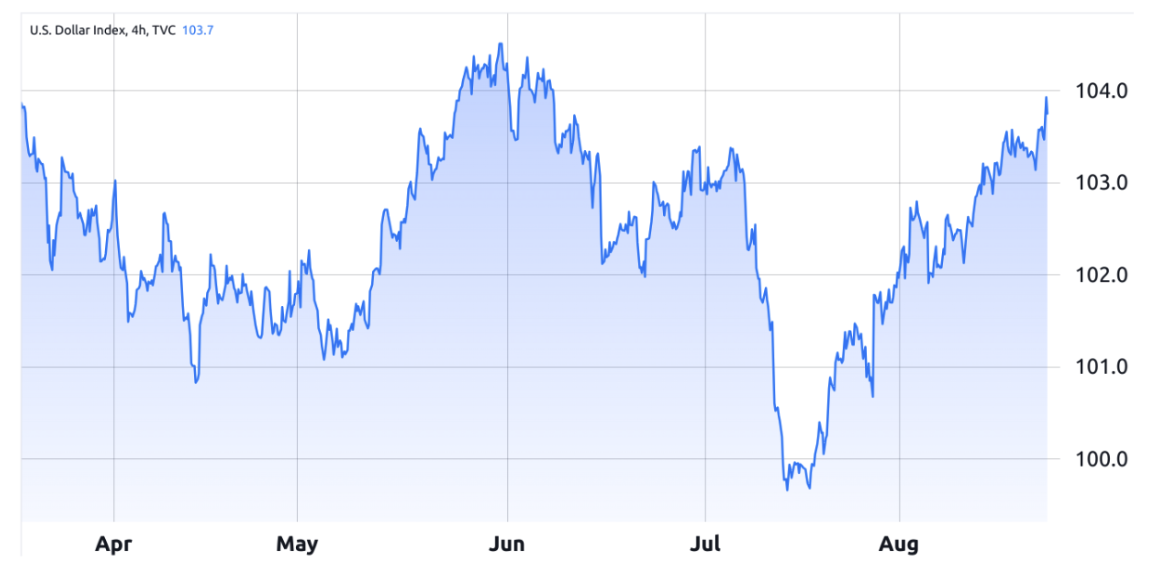 U.S. Dollar Index (DXY). Source: TradingView
As the cryptocurrency market navigates these complex challenges, the interplay of various economic factors and regulatory developments will undoubtedly continue to influence its path in the upcoming months.
This situation may be a result of excessive optimism following the submission of numerous spot Bitcoin ETF applications in mid-June, prompting a reconsideration of whether the rally in mid-July from a $1.0 trillion market capitalization to $1.18 trillion was warranted in the first place.
This article is for informational purposes only and is not intended to be and should not be construed as legal or investment advice. The views, thoughts, and opinions expressed here are solely those of the author and do not necessarily reflect or represent the views and opinions of Cointelegraph.
