Disclaimer: Information found on CryptoreNews is those of writers quoted. It does not represent the opinions of CryptoreNews on whether to sell, buy or hold any investments. You are advised to conduct your own research before making any investment decisions. Use provided information at your own risk.
CryptoreNews covers fintech, blockchain and Bitcoin bringing you the latest crypto news and analyses on the future of money.

Tech stocks dubbed the ‘Magnificent Seven’ drop an astonishing $280 billion as cryptocurrency rises.

Over $280 billion has been erased from the “magnificent seven” tech stocks following the announcement of several earnings reports on Oct. 25, igniting concerns about an impending tech recession.
The term “magnificent seven” encompasses the leading seven blue-chip tech companies, which include Apple, Microsoft, Meta, Amazon, Alphabet, Nvidia, and Tesla — collectively accounting for a quarter of the S&P 500 index’s value.
The parent company of Google, Alphabet, experienced a drop in its share price of more than 9%, resulting in a $180 billion decrease in its market capitalization and marking Google’s poorest performance day since the COVID-19 pandemic began in March 2020.
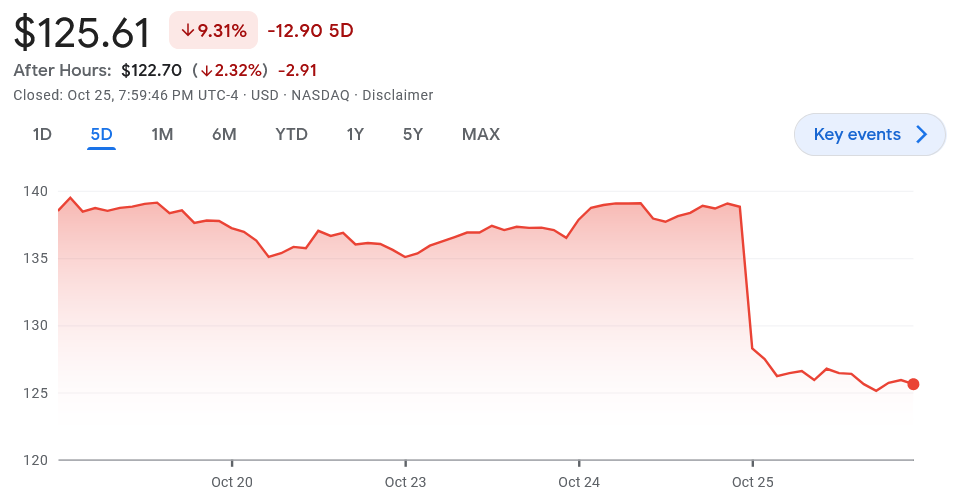
According to Y Charts, the share prices of Amazon, Nvidia, and Meta declined by 5.5%, 4.3%, and 4.2%, respectively.
In contrast, Apple and Tesla experienced smaller declines in their share prices at 1.35% and 1.9%, while Microsoft was the sole outlier among the seven, seeing its share price rise by 3.1% after reporting stronger-than-anticipated growth in its Azure division.
“This marks the most extensive tech selloff in months, leading to a five-month low for the S&P 500,” noted Kobeissi.
“This is the outcome when a few stocks supporting the entire market falter,” the firm remarked, indicating that investors in tech stocks may be starting to factor in a recession.
“It appears that buyers are becoming increasingly cautious as challenges mount,” Kobeissi remarked in a subsequent statement.
Concerns regarding a “stock market crash” have also been mirrored in Google search trends, with the three-word phrase surging 233% within the last week, as highlighted by Andrew Lokenauth, a reporter for TheFinanceNewsletter.com.
Google searches for Stock market crash up 233% in past week.
If the stock market crashed 10%, what stocks are you investing in? pic.twitter.com/TQz8tVyL5U— Andrew Lokenauth | TheFinanceNewsletter.com (@FluentInFinance) October 24, 2023
Related Posts
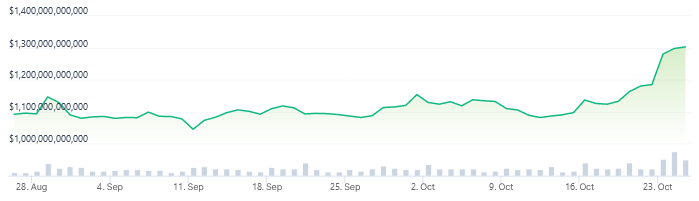
Conversely, the cryptocurrency market has been on an upward trend amid hopes for potential approvals of spot Bitcoin ETFs in the United States, with market capitalization rising by 16.3% to $1.3 trillion over the past week, according to CoinGecko.
Particularly, Bitcoin (BTC), Ether (ETH), Binance Coin (BNB), and XRP have registered increases of 23.3%, 16.7%, 8%, and 15.2%, respectively, over the last seven days.
Related: Google to protect users in AI copyright accusations
Nevertheless, the cryptocurrency market has not demonstrated immunity to adverse macroeconomic conditions.
During the first two quarters of 2022, when the United States real gross domestic product shrank, the cryptocurrency market cap plummeted by 61.7%, dropping from $2.37 trillion to $907 billion, according to CoinGecko.
While analysts ponder whether Bitcoin will further decouple from tech stocks and the S&P 500, previous research from the Multidisciplinary Digital Publishing Institute indicates that Bitcoin continues to behave like a “tech stock” over the long term, owing to its significant volatility.
However, it may act as a viable hedge against the U.S. dollar, to which it has a negative correlation, as deduced from a report by the research firm in October 2022.
Since Sept. 1, Bitcoin has detached from the NASDAQ 100, soaring by 34% while the NASDAQ has declined by 8.6% during the same period.
Meanwhile, the recent actions of investors have led some observers to suggest that this behavior could be interpreted as a “flight to safety” towards Bitcoin — especially in light of the recent sharp declines in several banking stocks.
It’s almost like I predicted that #crypto would decouple from stocks. And here we are with tech #stocks sinking and #bitcoin rallying. https://t.co/K1R3OIiOgV
— Bryan Ross (@bryanrosswins) October 25, 2023
Magazine: Joe Lubin — The truth about ETH founders split and ‘Crypto Google’
