Disclaimer: Information found on CryptoreNews is those of writers quoted. It does not represent the opinions of CryptoreNews on whether to sell, buy or hold any investments. You are advised to conduct your own research before making any investment decisions. Use provided information at your own risk.
CryptoreNews covers fintech, blockchain and Bitcoin bringing you the latest crypto news and analyses on the future of money.


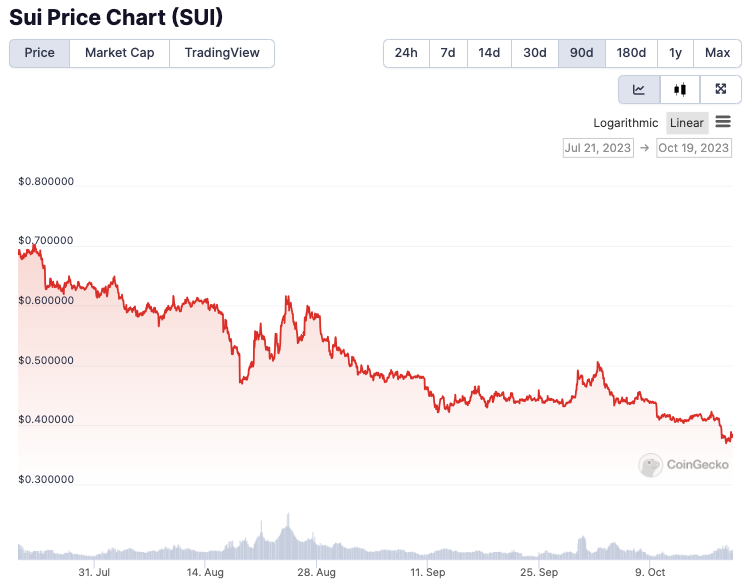
Sui's native SUI token has faced difficulties in recovering after a drop exceeding 9% due to accusations from South Korean regulators, who allege that the Sui Foundation manipulated the token’s supply for personal benefit.
The SUI token saw a slight increase of just under 1% in the past 24 hours after falling from $0.41 on October 16 to fresh lows of $0.37 on October 18. Current values indicate a 7% decrease within just two days, according to data from CoinGecko.
In a post on October 18 to X (formerly known as Twitter), the Sui Foundation — the entity behind the layer-1 blockchain Sui — criticized the claims of supply manipulation as “baseless and materially false.”
“We wish to clarify some inaccuracies that have emerged today,” stated the Sui Foundation.
"The baseless and materially false claims regarding the supply of SUI tokens require clarification. There has been no sale of SUI tokens by the Foundation following the initial Community Access Program (CAP) distributions. That is final,” it elaborated.
We wish to clarify some inaccuracies that have emerged today.
Sui Foundation has consistently committed to collaborating with DAXA and its member exchanges with full compliance and transparency.
The baseless and materially false claims surrounding the…— Sui Foundation (@SuiFoundation) October 17, 2023
“The circulating supply schedule presented on the Sui Foundation’s official website and accessible through public API endpoints is accurate.”
Related Posts
The resolute statement from the Sui Foundation was in reaction to reports from South Korean news sources TechM and Block Media, which indicated that regulators in the country had initiated an investigation into the Sui Foundation.
As per the reports, the South Korean Financial Supervisory Service (FSS) announced it would soon commence an investigation into the distribution of the Sui token, following allegations from Representative Min Byeong-deok, a member of the Democratic Party of Korea.
Related: South Korea focuses on OTC crypto regulations as unlawful deals reach $4B
Rep. Min alleged that the Sui Foundation had profited by staking coins that were supposed to stay in the non-circulating supply.
"It has decreased more than 67% in the five months since its listing. The issuer, Sui Foundation, benefited by staking (depositing) the locked-up amount and sold it to expand circulation,” Rep. Min remarked.
Furthermore, Rep. Min accused the foundation of misleading about the circulating supply, which he claimed contributed to the Sui token’s decline.
South Korean lawmakers have intensified their attempts to regulate cryptocurrency activities in the nation following the collapse of Do Kwon’s Terra Money ecosystem in May 2022. Consequently, the FSS anticipates introducing a comprehensive framework of crypto legislation as early as January next year.
Cointelegraph reached out to the Sui Foundation for additional comments but did not receive an immediate reply.
Magazine: How to protect your crypto in a volatile market — Bitcoin OGs and experts weigh in
