Disclaimer: Information found on CryptoreNews is those of writers quoted. It does not represent the opinions of CryptoreNews on whether to sell, buy or hold any investments. You are advised to conduct your own research before making any investment decisions. Use provided information at your own risk.
CryptoreNews covers fintech, blockchain and Bitcoin bringing you the latest crypto news and analyses on the future of money.


- Ethereum vs. Algorand: the competition in smart contracts intensifies with new developments.
- Algorand’s scalability approach: pure proof-of-stake consensus poses challenges to Ethereum.
- ALGO price pulls back; bulls defend 52-week low as market optimism continues.
In the rapidly changing landscape of blockchain technology, Ethereum has traditionally been recognized as the premier smart contract platform. Nevertheless, a rising competitor named Algorand is attracting attention with its distinctive methodology and technological innovations.
Understanding the Foundations:
Both Ethereum and Algorand aim to facilitate decentralized applications and smart contracts. While Ethereum was the first to introduce smart contracts, Algorand emphasizes scalability, security, and speed. Its commitment to high-performance distributed systems distinguishes it as a notable player in the blockchain arena.
The Scalability Challenge:
Scalability has consistently posed a challenge for Ethereum, often leading to network congestion and elevated transaction fees during peak times. Algorand tackles this problem with its Pure Proof-of-Stake consensus mechanism, which guarantees rapid and secure transactions without sacrificing decentralization. By employing a variant of the Byzantine Agreement protocol, Algorand achieves consensus in mere seconds, providing a scalable solution for developers and users alike.
Smart Contracts and Development:
Ethereum’s Solidity programming language has gained widespread acceptance, establishing it as the industry standard for smart contract development. In contrast, Algorand has introduced a new language known as TEAL (Transaction Execution Approval Language), which provides a straightforward and secure environment for creating smart contracts. Although Ethereum’s extensive developer community offers it an advantage in terms of available resources and support, Algorand’s emphasis on usability and security may draw new developers to its platform.
Decentralized Finance (DeFi) and Algorand:
Decentralized finance has emerged as a revolutionary force within the blockchain sector, facilitating financial services without intermediaries. Ethereum’s supremacy in the DeFi domain is clear, with numerous decentralized applications and protocols built on its platform. However, Algorand seeks to make significant progress in DeFi by providing a scalable infrastructure, reduced transaction fees, and an enhanced user experience. With its distinctive features and potential for innovation, Algorand has the chance to challenge Ethereum’s standing in the DeFi landscape.
Related Posts
Adoption and Partnerships:
Ethereum enjoys a considerable advantage in terms of adoption and partnerships, having established a robust network effect with many projects and developers already integrated into its ecosystem. Conversely, Algorand has been making notable progress in attracting partners across various sectors, including finance, supply chain, and real estate. Significant collaborations and initiatives, such as the Algorand Foundation’s backing for blockchain-based voting, highlight the platform’s potential for broader adoption.
Community and Governance:
The long-term viability of a blockchain platform is heavily reliant on the strength of its community and governance framework. While Ethereum’s decentralized governance model may be complex and contentious, it empowers stakeholders to influence the platform’s future.
In contrast, Algorand employs a hybrid governance model that merges decentralized decision-making with specific mechanisms for protocol enhancements. By balancing decentralization and efficiency, Algorand’s governance structure may appeal to users seeking a more streamlined decision-making process.
ALGO/USD Market Analysis
In the past 24 hours, the Algorand (ALGO) market has witnessed a significant retracement, with bears pushing the price down to a new 52-week low of $0.1475, where support was established. Attempts by ALGO bulls to recover were met with resistance at the 24-hour high of $0.1504. However, as of the latest update, bulls were leading the ALGO market, resulting in a 0.05% increase to $0.1504.
ALGO’s market capitalization rose by 0.02% during the decline to $1,088,597,789, while the 24-hour trading volume fell by 29.53% to $39,061,135. Despite the recent downturn, this movement indicates that investors remain hopeful about ALGO’s prospects.
If the bulls manage to surpass the 24-hour high of $0.1504, the next resistance level could be $0.1550. Conversely, if bears take control and push the price below the 24-hour low of $0.1475, the subsequent support level may be $0.1430.
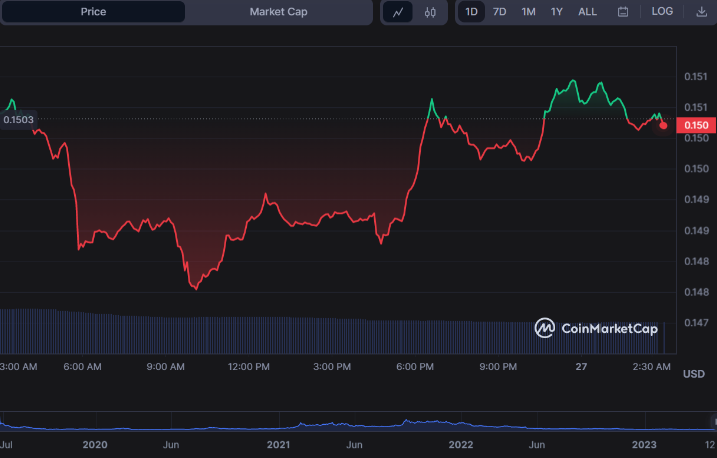 ALGO/USD 1-day price chart (source: CoinMarketCap)
In summary, as Algorand challenges Ethereum’s supremacy, its scalability, security, and potential for innovation position it as a strong competitor in the blockchain sector. The ALGO market demonstrates resilience despite recent pullbacks, reflecting optimism for its future development.
