Disclaimer: Information found on CryptoreNews is those of writers quoted. It does not represent the opinions of CryptoreNews on whether to sell, buy or hold any investments. You are advised to conduct your own research before making any investment decisions. Use provided information at your own risk.
CryptoreNews covers fintech, blockchain and Bitcoin bringing you the latest crypto news and analyses on the future of money.


For an extended period, Solana (SOL) has been linked to Sam Bankman Fried, the founder of the now-defunct cryptocurrency exchange FTX and hedge fund Alameda Research. He was an early backer of the project and invested in various Solana ecosystem initiatives during the bull market of 2020-2021.
When FTX collapsed towards the close of 2022, Solana and other “Sam coins” saw a significant decline, dropping to a low of $9.89 — a decrease of 96.3% from the peak of $259.96.
Since the beginning of 2023, Solana’s price has rebounded, experiencing a 175% increase to hit a high of $27.37, alongside growth in the ecosystem.
However, recently, SOL faced substantial selling pressure following the approval of the sale of FTX’s digital assets by the Delaware Bankruptcy Court, which includes 55.75 million SOL valued at $1.062 million. Nevertheless, the unlock schedule of FTX’s assets and the positioning in the derivatives market suggest that a potential upward counter-move could occur.
After Judge John Dorsey issued his ruling during a hearing on September 13, SOL’s price dipped to a weekly low of $17.96.
However, on September 14, SOL’s price climbed approximately 4%, with long positions worth $800,000 being liquidated since the previous day, according to CoinGlass data.
Crypto trader MartyParty contends that the selling pressure is exaggerated, as the majority of FTX’s SOL holdings are locked until 2025 to 2027.
This is Alameda’s Solana wallet, which has rights to the 26,740,743 staked $SOL from 2025-2028.
The keys to this wallet will be sold in the FTX liquidation, not the $SOL, which cannot be unlocked until 2025-2028.
As I have been stating for weeks – FTX/Alameda only hold 7 million $SOL and… pic.twitter.com/WeIkCKf2Ek— MartyParty (@martypartymusic) September 13, 2023
Furthermore, derivatives traders have increased their short positions following the announcement, which could lead to a counter-move upwards.
Most FTX tokens are locked
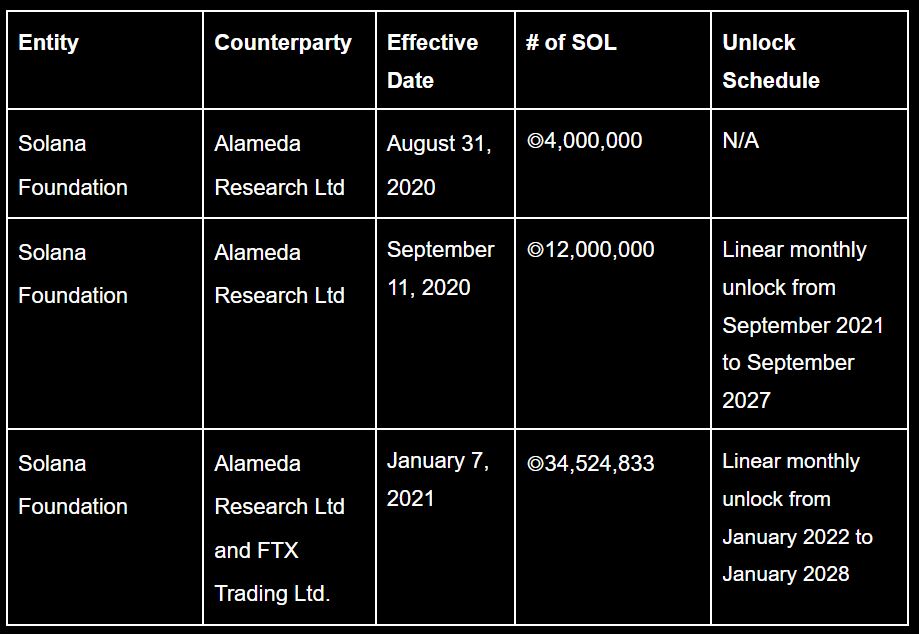
The Solana Foundation provided an update regarding FTX’s Solana holdings after its collapse, indicating that a portion of SOL tokens held by the failed exchange are locked until 2027.
As per the schedule, over 33 million SOL tokens remain locked. This accounts for more than 60% of FTX’s holdings intended for sale in the market.
Based on the crypto conversion terms to fiat by FTX, there will be a cap of $50 million for the first week and $100 million in subsequent weeks, which will help limit selling pressure.
There is a possibility to increase this limit, but it requires prior written consent from the creditors’ committee and ad hoc committee, or to elevate the limit to $200 million weekly with court approval.
If the creditors manage to sell all the SOL tokens, they would need approximately 10 to 12 weeks to unload their complete holdings, which would spread out the selling pressure over several weeks.
In the interim, SOL’s price may demonstrate volatility in both directions, particularly if the futures market provides opportunities for market makers or high-volume traders.
Related Posts
The 30-day average volume on spot exchanges stands at $338 million, according to CoinGecko data. On a weekly basis, it is around $2.5 billion, making FTX’s selling pressure a mere 4%.
MartyParty noted that, based on the comparison between daily spot volume and SOL’s potential selling pressure,
A tiny drip you wouldn’t even notice. If you thought this event would impact Solana, you are mistaken and should disregard grifters on social media and YouTube who lack knowledge about crypto.
Related: Court approves sale of FTX digital assets, up to $3.4B worth to be unleashed
Is a SOL short squeeze on the horizon?
Coinglass data indicates that the funding rate for perpetual swap contracts on cryptocurrency exchanges plummeted to negative 21.1% per annum on September 13, reflecting an abundance of short orders.
Perpetual swaps are futures contracts without expiration, featuring a funding rate mechanism that assists in gauging the demand for long and short orders. A positive funding rate indicates a demand for long orders, and vice versa.
The open interest volumes for SOL have risen from $266 million to $327 million over the week, with funding rate data showing that traders have maintained a bearish sentiment, opening the door for a short squeeze.
A short squeeze occurs when short traders are compelled to buy back an asset at a higher price to close their short positions as the asset’s price rises.
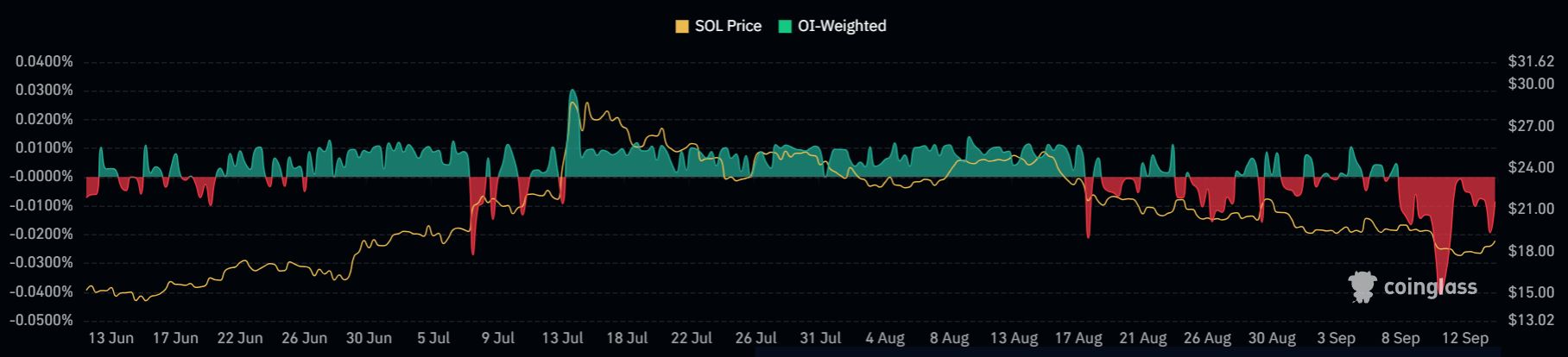
Notably, since August, negative funding rates have led to flat price returns thus far. However, it is common for there to be a price spike that forces shorts to exit and stabilizes funding rates.
MartyParty stated that “retail shorts stacked to $30 liquidation level,” as he anticipates “these will all be flushed in a market maker squeeze.”
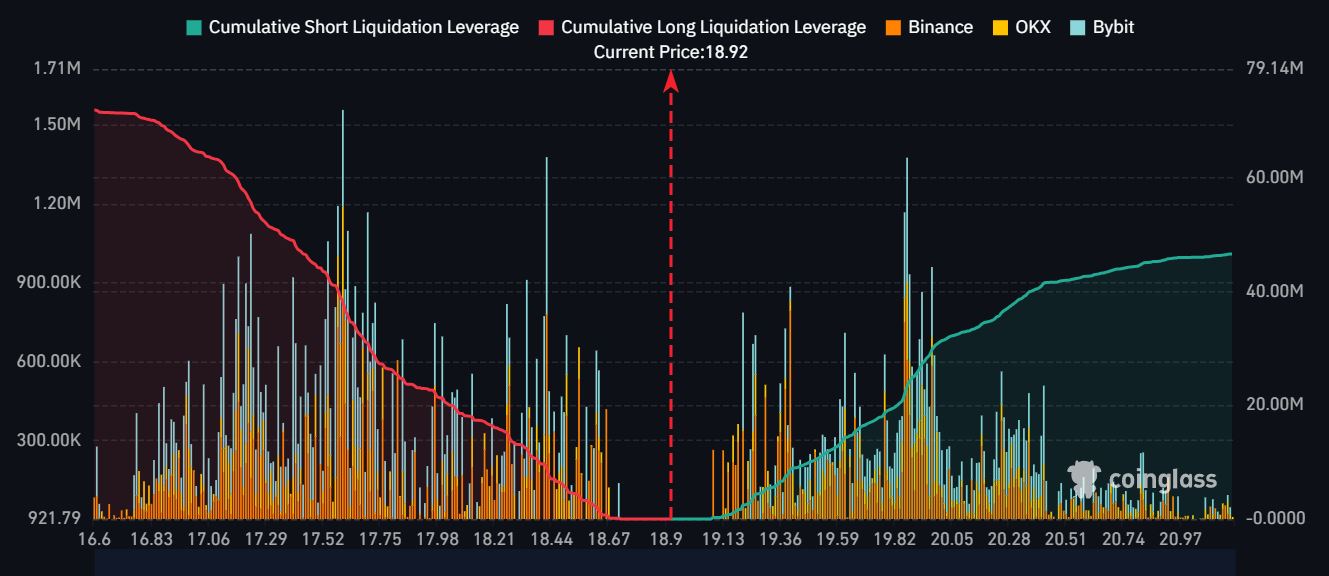
The liquidation heatmap from Coinglass illustrates a considerable number of leveraged positions on both sides of SOL’s current price, with the highest concentration at $20.50 and $17.06.
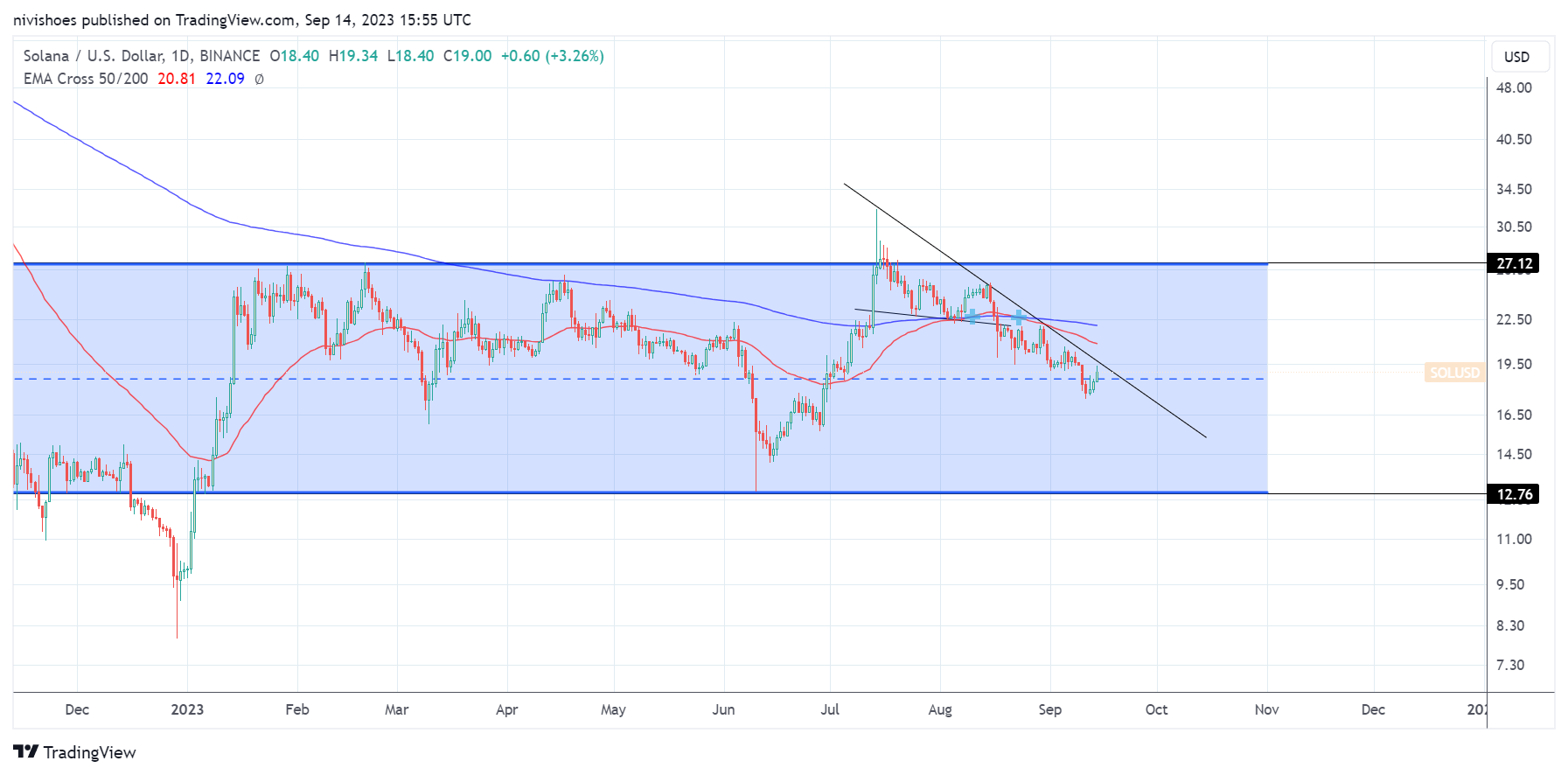
Technically, SOL faces resistance from the descending trendline since July. It is also trading below its 50 and 200 day moving averages at $21.08 and $22.09, which could serve as potential resistance levels.
This article does not provide investment advice or recommendations. Every investment and trading decision carries risk, and readers should perform their own research before making a choice.
