Disclaimer: Information found on CryptoreNews is those of writers quoted. It does not represent the opinions of CryptoreNews on whether to sell, buy or hold any investments. You are advised to conduct your own research before making any investment decisions. Use provided information at your own risk.
CryptoreNews covers fintech, blockchain and Bitcoin bringing you the latest crypto news and analyses on the future of money.


Only eight days after Terra co-founder Do Kwon remarked to American-Canadian chess player Alexandra Botez that 95% of cryptocurrencies were destined to fail, stating there was “entertainment in watching companies die,” the Luna flash crash transpired.
Do Kwon: "95% are going to die [coins], but there's also entertainment in watching companies die too"
8 days ago. Ironic. pic.twitter.com/fEQMZIyd9a— Pedr (@EncryptedPedro) May 11, 2022
During the crash from May 5 to May 13, 2022, over $40 billion in investor assets were lost. Less than a year later, Do Kwon was apprehended after allegedly attempting to evade prosecution for criminal activities linked to these losses.
A substantial amount of analysis has been conducted regarding the collapse, which saw the Luna (LUNC) coin decline sharply and Terra’s UST stablecoin lose its peg to the U.S. dollar.
Related Posts
Now, for what seems to be the first instance, researchers have utilized statistical mechanics to effectively reverse-engineer the crash, employing techniques typically used in particle physics.
The study, carried out at King’s College London, focused on transaction events and orders that took place during the crash. According to the team’s preprint research paper:
“We view the orders as physical particles with motion on a 1-dimensional axis. The order size corresponds to the particle mass, and the distance the order has moved corresponds to the distance the particle moves.”
These methodologies are also applied to analyze thermodynamic interactions, molecular dynamics, and atomic-level interactions. By applying them to specific events occurring during a defined timeframe in a contained ecosystem, such as the Luna market, the researchers gained enhanced understanding of the coin’s microstructure and the fundamental reasons for the collapse.
The approach involved shifting away from the snapshot methodology used in the current leading technique, Z-score-based anomaly detection, and adopting a more detailed perspective of events as they unfolded.
By interpreting events as particles, the team was able to integrate layer-3 data into its analysis (which, in addition to layer-1 and layer-2 data, includes information related to order submissions, cancellations, and matches).
The researchers indicated that this led to the discovery of “widespread instances of spoofing and layering in the market,” which significantly contributed to the Luna flash crash.
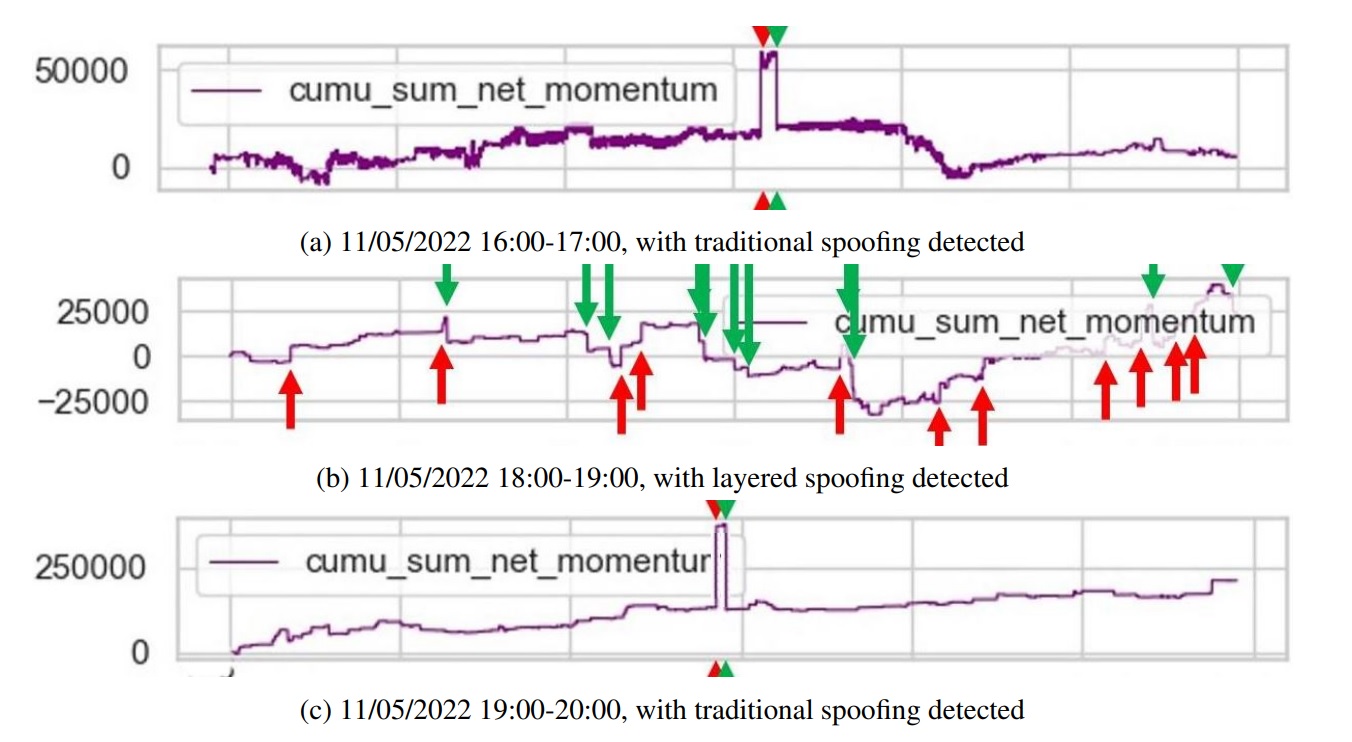 Luna spoofing revealed during the Terra collapse using three disparate data analysis techniques. Source: Li et al., 2023
The team subsequently developed an algorithm to identify layering and spoofing. This posed a considerable challenge, as noted in the paper, due to the absence of known data sets related to the Luna crash that contain accurately labeled instances of spoofing or layering.
To train their model to recognize these activities without such data, the researchers generated synthetic data. Once trained, the model was applied to the Luna data set and compared against an existing analysis conducted using the Z-score system.
Related: Top UK university partners with AI startup to analyze crypto market
“Our method successfully detected spoofing events in the original dataset of LUNA trading market,” the researchers stated, adding that the Z-score method “not only failed to identify spoofing but also incorrectly flagged large limit orders as spoofing.”
Looking ahead, the researchers believe their findings could provide a basis for examining market microstructure across the financial sector.
