Disclaimer: Information found on CryptoreNews is those of writers quoted. It does not represent the opinions of CryptoreNews on whether to sell, buy or hold any investments. You are advised to conduct your own research before making any investment decisions. Use provided information at your own risk.
CryptoreNews covers fintech, blockchain and Bitcoin bringing you the latest crypto news and analyses on the future of money.


The creator of the layer-1 blockchain Jurat has stood up for his protocol against potential detractors, asserting that on-chain legal enforcement is a vital compromise for the widespread acceptance of cryptocurrency.
On August 8, a U.S. District Court utilized Jurat’s on-chain enforcement feature to restrict several sanctioned individuals from accessing their crypto accounts. These individuals were penalized for money laundering and employing ransomware to extort cryptocurrency payments, which supported North Korea’s armament program.
A federal lawsuit has just concluded with a final judgment, and the court employed @JuratNetwork to enforce its order on-chain!
The judge has prohibited Russian and North Korean hackers from accessing their accounts, marking $JTC as the first cryptocurrency to adhere to @USTreasury…— Mike Kanovitz (@MikeKanovitz) August 8, 2023
In an interview with Cointelegraph, Mike Kanovitz, the founder and CEO of Jurat, mentioned that the judicial ruling was unprecedented.
The Jurat blockchain was introduced in late 2022, developed through a fork of the Bitcoin blockchain. The technology links blockchain nodes with court records to implement court mandates.
Kanovitz acknowledges that this technology will likely attract criticism from staunch advocates of decentralization.
“Some individuals will assert their philosophical purity and criticize it. I understand that.”
Nevertheless, the Illinois-based attorney stated that such technology could provide essential due process protections for digital assets, which will be crucial for mainstream acceptance.
"Many of those who currently believe that there should not be effective law enforcement on-chain would change their perspective if they were hacked, defrauded, or lost their private keys. They would then appreciate the ability to reclaim their property," he explained.
Related Posts
In the first half of 2023, $656 million worth of cryptocurrencies were lost due to scams, hacks, and rug pulls, according to a report from blockchain security firm Beosin dated June 30.
H1 2023 Web3 Security Statistics
Total losses from hacks, phishing scams, and rug pulls in Web3 reached $655.61 million in the first half of 2023.
Among them,
108 attacks -> $471.43M
Phishing scams -> $108M
110 rug pulls -> $75.87M pic.twitter.com/8Q9kmDETfQ— Beosin Alert (@BeosinAlert) June 30, 2023
“This will not only curb the lawlessness that deters potential adopters and provokes government officials, it can also unlock tremendous utility for commerce,” he added.
Related: MetaCourt’s IDO launch: A paradigm shift in Web3 legal services
Until now, courts have had limited methods to effectively freeze and seize crypto assets. A prevalent strategy has involved instructing centralized crypto exchanges to freeze funds or provide identifying details of the suspect.
However, the on-chain enforcement tool operates by connecting JTC’s blockchain and software nodes with the user’s selected court.
During a lawsuit, each party presents the court with a competing hash reflecting their desired outcome. Once a ruling is rendered, the court simply inputs the hash of the victorious side, and the software nodes will autonomously execute the order once they access the online court records.
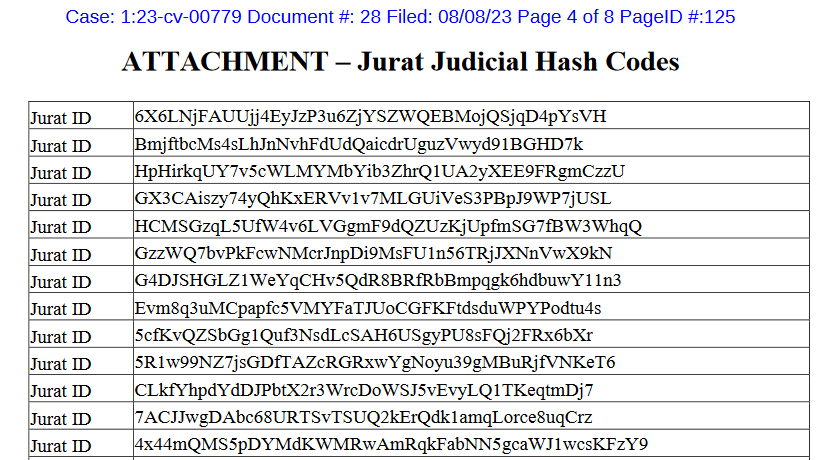 The court linked the Jurat IDs, which JCT’s blockchain nodes then interpreted to restrict the private keys of the defendants on the JCT Blockchain. Source: Jurat
Kanovitz mentioned that the tool currently operates solely in the United States and exclusively on the JCT blockchain. However, he aspires to extend JCT’s technology to other Ethereum Virtual Machine-compatible blockchains in the future.
Magazine: ‘Moral responsibility’ — Can blockchain really improve trust in AI?
