Disclaimer: Information found on CryptoreNews is those of writers quoted. It does not represent the opinions of CryptoreNews on whether to sell, buy or hold any investments. You are advised to conduct your own research before making any investment decisions. Use provided information at your own risk.
CryptoreNews covers fintech, blockchain and Bitcoin bringing you the latest crypto news and analyses on the future of money.

Cardano stablecoin initiative reportedly mismanaged investors’ funds prior to collapse: Report

In 2021, Ardana Labs announced its intention to launch an innovative stablecoin platform for the Cardano network. The initiative, named “Ardana,” aimed to enable investors to secure crypto collateral and generate fiat-pegged stablecoins, including a U.S. dollar-backed token known as dUSD. That year, it successfully raised $10 million from investors, but abruptly ceased operations in November 2022, citing “funding and project timeline uncertainty.”
Some investors attributed the failure to the “crypto winter” of 2022, during which numerous legitimate projects collapsed due to insufficient funding amid a prolonged bear market. However, new findings from Web3 risk-management platform Xerberus indicate that there may be additional factors contributing to Ardana’s downfall beyond mere fundraising challenges.
Xerberus reports that Ardana executives likely transferred 80% of the project’s funds to a personal wallet after initially attempting to conceal the transactions by routing some through centralized exchanges. Allegedly, these transfers were executed by CEO Ryan Motovu or another member of the executive team. Once the funds were in this wallet, the executives purportedly made a series of poor crypto investments, leading to a loss of around $4 million, which diminished the project’s financial runway and ultimately resulted in its failure.
2) The capital was deposited in stablecoins. Ardana used this capital to invest in highly risky Ethereum-based tokens. As the bear market set in, prices plummeted, and Ardana lost at least $4 million just on their DEX trades. pic.twitter.com/PIj5o55Flr
— Xerberus (@Xerberus_io) September 6, 2023
Ardana’s rise and fall
Ardana was initially unveiled in the summer of 2021, and by October of that year, it had secured $10 million from venture capital firms CFund, Three Arrows Capital (3AC), and Ascensive Assets. Due to its successful fundraising and the stature of its investors, some believed that Ardana’s forthcoming token, DANA, would yield significant market returns.
The following month, Ardana announced a partnership with Near Protocol to establish an asset bridge between Cardano and Near.
Nevertheless, no Ardana stablecoin platform or bridge was ever launched, and the protocol shut down in November 2022 without a viable product. The development team attributed the closure to “funding and project timeline uncertainty.” This occurred during the fallout from the collapse of FTX, which complicated fundraising efforts for many projects. Additionally, one of Ardana’s investors, 3AC, had declared bankruptcy a few months prior. Given this context, many accepted the official narrative without question.
However, blockchain data and analysis by Xerberus suggest that Ardana’s failure may have stemmed less from a lack of funding and more from the risky asset management practices of Ardana Labs’ executives.
A trail of questionable money
Xerberus co-founders Simon Peters and Noah Detwiler informed Cointelegraph that they identified the Ethereum wallet used by Ardana Labs to gather funds from the DANA initial coin offering (ICO) in November 2021. They noted that links to this address were present on the ICO platform Tokensoft’s web pages related to the token. Furthermore, they claim to have traced a $1 million transaction from 3AC to this address at a time when 3AC had announced its investment in Ardana.
Blockchain data indicates that the first transaction to this account took place on September 2, 2021, when roughly 0.46 Ether (ETH) (valued at $1,747 at that time) was sent to it. This occurred approximately two weeks after the August 15 start date for the initial round of Ardana fundraising. Starting on September 15, the account received multiple transfers of USD Coin (USDC) that ultimately totaled millions of dollars in stablecoins.
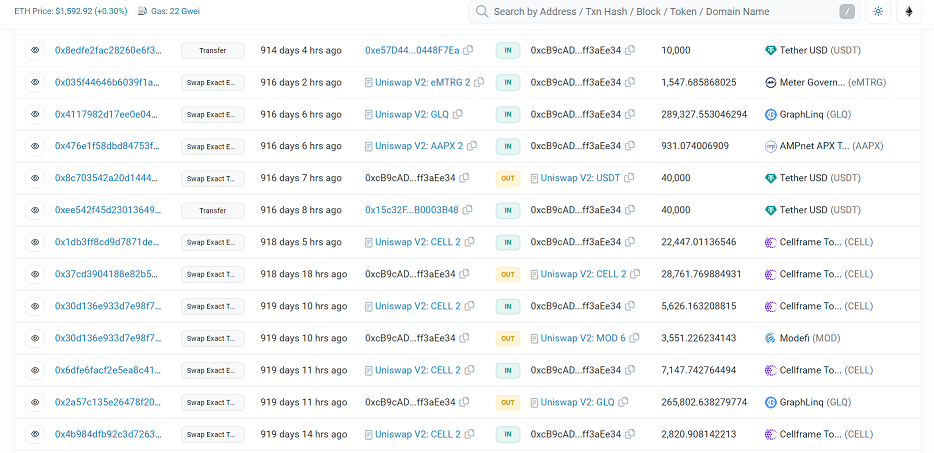 Caption: USDC transfers into alleged Ardana fundraising wallet. Source: Etherscan.
Once the funds were raised, they were transferred to other wallets through a series of intermediary steps, according to Xerberus.
Peters and Detwiler explained that approximately $3.2 million worth of stablecoins was moved from the fundraising wallet to a “Target Wallet” via two intermediary addresses. This amount represents around 30% of the total funds raised. Initially, the fundraising account sent the funds to what they refer to as “Proxy Wallet 1.”
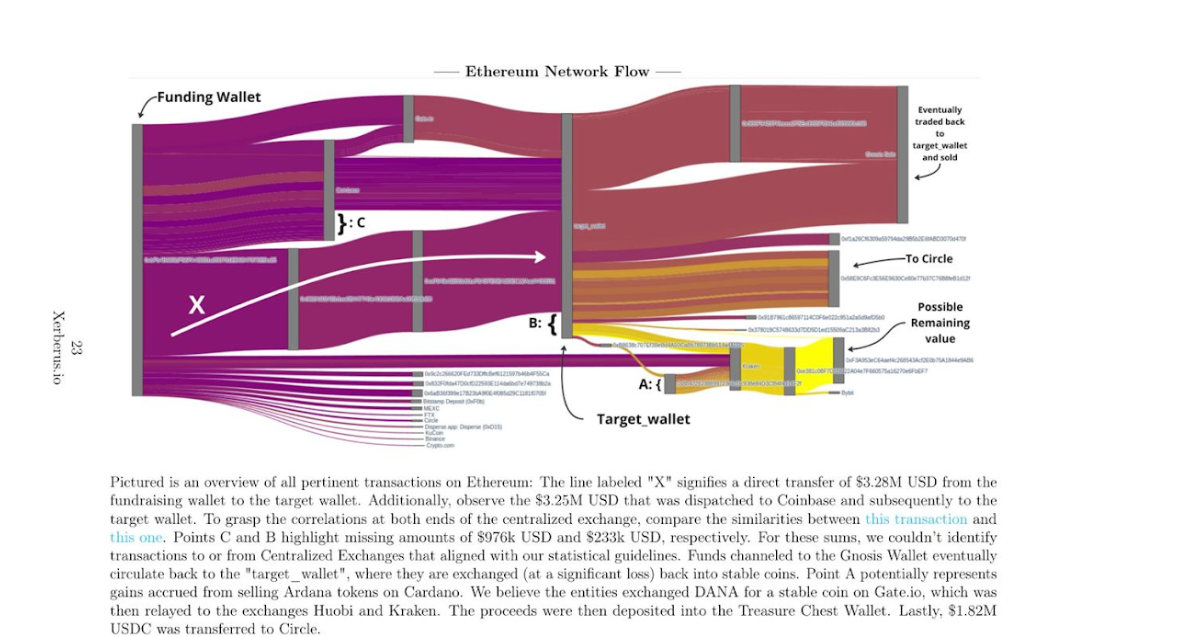 Diagram of Ardana fund flows. Source: Xerberus
After receiving the funds, Proxy Wallet 1 exchanged all of the stablecoins for CVX, a utility token used to earn fees from the Convex Finance platform. Blockchain data indicates that decentralized exchange (DEX) SushiSwap was utilized for this swap.
Subsequently, the funds were sent to what the Xerberus founders assert is an old personal wallet (“Old Address”) belonging to Ardana founder Motovu. They noted that Motovu claimed to have profited during the previous bull market of 2017. They discovered that “between $200,000 and $400,000” was in this wallet prior to the Ardana ICO, but the majority of the funds it later contained were from Ardana.
“When this project went under and when it failed, [Motovu] went onto a live Space and said, ‘A lot of my personal money that I had earned over the previous bull market in 2017′ […] is the money he made out of this old wallet,” Detwiler clarified. “It sums up to something around $200,000 to $400,000, nothing more.”
Blockchain data reveals that approximately four minutes after the CVX tokens were sent to the Old Address, they were transferred to the Target Wallet. This wallet is claimed to have been used to acquire a range of cryptocurrencies, ultimately resulting in the loss of Ardana’s funds due to poor investments.
CeFi exchanges join the trail
Related Posts
In addition to the amount transferred on-chain to the Target Wallet, another $4 million was routed through centralized exchanges before being sent to the Target Wallet, according to the Xerberus co-founders.
They assert that they identified the deposit addresses for Kraken, Coinbase, and Gate.io utilized by the Ardana team. To locate these, they searched for addresses that received funds from the fundraising wallet and subsequently sent funds to a known exchange address. For instance, one specific address received funds from the fundraising wallet and only sent funds to the Coinbase 6 and Coinbase: Miscellaneous wallet addresses.
Once funds were deposited into a centralized exchange, tracking their subsequent movements became more challenging. However, the team employed various techniques to ascertain with a reasonable degree of certainty where the funds were directed.
In certain instances, the team was able to trace funds sent to Kraken that were then immediately dispatched to another address, as Kraken frequently utilizes the same address for sending and receiving funds for each user, particularly when the time between transactions is brief. In other cases, Kraken redirected the deposited funds to another of its wallets, obscuring the user’s actions with the funds. Deposits made to Coinbase and Gate.io are consistently sent to other wallets and pooled with other users’ tokens. Thus, with transactions involving these exchanges, the team could not easily determine the subsequent actions.
Nevertheless, they analyzed all outgoing transactions executed by each exchange within an hour of the fundraising wallet depositing to it. They discovered that many outgoing transactions matched the exact amounts of the deposits. For example, the fundraising wallet would deposit $220,000 worth of Tether (USDT) to Gate.io, and then, 40 minutes later, the exchange would send precisely $220,000 in USDT to a different wallet. Ultimately, much of these funds ended up in the Target Wallet, providing what Xerberus considers compelling evidence that the same user executed the outgoing transactions.
Peters and Detwiler cautioned that this process does not definitively prove that the transactions were executed by Motovu or a member of the Ardana team. “This is not a UTXO [unspent transaction output] trail or a ledger trail. This is not a blockchain exact trail. […] However, the time frames and amounts do correlate with each other,” Detwiler stated. They estimate that a total of $4 million was sent to the Target Wallet through these methods, bringing the total funds directed into it to $7.2 million.
Some funds remain, while some were spent on development
Research conducted by the Xerberus team indicates that approximately $1.82 million worth of Ardana’s funds were allocated to development expenses related to the project, including salaries for team members. They reached out to an individual they referred to as “the main contractor for the project,” who provided Ardana with their wallet address. This address revealed payments totaling $1.82 million, which constitutes about 20% of the funds raised.
Additionally, they assert that around $1.4 million worth of USDC has not been lost and still resides in the project’s possession in a wallet they refer to as the “Treasure Chest” account. The first transaction to this account was an incoming transfer of 0.3 ETH, valued at $562.29 at the time, which was sent from the Target Wallet.
Related: Multichain victims search for answers in $1.5B exploit as new evidence emerges
Nearly $4 million lost in bad trades
According to Xerberus’ September 6 report on Ardana, nearly $4 million of the Target Wallet’s token balance was lost through unsuccessful trades. The wallet owner transferred the majority of the funds to two Safe (formerly Gnosis Safe) multisignature accounts. These funds were utilized to execute trades on DEXs PancakeSwap, Uniswap, SushiSwap, and GMX, resulting in near-total losses. The Target Wallet also engaged in its own unprofitable trades.
Blockchain data indicates that the Target Wallet executed over 1,000 transactions, most of which involved interactions with DEX contracts.
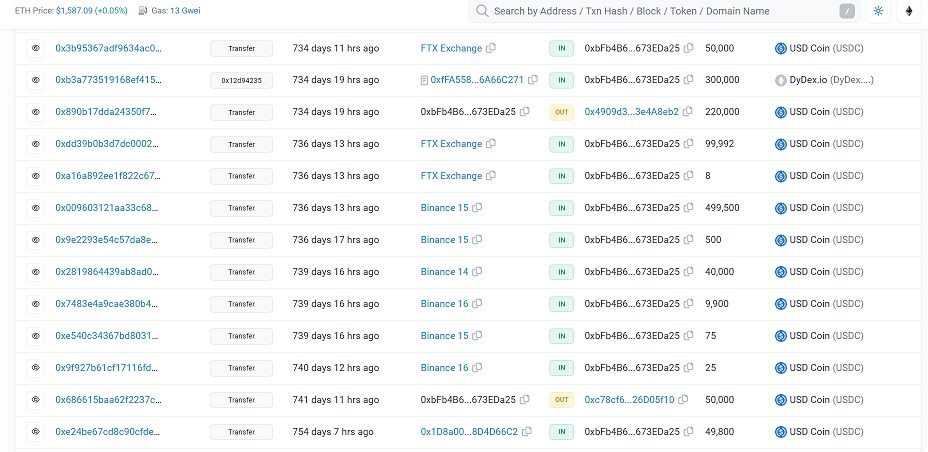 Transactions of the account identified as “target wallet” by Xerberus. Source: Etherscan.
Ardana’s liquidation and closure
Xerberus claims that the on-chain activities of the Ardana team began to shift in March 2022, when the team’s wallets started “dumping” their assets onto DEXs. They continued to liquidate all remaining assets until November 2022, when the project officially announced its closure. The funds obtained from these sales remain in the treasury wallet.
The firm states it has developed an early warning system designed to alert investors when a project engages in risky behaviors that could lead to closure. Xerberus refers to this as “Blockchain Native Risk Ratings based on verifiable mathematics,” and it asserts that investigations like the Ardana case are utilized to “fine-tune” its risk model, which it anticipates will “transform crypto markets, making them a safer alternative to traditional financial markets.”
Cointelegraph attempted to reach Ardana’s Motovu via LinkedIn, seeking his perspective on the situation. A response was not received within the two weeks leading up to publication.
Many Ardana investors were strong proponents of the Cardano ecosystem. They anticipated that Ardana would be the project to finally garner the attention they believed Cardano deserved. Instead, over $10 million in capital was extracted from the Cardano community, leaving virtually nothing in its wake.
The Ardana narrative serves as a stark reminder of the risks associated with investing in emerging Web3 startups lacking a functioning product. While these projects can yield substantial returns, they can also result in significant losses. Investors may wish to closely examine a project’s on-chain activities when evaluating whether to invest in such initiatives.
Cointelegraph editor Zhiyuan Sun contributed to this story.
Related: Binance’s indecision to freeze wallets drew controversy in this $11M rug pull
